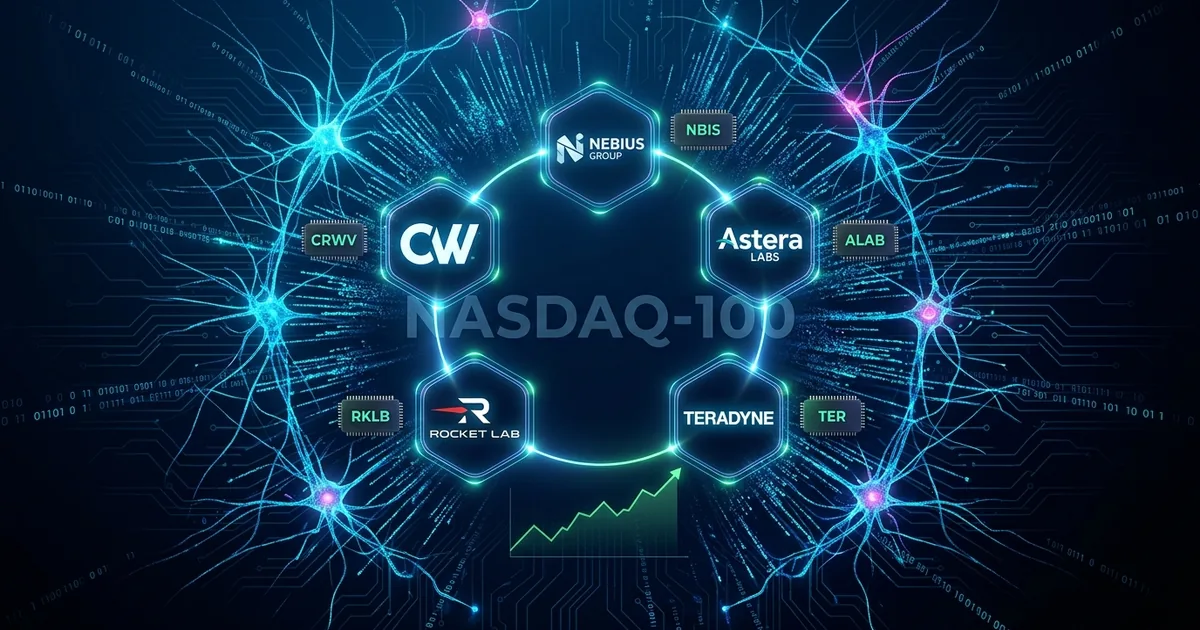
The Nasdaq-100 just got its most AI-concentrated shake-up ever, and your retirement account changed with it. Five companies specializing in artificial intelligence infrastructure, GPU cloud computing, and high-performance semiconductor testing joined the index before Monday’s opening bell, replacing a roster of legacy tech and healthcare names that no longer reflect where the market’s center of gravity has shifted.
What Changed at the Open
Nasdaq’s June 2026 quarterly rebalance added five companies effective before the market open on June 22: CoreWeave (CRWV), Nebius Group (NBIS), Astera Labs (ALAB), Rocket Lab (RKLB), and Teradyne (TER). Out go Charter Communications (CHTR), Cognizant Technology Solutions (CTSH), Insmed (INSM), Verisk Analytics (VRSK), and Zscaler (ZS).
Four of the five incoming names operate directly within AI compute, semiconductor connectivity, or high-performance testing. The fifth, Rocket Lab, is building the launch infrastructure that AI-reliant satellite constellations and orbital computing ventures depend on. The composition shift is not subtle: this is the index formally ratifying that AI infrastructure is the new backbone of large-cap tech.
Follow the Money: $800 Billion in Passive Flows
Here is where it gets consequential for anyone with a 401(k) or an index-tracking portfolio. The Invesco QQQ Trust, which passively mirrors the Nasdaq-100, manages over $800 billion in assets. Every dollar in that fund now includes exposure to CoreWeave’s GPU cloud debt, Nebius’s AI training clusters, and Astera Labs’s data center interconnect silicon. That reallocation happens automatically, no opt-in required, no retail investor decision involved.
As The Daily Upside reported, the five new entrants collectively represent a bet that the next phase of the AI buildout will be won by infrastructure providers, not just the foundation-model companies training on top of them.
CoreWeave is the most notable addition. The company provides cloud infrastructure optimized specifically for Nvidia GPUs, positioning it as a pure-play AI compute landlord at a moment when hyperscalers are scrambling for GPU capacity. It also carries significant debt from its aggressive data center expansion, and Nvidia’s own $20 billion bond offering last week underscored just how capital-intensive this buildout has become.
Nebius: Nvidia’s $2 Billion Bet Gets Index Validation
Nebius Group may be the most strategically loaded entrant. The AI cloud services provider received a $2 billion investment from Nvidia earlier this year, a move that signaled Jensen Huang’s conviction that the GPU market needs dedicated infrastructure partners outside the hyperscaler oligopoly. Index inclusion now adds passive fund demand on top of that strategic backing, creating a virtuous cycle for the stock’s liquidity and institutional visibility.
Astera Labs rounds out the AI infrastructure trio with high-speed connectivity hardware for data centers, building the PCIe, CXL, Ethernet, and NVLink Fusion bridges that let GPU clusters talk to each other at the speeds AI training workloads demand.
What the Exits Tell You
The departures are as revealing as the additions. Charter Communications, a cable operator navigating cord-cutting headwinds. Cognizant, an IT services firm whose consulting model faces margin pressure from AI automation. Zscaler, a cybersecurity company whose valuation multiples have compressed. Verisk Analytics and Insmed, neither of which carries the growth narrative the index increasingly rewards.
The pattern is clear: the Nasdaq-100 is shedding companies that serve the old digital economy and replacing them with companies building the physical and computational substrate of the new one.
Teradyne and Rocket Lab: The Supporting Cast
Teradyne manufactures the semiconductor testing equipment that every advanced chip must pass through before deployment. As AI accelerators grow more complex, with Nvidia’s Blackwell architecture pushing the limits of packaging and power delivery, the testing bottleneck becomes more valuable. Teradyne is a picks-and-shovels play on the entire AI chip supply chain.
Rocket Lab is the outlier in terms of direct AI exposure, but the company’s Electron and Neutron launch vehicles serve the satellite and space infrastructure market that AI-driven ventures are beginning to populate. SpaceX’s orbital ambitions have opened the aperture for what “AI infrastructure” means, and Rocket Lab’s index inclusion reflects that expanding definition.
What Investors Should Watch
The Nasdaq-100 rebalance is a backward-looking signal: it confirms that these companies have already achieved the market capitalization and trading volume thresholds the index requires. The forward-looking question is whether passive fund inflows will compress risk premiums on what are still, in several cases, unprofitable or debt-heavy companies.
CoreWeave’s debt load is the obvious stress test. Nebius’s dependence on Nvidia’s strategic goodwill is another. And the broader bet, that AI infrastructure spending continues at its current pace, assumes that enterprise AI adoption follows the trajectory the market is pricing in.
For now, the index has made its call. The Nasdaq-100 is an AI infrastructure index in all but name, and Monday’s open made that official.