Google’s parent company replaced Verizon in the 130-year-old index on Monday, and the timing tells you everything about where the money is moving.
The Biggest Index Reshuffle in a Decade
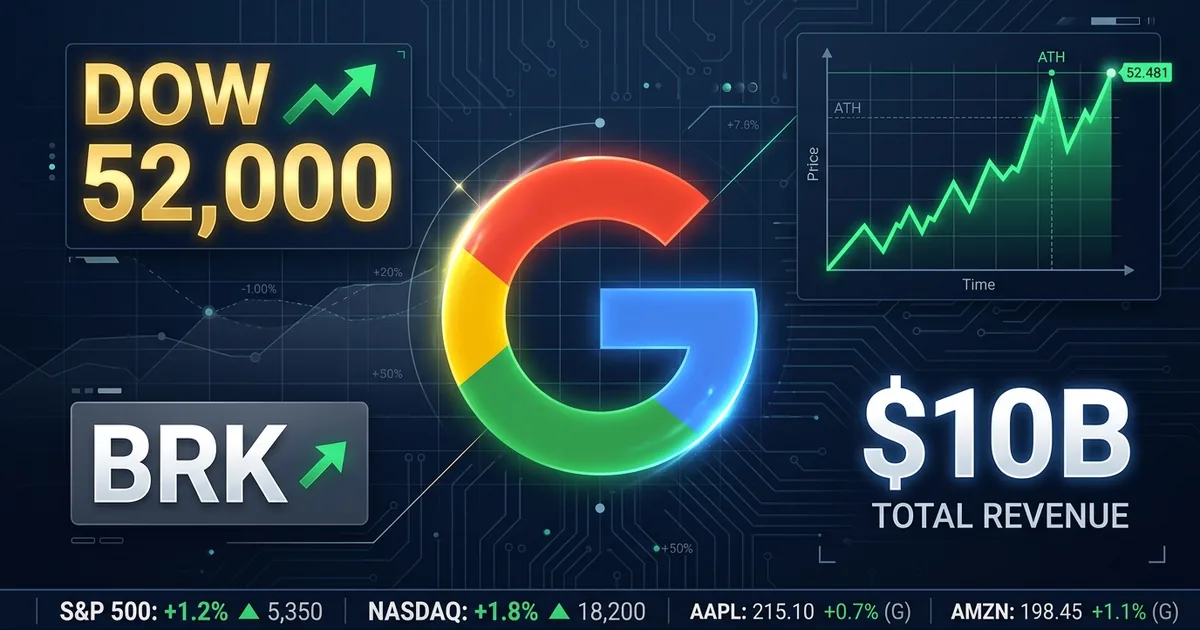
Alphabet officially joined the Dow Jones Industrial Average on June 29, replacing Verizon Communications in a swap that S&P Dow Jones Indices announced on June 23. The stock climbed nearly 5% on its first day as a Dow component, closing at $350.24 and helping push the blue-chip index above 52,000 for the first time in its history. The Dow finished at 52,182.74, up 306.63 points.
The move puts Alphabet alongside Nvidia, Amazon, Apple, and Microsoft in the price-weighted index, completing a generational shift from telecom infrastructure to AI-driven platforms. Verizon, whose low share price gave it barely half a percentage point of index weight, had been a Dow member since 2004. Its removal is less a judgment on the company than an acknowledgment that the index’s relevance depends on reflecting where capital actually flows.
Berkshire’s $10 Billion Vote of Confidence
The Dow inclusion lands weeks after Berkshire Hathaway committed $10 billion to Alphabet’s $80 billion equity capital raise, split evenly between Class A shares at $351.81 and Class C shares at $348.20. That $80 billion raise, the largest equity offering tied to AI infrastructure spending, funds Alphabet’s 2026 capital expenditure guidance of $180 billion to $190 billion, with 2027 expected to climb even higher.
This is an unusual move for Berkshire. Warren Buffett’s successor Greg Abel has historically reserved big checks for corporate takeovers or rescue deals in distressed situations. A $10 billion private placement in a $2 trillion tech company signals that even the most value-oriented institutional money now views AI compute capacity as a hard asset worth paying up for. Berkshire’s total Alphabet position has grown to roughly $16.6 billion, making it one of the conglomerate’s largest tech bets outside of Apple.
The capital raise structure itself is telling: $30 billion in underwritten offerings of shares and mandatory convertible preferred stock, the $10 billion Berkshire placement, and a $40 billion at-the-market program for open-market share sales starting in Q3. Alphabet is not raising this money because it needs to. It is raising it because the AI infrastructure arms race demands it, and the company that controls the most compute when enterprise demand peaks will set the terms for everyone else.
The Broader Market Picture
The Dow’s milestone came on a day when all three major indexes rallied. The S&P 500 rose 1.18% to close at 7,440.43, and the Nasdaq Composite surged 2.07% to 25,820.14. Tech led across the board, with investors positioning ahead of a consequential week: the June jobs report drops Thursday (moved up from the usual Friday release), and markets close Friday for the Fourth of July holiday.
The 10-year Treasury yield is holding near 4.38%, keeping the cost-of-capital conversation alive. Meanwhile, the US goods trade deficit blew out to $105.8 billion in May, well above the $85 billion consensus estimate, as businesses front-loaded imports to hedge against Middle East supply disruptions. Morgan Stanley and Goldman Sachs both trimmed their Q2 GDP growth estimates in response.
What the Dow Addition Actually Means
The Dow is price-weighted, not market-cap-weighted, which means Alphabet’s inclusion reshapes the index differently than it would the S&P 500. At $350 per share, Alphabet commands roughly 2.5% of the Dow’s weight on day one, more influence than Verizon ever had but still less than UnitedHealth Group, Goldman Sachs, or Microsoft, whose higher share prices give them outsized sway.
For passive investors, the mechanical effect matters: index funds tracking the Dow had to buy Alphabet and sell Verizon on the rebalance date, creating a short-term demand tailwind for GOOGL. But the symbolic signal may be the more durable one. The Dow has always been a lagging indicator of economic reality, adding companies after they have already won rather than when they are still proving the thesis. Alphabet’s inclusion, after years of being conspicuously absent, says the market’s gatekeepers have finally accepted that advertising-funded AI platforms are as foundational to the US economy as the railroads and steelmakers the index was built to track.
What Comes Next
The jobs report Thursday will set the tone for the rest of July. A strong number strengthens the case for the Fed to hold rates higher for longer, which would pressure the growth stocks that just carried the Dow to its record. A weak print reopens the rate-cut conversation and likely extends the rally. Either way, Alphabet’s first week in the Dow will be a referendum on whether AI spending translates into the kind of earnings growth that justifies a $2 trillion valuation, or whether the market is pricing in a future that the balance sheet has not yet delivered.