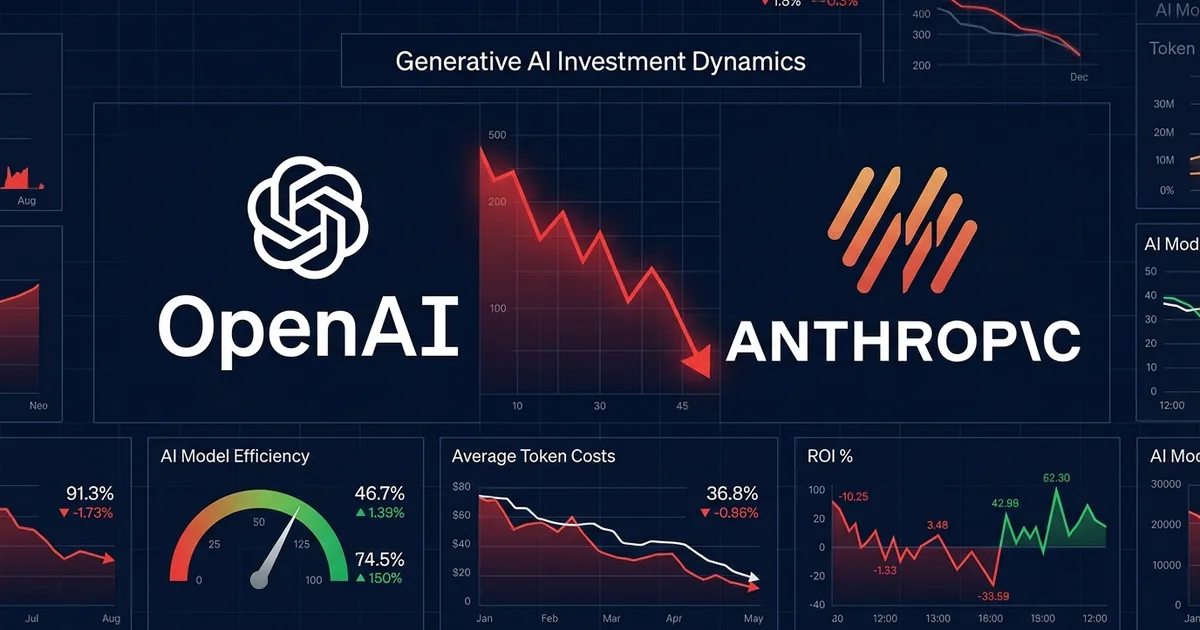
The era of unlimited AI budgets is over. Enterprises that spent the past two years racing to consume as many frontier AI tokens as possible are now tightening controls, demanding ROI, and switching to cheaper models, a shift that directly threatens the revenue trajectories that Anthropic and OpenAI built their IPO narratives around.
The timing could not be worse for both companies, which filed confidentially for public offerings in early June.
The Tokenmaxxing Hangover
CNBC reported last week that the mood around AI spending has hardened. Business leaders are no longer willing to throw money at frontier models without a clear return. The shift has a name in the developer community: the move from “tokenmaxxing,” burning through as many AI tokens as possible to prove adoption, to efficiency, where each task goes to the cheapest model that can handle it.
The examples are concrete. Uber reportedly burned through its entire annual AI budget in just four months, prompting the company to introduce spending tiers for AI tools. Lindy, an AI startup, moved 100% of its traffic from Anthropic’s Claude to DeepSeek, a Chinese company that offers cheaper open-weight alternatives. These are not edge cases. They are the leading indicators of a broader repricing of what enterprises are willing to pay for intelligence.
Model Routing Kills the Premium
The mechanism driving this shift is model routing, a practice where enterprises send each AI task to the model best suited for it based on cost, complexity, latency, and performance. A customer service query does not need a frontier model that costs 10 times more than a smaller one. A complex coding task might. The router decides.
This is rational behavior. It is also devastating for companies whose business models assume customers will use their most expensive products by default. CNBC’s earlier analysis of model routing laid out the problem: when enterprises get smart about routing, the average revenue per token drops, and the fastest-growing line items on Anthropic’s and OpenAI’s income statements start to compress.
The open-source pressure compounds the problem. Microsoft, Amazon, and Google are all promoting efficiency-focused offerings that undercut frontier pricing. Meta’s Llama models run locally at zero marginal cost. DeepSeek and other Chinese labs offer competitive performance at a fraction of the price. The premium for “best in class” narrows when “good enough” handles 80% of enterprise use cases.
The IPO Timing Problem
Both Anthropic and OpenAI filed their S-1 drafts confidentially in early June. The growth rates they are presenting to potential investors are, by basic math, the fastest they will ever be. Revenue is growing from a small base against pent-up demand. The question every institutional investor is now asking is whether that growth rate is sustainable when the very customers driving it are actively trying to spend less.
Anthropic’s annual revenue run rate reportedly sits around $30 billion. OpenAI’s is higher. But current growth rates were set during the tokenmaxxing era, when enterprise budgets were open and the mandate was to “use AI everywhere.” The retrenchment underway right now, spending tiers at Uber, full-model swaps at Lindy, routing infrastructure becoming standard, means the next twelve months of revenue growth will be measured against a period of unconstrained spending. The comparison will not be flattering.
Infrastructure Spending Tells a Different Story
The irony of the enterprise retrenchment is that infrastructure spending on AI is still accelerating at a staggering pace. Google, Amazon, Microsoft, and Meta collectively plan to spend $725 billion on capital expenditure in 2026, up 77% from last year’s record $410 billion. Microsoft alone raised its calendar 2026 capex to $190 billion, driven by insatiable demand for data center capacity, GPUs, and memory components.
That disconnect, shrinking application-layer spending against ballooning infrastructure investment, is the defining tension of the AI market right now. The hyperscalers are betting that demand for compute will continue to grow exponentially. The enterprises buying that compute are saying they want to use less of it per task. Both cannot be right at the same time, and the resolution of that tension will determine which AI companies are worth their current valuations and which are not.
The Deeper Structural Issue
The AI spending correction is not a rejection of the technology. It is the market discovering what the technology is actually worth, task by task, token by token. That discovery process is healthy in the long run. In the short run, it reprices every assumption baked into the $96.5 billion and $300 billion valuations that Anthropic and OpenAI are carrying into their public offerings.
For investors evaluating both IPOs, the question is no longer “how fast is revenue growing?” It is “what happens to revenue growth when your best customers start optimizing their bills?” The answer to that question will define whether the AI industry’s first major public offerings land as transformative events or cautionary tales.
The companies that thrive in this environment will be the ones that can deliver measurable, specific value at a cost enterprises can justify quarter after quarter. The ones that relied on hype-cycle spending to hit their numbers will find the next earnings cycle considerably less forgiving.