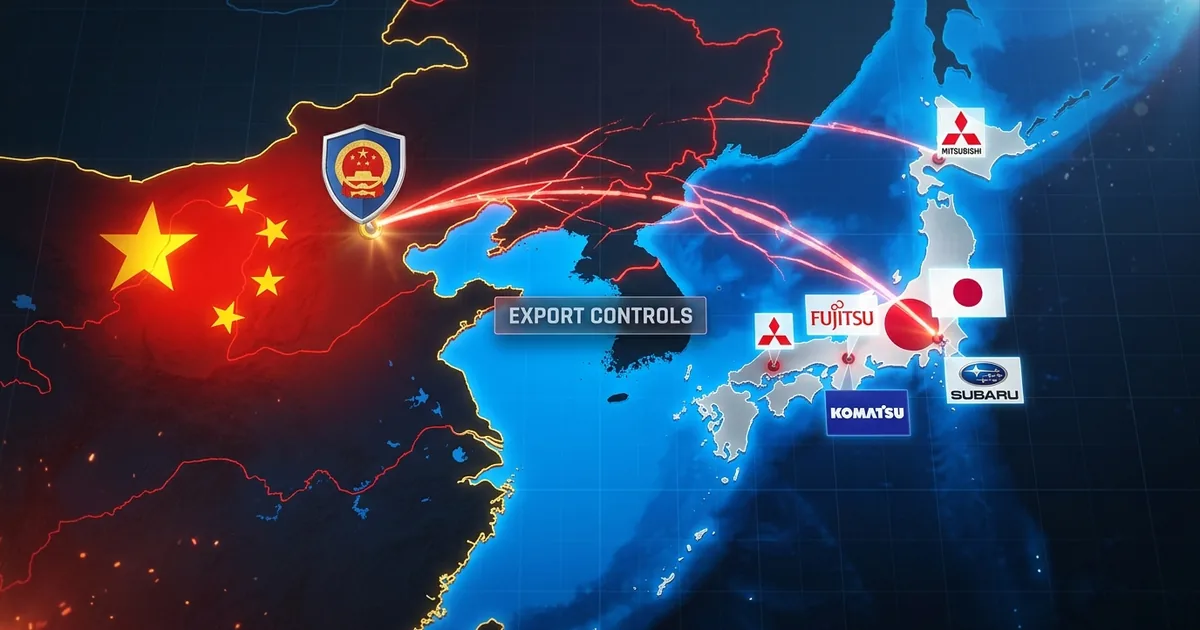
Beijing just fired its latest shot in a deepening trade war with Tokyo, and this time it went straight for the defense industrial base.
China’s Ministry of Commerce announced Monday that it has placed 20 Japanese entities on its dual-use export control list and added another 20 to a watch list requiring enhanced licensing scrutiny, targeting drone manufacturers, nuclear fuel processors, defense research institutes, and subsidiaries of Japan’s biggest industrial conglomerates. The action represents the most significant escalation of Chinese economic pressure on Japan since the two countries clashed over the Senkaku/Diaoyu Islands in 2012.
Who Got Hit and Why It Matters
The blacklist reads like a who’s who of Japan’s defense-adjacent industrial ecosystem. Subsidiaries of Mitsubishi, Fujitsu, and Komatsu are on the export control list alongside the National Institute for Defense Studies, Japan’s primary military think tank. The watch list sweeps even wider: Subaru Corp, Itochu Aviation, Mitsubishi Materials Corp, Mitsui E&S Co., drone maker Terra Drone Corporation, autonomous flight specialist ACSL Ltd, and multiple units of OKI Electric Industry all now face enhanced licensing requirements for Chinese-origin dual-use goods.
The stated rationale is blunt. Beijing’s commerce ministry demanded that exporters “provide a commitment that their sales will not be used for any purpose that would enhance Japan’s military strength,” framing the restrictions as a direct response to what China calls Japan’s remilitarization under Prime Minister Sanae Takaichi.
The real trigger is specific: Takaichi’s late-2025 statement that a Chinese attack on Taiwan could constitute an “existential threat” warranting Japanese military intervention. That language crossed Beijing’s brightest red line, and the economic consequences have been escalating ever since.
The Market Read Is Deceptively Calm
Tokyo’s initial reaction was mixed. Subaru shares fell 3.5%, Mitsubishi Heavy Industries dropped 3.1%, while Mitsubishi Materials actually rose 3.8%. The contained response reflects Beijing’s careful framing: the commerce ministry explicitly stated that “normal bilateral trade” remains unaffected, a signal designed to prevent broader panic.
But the calm is misleading. The real risk is not what is on the list today. It is the template Beijing just established. If the Ministry of Commerce is willing to place subsidiaries of Mitsubishi, Komatsu, and Fujitsu on a dual-use blacklist now, the perimeter of that list can expand to any industrial conglomerate with defense-adjacent operations. Japan’s zaibatsu-descended conglomerates are precisely the entities most exposed because their commercial and defense businesses share supply chains, engineering talent, and institutional knowledge.
A Broader Pattern of Economic Coercion
This is not an isolated action. Since Takaichi’s Taiwan comments, Beijing has rolled out a coordinated pressure campaign: travel advisories discouraging Chinese tourists from visiting Japan, restrictions on Japanese seafood imports (originally imposed after the Fukushima wastewater release, now extended), and the suspension of cultural exchange programs. Major Japanese business leaders cancelled their annual visits to China, breaking a 50-year tradition for the first time since the 2012 Senkaku crisis.
The dual-use restrictions carry particular weight because of Japan’s dependence on Chinese supply chains in critical sectors. As of late 2024, Chinese manufacturers represented 91% of Japan’s drone market, according to the South China Morning Post. That is not a bargaining chip; it is a chokepoint. Terra Drone and ACSL, two of Japan’s few domestic drone makers, are now on the watch list, meaning the very companies Japan needs to reduce its dependence on Chinese drones face new obstacles sourcing Chinese components.
The Defense Budget Connection
The timing aligns with Japan’s accelerating defense buildup. Takaichi’s cabinet approved a 1.1 trillion yen ($7.1 billion) supplementary defense budget in late November 2025, part of a broader five-year plan to double Japan’s defense spending to 2% of GDP. That spending surge is exactly what Beijing’s restrictions are designed to complicate: if Japanese defense contractors cannot source dual-use inputs from China, either costs go up or timelines stretch.
For investors watching Japanese defense stocks, the near-term calculus has shifted. Companies like Mitsubishi Heavy Industries and other defense contractors saw war-premium valuations earlier this month, but supply-chain risk from Chinese export controls adds a new discount factor. The question is no longer just whether Japan will spend more on defense, but whether its industrial base can execute those plans without Chinese cooperation.
What Comes Next
Liu Jiangyong, a Japan specialist at Tsinghua University, told CNBC that the outlook for China-Japan relations in 2026 is “bleak”, and the trajectory supports that assessment. Beijing is building an economic coercion playbook that mirrors the export-control architecture Washington has used against China in semiconductors, rare earths, and AI chips. The difference is that China is applying it to a US ally, which means the pressure flows in both directions: Tokyo must now decide how aggressively to decouple from Chinese supply chains, and Washington must decide how much reshoring support to offer.
The structural why here is straightforward: Takaichi broke the implicit bargain that kept China-Japan economic ties insulated from security disputes. By publicly linking Taiwan contingencies to Japanese military action, she gave Beijing the political cover to weaponize trade ties it had previously kept separate. The 40-entity blacklist is not the end of that process. It is the template.