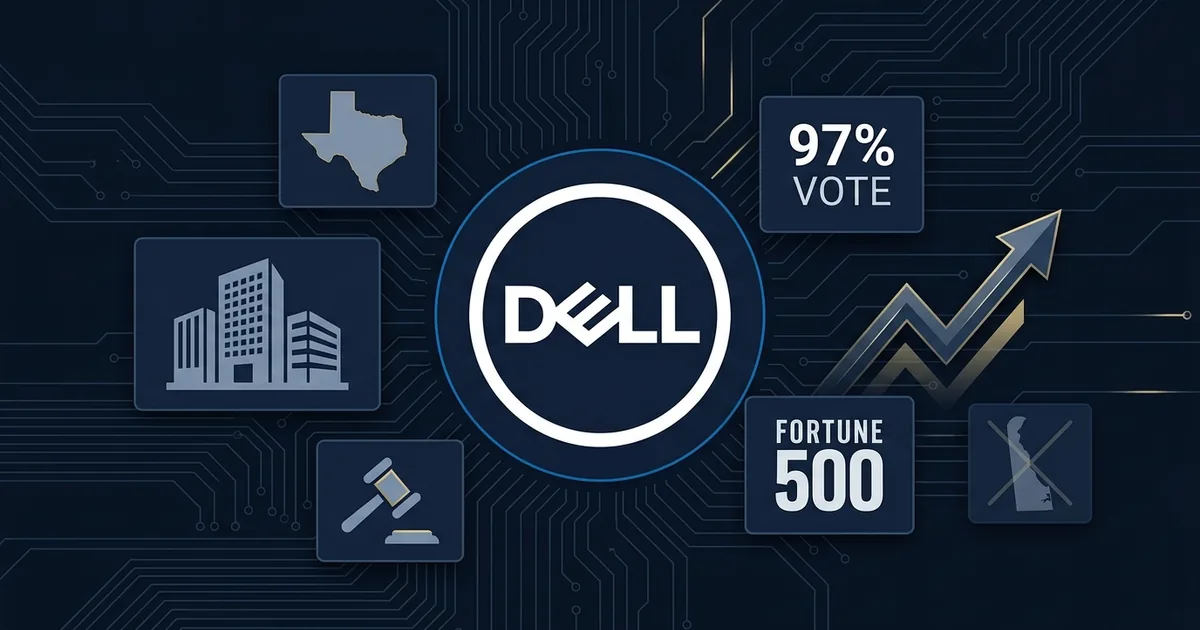
Dell Technologies shareholders voted overwhelmingly to move the company’s legal home from Delaware to Texas, with 97% approval on June 25. The vote makes Dell the second Fortune 500 company this year to redomicile in Texas after Exxon Mobil, and it is accelerating a corporate exodus that is quietly reshaping American business law.
Why Companies Are Leaving Delaware
Delaware has been the default state of incorporation for public companies for more than a century, home to roughly two-thirds of Fortune 500 firms. The state’s Court of Chancery, which operates without juries and specializes exclusively in corporate law, built a body of precedent that lawyers and boards relied on for predictability.
That calculus is changing. A series of recent Court of Chancery rulings has spooked corporate boards, most notably the January 2024 decision rejecting Elon Musk’s $55.8 billion Tesla compensation package. Tesla subsequently reincorporated in Texas. Exxon followed. Now Dell has joined them, and Bloomberg Law reported that several more large companies are actively evaluating the same move.
Michael Dell framed the decision as a homecoming. He founded the company in his University of Texas dorm room in 1984, and today Dell’s global headquarters, its CEO, and the largest concentration of its U.S. workforce are all based in Austin. “This is where we’ve always belonged,” Dell said after the vote.
The Shareholder Rights Trade-Off
The redomicile is not just symbolic. Texas adopted a new Business Organizations Code in 2024 specifically designed to attract large public companies, and Dell is opting into provisions that meaningfully restrict shareholder rights compared to Delaware law.
Under the new structure, Dell plans to adopt a 3% or $1 million stock ownership threshold for submitting shareholder proposals, up from the much lower bar Delaware allows. The company will also impose a 3% ownership requirement for shareholders seeking to file derivative lawsuits against management, a provision that effectively limits legal challenges to institutional investors.
For retail shareholders, the practical effect is clear: the bar to hold management accountable through formal governance channels just got significantly higher. Institutional investors with large positions retain their tools. Individual shareholders, in most cases, do not.
The Business Case and the Political Context
Dell’s operational argument is straightforward. The company is headquartered in Texas. Its workforce is concentrated there. Aligning legal domicile with operational reality simplifies governance and, the company argues, reduces legal costs. Fox Business reported that the operational rationale centers on aligning the legal home with where the company actually operates, while the governance changes are detailed in the proxy filing.
But the timing matters. Texas has made attracting corporate reincorporations a deliberate economic development strategy, and the state’s business-friendly legal framework is explicitly designed to give boards more protection from shareholder activism and litigation. For companies navigating a period of rising ESG pressures, proxy fights, and activist campaigns, that environment is attractive.
Dell’s AI server business is also booming. The company raised its fiscal 2027 revenue guidance to $167 billion on the strength of surging AI server demand that sent the stock up 40% earlier this year. Moving to a more management-friendly jurisdiction while the stock is riding high gives the board maximum negotiating power with minimal shareholder resistance, as the 97% approval demonstrates.
What the DExit Trend Means for Markets
The corporate migration out of Delaware is still small in absolute numbers, but the direction is unmistakable. Tesla, Exxon Mobil, TripAdvisor, and now Dell have all moved or announced moves. Several others are reportedly weighing it.
For investors, the key question is whether management-friendly governance translates into better capital allocation or simply insulates boards from accountability. Delaware’s system, for all its imperfections, gave shareholders meaningful legal tools to challenge self-dealing, excessive compensation, and conflicted transactions. Texas’s framework trades some of that oversight for speed and predictability.
Delaware has begun responding. The state legislature is considering reforms to its corporate code to stem the outflow, recognizing that franchise taxes from incorporated companies generate roughly $2 billion annually, about a third of Delaware’s general fund revenue.
The financial stakes, in other words, are real on both sides. For Dell shareholders, the bet is that a Texas-domiciled Dell with a booming AI business and a protected board will allocate capital more effectively than a Delaware-domiciled Dell with more shareholder oversight. That bet will be tested in the next downturn, when the governance protections that feel academic in a bull market start to matter.