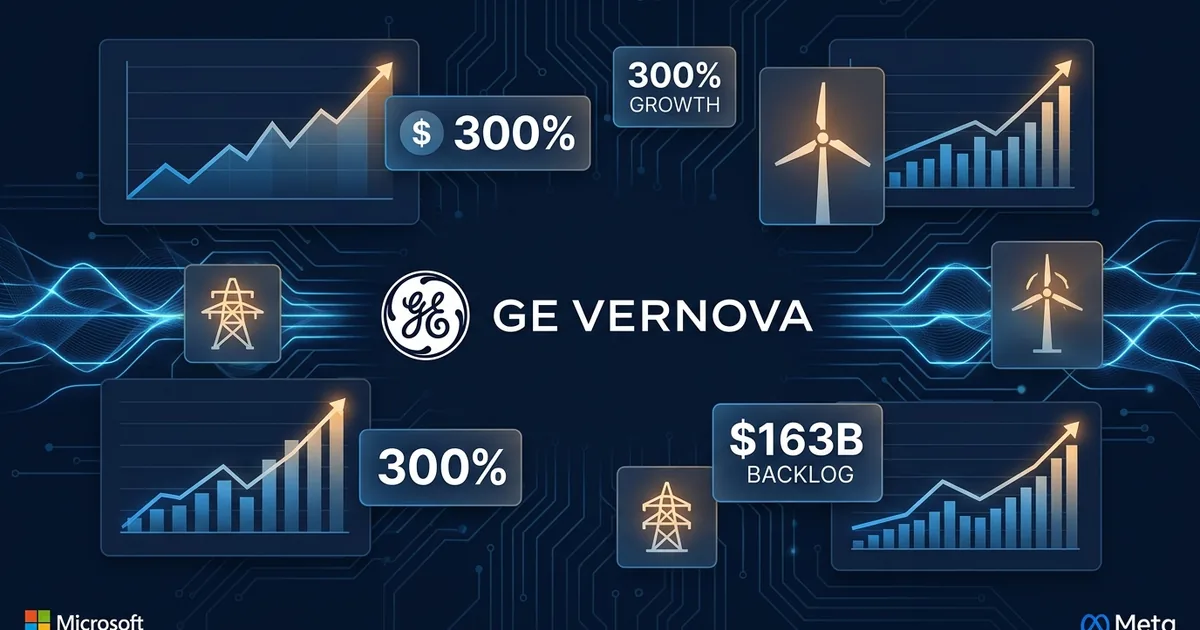
GE Vernova has become the most unlikely kingmaker of the AI era, with its heavy-duty gas turbines completely sold out through at least 2031 and prices up 300% in three years. The company’s $163 billion backlog tells you everything about where the AI infrastructure bottleneck has shifted: from chips to kilowatts.
The Numbers Behind the Power Supercycle
GE Vernova’s Q1 2026 results read like a company operating in a seller’s paradise. Total orders surged 71% year over year to $18.3 billion, and CNBC reported this week that every turbine slot is spoken for through at least 2029, with some commitments stretching to 2031. The electrification segment alone booked a record $2.4 billion in data center equipment orders in a single quarter.
Gas turbine pricing tells the real story. Prices in the first half of 2026 are running 10 to 20 percentage points higher than Q4 2025, and some contracts have tripled over a three-year window. When your product has a three-year lead time and every hyperscaler on the planet needs it yesterday, that is pricing power most tech companies can only dream about.
The stock reflects the math. GEV shares trade around $1,066, up roughly 108% over the past year. Management raised full-year guidance to $44.5 billion to $45.5 billion in revenue with adjusted EBITDA margins of 12% to 14% and free cash flow of $6.5 billion to $7.5 billion. The 2028 target is $56 billion in revenue at a 20% margin.
Why AI Broke the Power Grid
Data centers now consume an estimated 70% of all memory chips produced globally, but the appetite for electricity is proving even harder to satisfy. Microsoft ordered seven GE Vernova turbines for a roughly 2.7-gigawatt data center in West Texas, part of Project Kilby, the $7 billion joint venture between Microsoft and Chevron that BTN covered last week. OpenAI has vetted the same plant. Every major hyperscaler, from Meta to Amazon, has been locking in long-term power purchase agreements.
The problem is structural, not cyclical. S&P Global projected in February that electrification-tied orders would climb 29% this year to $24.8 billion, with the backlog in GE Vernova’s electrification segment projected to hit $45.3 billion. Gas Power’s combined backlog and slot reservation agreements grew from 83 to 100 gigawatts sequentially last quarter, and management is targeting at least 110 gigawatts by year end.
Nuclear gets the headlines, but natural gas does the heavy lifting right now. New nuclear capacity takes a decade or more to permit and build. Gas turbines can be commissioned in three to four years, which still feels like an eternity when your AI training cluster needs power by next quarter.
The Broader AI Infrastructure Squeeze
GE Vernova’s dominance is part of a cascading set of bottlenecks reshaping the entire tech supply chain. The memory chip shortage that forced Apple to raise MacBook and iPad prices by hundreds of dollars last week has the same root cause: hyperscale AI infrastructure consuming components faster than the supply chain can produce them.
DRAM prices have more than doubled in 2026. Memory chips, power capacity, cooling systems, and skilled labor are all constrained simultaneously. The AI capex arms race, with four major tech companies committing to $725 billion in 2026 alone, is creating a structural reallocation of industrial capacity toward a single use case. Everyone else competes for the leftovers.
For GE Vernova, this is an almost perfect business environment. Demand is locked in. Pricing power is extraordinary. The competitive moat is physical: you cannot 3D-print a 300-ton gas turbine. Analysts are overwhelmingly bullish, with 29 of 36 ratings at Buy or Strong Buy and an average price target north of $1,200.
What Could Go Wrong
The bull case is obvious. The risks are subtler. Regulatory pushback on natural gas for data centers is building in several states, with environmental groups arguing that AI companies are effectively greenwashing their operations by pointing to renewable energy credits while running on gas. A meaningful shift in permitting could slow new installations.
There is also the question of whether AI spending itself is sustainable. The Nasdaq slipped nearly 5% last week as investors questioned whether trillions in AI infrastructure investment will deliver proportional revenue. If hyperscaler capex budgets contract, the turbine order book is contractual, but future orders would slow.
For now, though, the math is straightforward. The AI industry needs more power than the grid can deliver. GE Vernova builds the machines that generate that power. And it has priced accordingly. In an era of AI hype and speculative bets, a company selling something every customer physically needs and none can easily substitute is about as close to a sure thing as Wall Street gets.