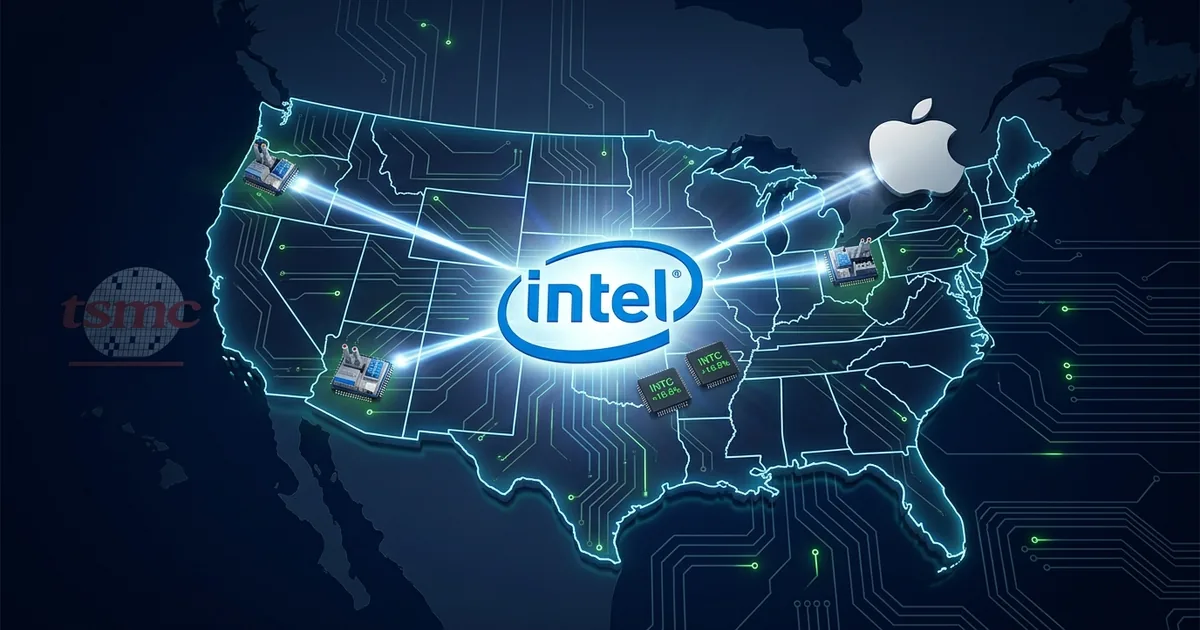
Intel stock surged 10.5% to $133.82 on June 18 after President Trump announced that Apple has agreed to use Intel’s foundry business to design and manufacture chips on American soil. The deal centers on Intel’s 18A-P process node, and it represents the single biggest validation yet of Intel’s bet-the-company pivot from chipmaker to contract manufacturer.
But before anyone pops champagne in Santa Clara, the fine print matters. Apple will route lower-end chips through Intel’s fabs. TSMC still commands more than 90% of Apple’s silicon supply, including every A-series and M-series processor that powers the flagship iPhone, iPad, and Mac lines. This is a political win dressed up as a manufacturing revolution, and the market is pricing it accordingly.
The Deal Behind the Deal
The arrangement did not materialize overnight. Intel began production of its 18A-P node just days before the announcement, a milestone CNBC first reported on June 16 as the clearest signal yet that an Apple partnership was imminent. The Trump administration had been working the phones for months, leveraging the federal government’s roughly 10% equity stake in Intel, a position acquired through an $8.9 billion investment last year, to accelerate the courtship.
Tim Cook showed up at the White House for the announcement and said what everyone already suspected: iPhone prices will rise. The cost of onshoring chip fabrication is not hypothetical. Intel’s American fabs carry labor and energy costs that TSMC’s facilities in Taiwan and Arizona simply do not match at scale. Somebody pays the premium, and Cook made clear it will be the consumer.
Follow the Money
Intel’s stock reaction tells a story about expectation management. A 10.5% pop on a deal that covers only a fraction of Apple’s chip volume suggests the market was pricing in something far worse for Intel’s foundry ambitions. For months, skeptics had questioned whether Intel Foundry Services could land a single marquee customer. Now it has one, even if the scope is limited.
The financial architecture here is layered. The $8.9 billion federal investment gave Washington both a financial stake and a policy lever. When Trump says he “brokered” the deal, he is not entirely wrong. The government literally owns a piece of Intel, and that ownership created the kind of alignment between industrial policy and corporate strategy that rarely exists in American capitalism. It is closer to what South Korea does with Samsung or what Taiwan does with TSMC than anything the U.S. has attempted in the semiconductor space since the CHIPS Act debates.
For Apple, the calculus is defensive. The company has faced relentless pressure from the Trump administration over its dependence on Asian manufacturing. Cook’s $100 billion American spending pledge in 2025 bought goodwill, but it did not buy immunity. Routing some chip production through Intel gives Apple a political shield without requiring a wholesale restructuring of its supply chain.
TSMC’s Position: Stronger Than the Headlines Suggest
The most important number in this story is not Intel’s stock price. It is the 90%-plus share of Apple silicon that TSMC retains. Apple’s highest-margin, highest-performance chips, the ones inside every iPhone Pro, every MacBook Pro, every data center accelerator, will continue to come from TSMC’s leading-edge nodes in Taiwan and its expanding Arizona campus.
TSMC’s Arizona fab, which began volume production earlier this year, already manufactures Apple chips on American soil using TSMC’s own N3E process. That facility exists precisely because Apple and TSMC anticipated the political pressure that this Intel deal confirms. In other words, TSMC saw this coming and moved first.
Intel’s 18A-P process is competitive on paper, but it has zero track record in volume production for a customer as demanding as Apple. The process node began production only days ago, and ramping yields to Apple’s standards will take quarters, not weeks. Intel’s foundry business has never manufactured at the volume or defect density that Apple requires for consumer devices shipping hundreds of millions of units annually.
The Reshoring Math
The broader reshoring narrative deserves scrutiny. The Trump administration has framed this deal as proof that American manufacturing can compete in advanced semiconductors. That framing skips over inconvenient details.
Intel’s U.S. fabs in Arizona, Oregon, and Ohio received billions in federal subsidies through the CHIPS and Science Act, plus the $8.9 billion equity investment. TSMC’s Arizona facility also received CHIPS Act funding. The stock surge CBS News reported reflects investor enthusiasm for government-subsidized demand, not a market verdict on Intel’s unsubsidized competitiveness.
The question nobody in Washington wants to answer: what happens when the subsidies run out? Intel’s foundry business has been a money-losing operation for years. Landing Apple as a customer helps, but lower-end chips carry lower margins than the work TSMC performs on leading-edge nodes. Intel needs volume across multiple customers to make the foundry economics work, and so far, Apple is the only name-brand win.
What This Means for Chip Stocks
The Nvidia-Intel-AMD dynamic shifted at Computex earlier this month, and this Apple deal reshuffles the deck again. Intel’s foundry play now has credibility it lacked two weeks ago. AMD, which has no foundry ambitions, faces no direct competitive threat but loses the narrative advantage of being the scrappy alternative. Nvidia remains in its own orbit, focused on AI accelerators rather than general-purpose chips.
For investors, the trade is straightforward but risky. Intel at $133.82 prices in a successful foundry ramp that has not happened yet. If 18A-P yields disappoint, or if Apple’s “lower-end” allocation turns out to be trivially small, the air comes out fast. The government’s 10% stake provides a floor of sorts, since Washington has every incentive to keep Intel solvent, but a floor is not the same as a growth story.
The Bigger Picture
This deal is best understood as the opening move in a longer game. The U.S. government is using its equity position in Intel the way sovereign wealth funds operate in Singapore and the Gulf states: as a tool of industrial policy with a financial return attached. Whether that model works in American politics, where election cycles are short and subsidy fatigue is real, remains an open question.
Apple gets a political talking point. Intel gets a customer. Trump gets a photo op and a market rally. TSMC keeps the business that actually matters. The consumer gets a higher iPhone price.
Everyone wins something. Nobody wins everything. That is usually how Washington dealmaking works, and the semiconductor industry just learned it applies to chip fabs too.