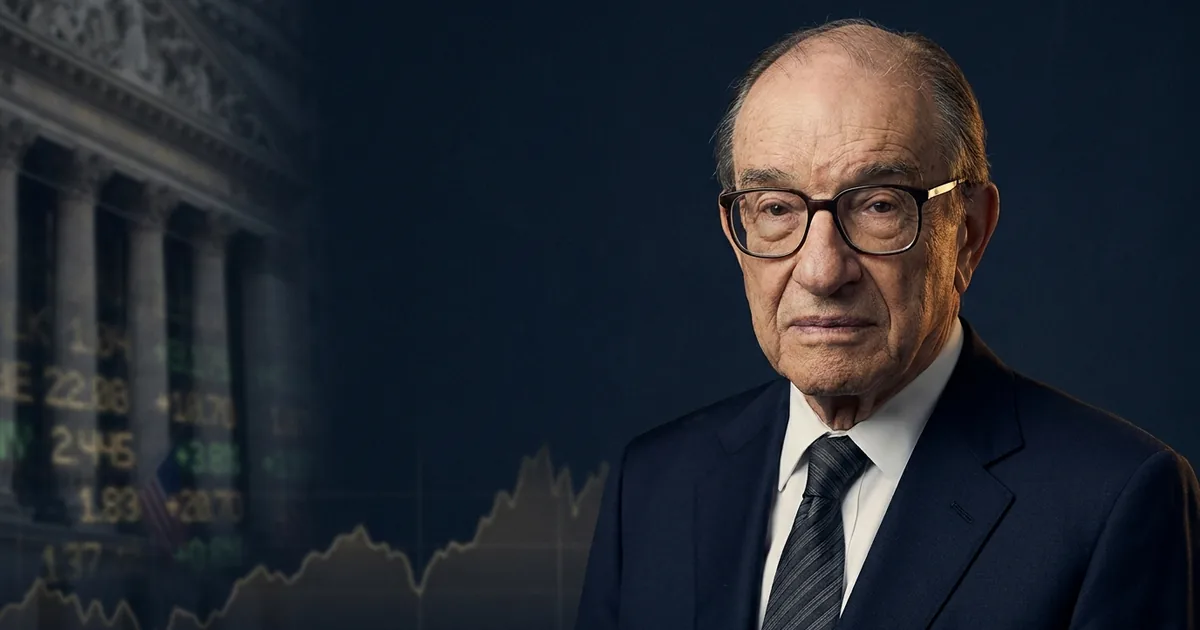
Alan Greenspan, who ran the Federal Reserve for 18 years and convinced a generation of investors that the central bank would always have their back, died Monday at his Washington home at 100. His wife, NBC News correspondent Andrea Mitchell, said the cause was complications from Parkinson’s disease, closing out a life that shaped how money moves more than any unelected American of his era.
For nearly two decades, markets treated Greenspan less like a regulator and more like a backstop. That belief, not any single rate decision, is the part of his legacy still trading on Wall Street today.
How a Forecaster Became “the Maestro”
Ronald Reagan appointed Greenspan in 1987, and he stayed through three more presidents until 2006, the second-longest run in the Fed’s history. As CNBC noted in its obituary, his tenure spanned the 1987 crash, the long boom from 1991 to 2001, and the dot-com bust, a stretch that earned him the nickname “the Maestro” from Bob Woodward’s admiring 2000 book.
The legend was built on a simple proposition. Greenspan could read the economy’s plumbing better than anyone, and he would act before trouble spread. Presidents deferred to him. Markets hung on the deliberately impenetrable syntax he called “Fedspeak.” Senators treated his testimony as scripture.
The trouble with the Maestro story is that the music stopped two years after he left.
The “Greenspan Put” Was His Most Durable Product
Greenspan’s real invention was not a policy. It was an expectation. Every time markets wobbled, from the 1987 crash to the 1998 collapse of the hedge fund Long-Term Capital Management to the dot-com unwind, the Fed cut rates or flooded the system with liquidity. Traders learned the lesson and priced it in. They called it the “Greenspan put,” the assumption that the central bank would always step in to cushion a falling market.
That assumption never died. It just got renamed. The “Fed put” that investors lean on today, the reflex that has them buying every dip in the expectation of a rescue, is Greenspan’s doctrine wearing newer clothes. Jerome Powell ran a version of it in 2020. The current chair, Kevin Warsh, is managing markets that still assume the floor is there, a dynamic visible in how traders read the Fed’s first meeting under Warsh. Greenspan taught markets to expect a save, and they have never unlearned it.
There is a cost to that lesson. When investors believe losses will be socialized, they take more risk than the fundamentals justify. Greenspan spent the 1990s warning about exactly that behavior, then spent the 2000s feeding it.
“Irrational Exuberance,” Then the Punch Bowl Stayed Out
In a 1996 speech, Greenspan asked how anyone could know when “irrational exuberance” had pushed asset values too high. It was the most famous warning he ever issued. It was also one he declined to act on.
Instead he held interest rates low into the 2000s, backed the deregulation of derivatives, and waved off calls to police the subprime mortgage machine. He argued that banks, acting in their own self-interest, would regulate themselves. He argued that a nationwide housing bubble was unlikely. He was wrong on both counts, and the bill arrived in 2008.
The Flaw He Finally Admitted
The bipartisan Financial Crisis Inquiry Commission later concluded that the meltdown was triggered in part by Greenspan’s failure to rein in subprime lending and his promotion of financial deregulation. The man once treated as infallible became a defendant in the story of the crisis.
His own reckoning came in October 2008, in a House Oversight Committee hearing room. Greenspan testified that he had “found a flaw” in his model of how the world worked, and conceded he had been wrong to assume banks could police themselves. It was a remarkable admission from a man who had spent forty years preaching the opposite. In a later Harvard Business Review interview about what he had learned since the crash, he was still defending the broad strokes of his free-market faith while granting that he had underestimated human irrationality.
That tension is the honest version of his legacy. Greenspan was neither the infallible Maestro nor a simple villain. He was a true believer in markets who built the most powerful market backstop in history and never reconciled the contradiction.
The Brand Outlived the Record
Greenspan did not retire into silence. He opened the consulting shop Greenspan Associates, signed on as an adviser to Deutsche Bank, the bond manager Pimco, and John Paulson’s hedge fund, and published a best-selling memoir, “The Age of Turbulence,” in 2007, the year before the crisis he had helped seed. Wall Street kept paying handsomely for his read on the economy even after that read had failed its biggest test. The Maestro brand outlasted the Maestro’s record.
What His Death Leaves Behind
The Fed that Kevin Warsh runs today is still arguing with Greenspan’s ghost. Every debate about whether the central bank should lean against asset bubbles, whether cheap money widens inequality, and whether regulators can trust banks to behave traces back to choices Greenspan made and defended. The “Greenspan put” is still priced into one of the most expensive markets in history.
Greenspan got 18 years to build that framework and 20 more to watch it strain. The people who inherit it, the traders betting on a rescue and the policymakers deciding whether to provide one, will be living inside his decisions long after the obituaries fade.