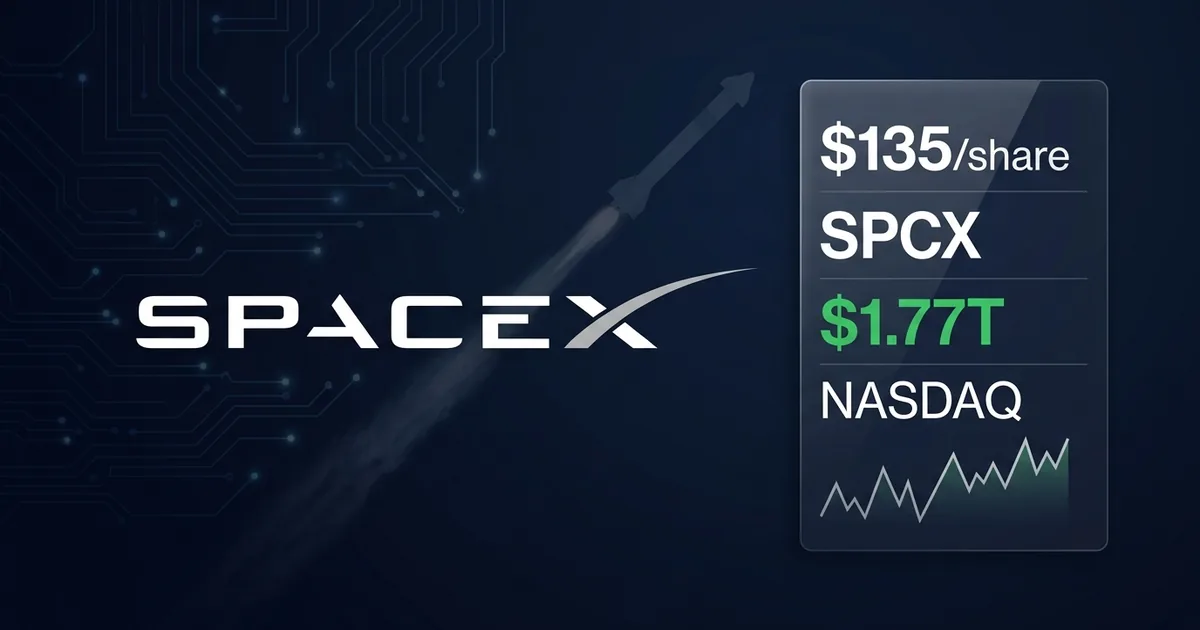
SpaceX is about to become the biggest IPO in history, pricing 555.6 million shares at $135 each for a $75 billion raise that would value the company at $1.77 trillion. But the smart money is already raising red flags about what happens after the confetti falls, and at least one legendary investor is sitting this one out entirely.
The Numbers That Broke Every Record
When SpaceX lists on Nasdaq under the ticker SPCX on June 12, it will not just break Alibaba’s 2014 record of $25 billion. It will more than triple it. At a $1.77 trillion valuation, Elon Musk’s rocket company would immediately slot in as the seventh-largest publicly traded company in the United States, leapfrogging Tesla’s roughly $1.6 trillion market cap and putting it in the same rarefied air as Apple, Microsoft, and Nvidia.
The roadshow was reportedly 2x oversubscribed, with institutional giants like Fidelity and retail investors alike scrambling for allocations. That demand gave SpaceX the bargaining power to set a fixed price rather than a range, a power move that signals extraordinary confidence from the underwriting team.
The Free Float Problem Nobody Wants to Talk About
Here is where the story gets interesting for anyone who actually trades stocks rather than just cheering from the sidelines. Business Insider reported this week that SpaceX’s “puny free float” could spark serious stock volatility once trading begins. Only a small percentage of the company’s total shares will actually be available for public trading, with Musk and early insiders retaining the vast majority.
Low float IPOs are volatility machines. When demand outstrips available shares by a wide margin, prices can spike dramatically on day one, only to crash just as hard when the initial euphoria fades. GameStop taught retail investors that lesson. SpaceX could teach it again at a much larger scale.
The math is straightforward: $1.77 trillion in market cap sitting on a thin float means every large buy or sell order will move the stock disproportionately. Institutional investors who need to build positions gradually will find themselves competing for scraps, and that competition creates exactly the kind of price instability that makes risk managers nervous. For context, most mega-cap IPOs in recent years have targeted free floats of 10% to 15%. Anything below that enters meme-stock territory, regardless of the underlying business quality.
Steve Eisman Says No Thanks
Perhaps the most telling signal comes from Steve Eisman, the hedge fund manager immortalized in “The Big Short” for his prescient bet against the subprime mortgage market. Eisman told CNBC he is steering clear of the SpaceX IPO entirely, citing two concerns that deserve more attention than they are getting.
First, SpaceX’s growing capital needs. Building rockets, launching satellites, and colonizing Mars are spectacularly expensive endeavors, and the company’s burn rate is not slowing down. Starlink is generating revenue, but the broader ambitions require ongoing capital infusions that could dilute shareholders over time.
Second, Eisman expressed skepticism about some of SpaceX’s longer-term goals. When the guy who saw the 2008 financial crisis coming tells you he has doubts about a company’s path to profitability, that is worth hearing out, regardless of how many rockets it has landed successfully.
California’s Accidental Payday
In an irony that would make a screenwriter proud, SpaceX relocated its headquarters from California to Texas in 2024, but Forbes reported Monday that California stands to collect a massive tax windfall from the IPO anyway. Employees who earned SpaceX equity while working in California still owe the state taxes on those gains, regardless of where they or the company are domiciled now.
It is a reminder that corporate relocations designed to dodge state taxes are often less effective than executives hope. The people who built the value carry the tax liability with them, and California’s Franchise Tax Board is not known for leaving money on the table.
What This Means for Markets
The SpaceX IPO will test several assumptions simultaneously. Can a company worth nearly $2 trillion sustain its valuation on revenue that, while impressive, still trails the tech giants it would be joining in the market cap rankings? Will the thin float create the kind of day-one fireworks that generate headlines but destroy retail investor confidence? And does the appetite for this offering signal genuine belief in the Musk empire, or just FOMO at industrial scale?
For investors weighing whether to chase an allocation, Eisman’s caution is worth sitting with. SpaceX is a genuinely extraordinary engineering company. That does not automatically make it a good stock at $135 a share. The distance between “impressive company” and “well-priced equity” is where most IPO investors lose money, and at $1.77 trillion, there is not much room for disappointment.
The biggest IPO ever deserves the biggest scrutiny. So far, it is not getting nearly enough. When the bell rings on June 12, the market will have its answer. The question is whether retail investors will still be cheering a week later.