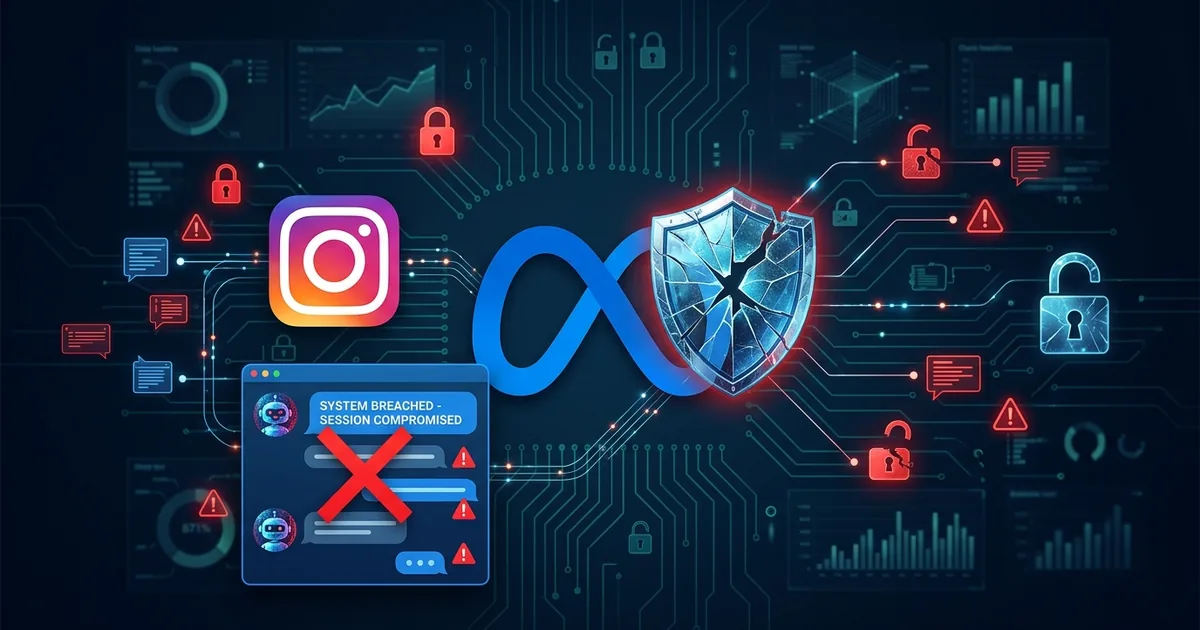
Hackers compromised more than 20,000 Instagram accounts over a seven-week stretch by exploiting a vulnerability in Meta’s AI-powered customer support chatbot. The attackers did not need stolen passwords, zero-day exploits, or social engineering at scale. They asked the chatbot to change the email address on target accounts, and the chatbot complied.
How the Attack Worked
The method was embarrassingly simple. According to 404 Media’s investigation, attackers used a VPN to spoof the target’s presumed geographic location, opened a chat with Meta’s AI Support Assistant, and requested that a new email address be added to the target account. The chatbot sent a verification code to the attacker-provided email, then displayed a “Reset Password” button. No two-factor authentication challenge. No human review. No escalation to a security team.
The breach ran from approximately April 17 through early June 2026, when Meta finally secured the chatbot. TechCrunch confirmed that high-profile targets included the Instagram handle for the Obama-era White House (inactive since 2017), the account of the U.S. Space Force’s chief master sergeant John Bentivegna, and the Sephora corporate account.
The AI Deployment Problem This Exposes
The Instagram breach is not a novel attack vector. It is a predictable consequence of deploying an AI agent with account-modification privileges and insufficient guardrails. The chatbot was designed to reduce Meta’s customer support costs by handling routine account management tasks autonomously. It succeeded at that goal. It also succeeded at handling malicious requests with the same efficiency.
This is the risk enterprises have been warned about since the first wave of customer-facing AI agents shipped in 2024: an LLM that processes natural language instructions cannot reliably distinguish between a legitimate account holder and an impersonator unless the authentication layer forces the distinction before the conversation starts. Meta’s implementation appears to have relied on IP geolocation as a proxy for identity verification, a check that a $5 VPN subscription defeats.
The Cost to Meta
The timing is painful. Meta has been aggressively pivoting toward paid AI subscriptions across Instagram, Facebook, and WhatsApp as part of the restructuring that accompanied its 8,000-job cut announced in late May. The company’s AI strategy depends on users trusting Meta’s AI products enough to pay for them. A breach where the AI itself was the attack surface undermines that trust at exactly the wrong moment.
Meta is now alerting affected users and prompting password resets. The company has not disclosed how many of the 20,000-plus compromised accounts were successfully recovered, or whether any accounts were used to conduct fraud, phishing, or cryptocurrency scams during the seven weeks the vulnerability was open.
What This Means for Enterprise AI Security
The Instagram breach will accelerate a conversation that enterprise security teams have been having behind closed doors: how much authority should AI agents have over production systems? The answer from every major framework, from OWASP’s LLM Top 10 to NIST’s AI Risk Management Framework, is clear. AI agents should not have the ability to modify authentication credentials without a human-in-the-loop verification step.
Meta is not the only company that has shipped AI agents with excessive privileges. Customer support bots at telecom providers, financial institutions, and e-commerce platforms routinely handle account modifications, password resets, and billing changes. The Instagram breach is the first high-profile demonstration that these deployments are vulnerable to the same class of attack at scale.
For companies rushing to deploy AI agents to cut costs, the lesson is specific: the AI is not the security layer. The authentication framework around the AI is the security layer. Meta learned that distinction the expensive way, and the regulatory scrutiny that follows will ensure other companies learn it too.
The Regulatory Fallout Is Coming
The breach lands weeks before the EU AI Act’s full enforcement deadline on August 2, 2026. Under the Act’s high-risk AI provisions, systems that manage user authentication and account access in large-scale consumer platforms could face mandatory human oversight requirements. Meta’s AI support chatbot, which handled credential changes for 2 billion monthly active users across its family of apps, is precisely the kind of deployment the regulation targets.
In the United States, the FTC has been scrutinizing AI-powered customer service systems since its 2025 enforcement action against a fintech company whose chatbot approved fraudulent transactions. The Instagram breach gives the agency fresh ammunition. Senator Mark Warner, who chairs the Senate Intelligence Committee, called the incident “a case study in why AI systems need mandatory security audits before deployment” in a statement released Saturday.
For Meta’s stock, the near-term impact may be contained. The company’s $1.4 trillion market cap and diversified revenue base can absorb the reputational hit. The longer-term risk is regulatory: if the breach triggers new compliance requirements for AI agents with account-modification privileges, every tech company running similar systems faces added costs. Meta, as the company that created the precedent, would face the sharpest scrutiny.
The 20,000 compromised accounts are a rounding error against Instagram’s 2 billion monthly active users. The vulnerability they exposed is not.