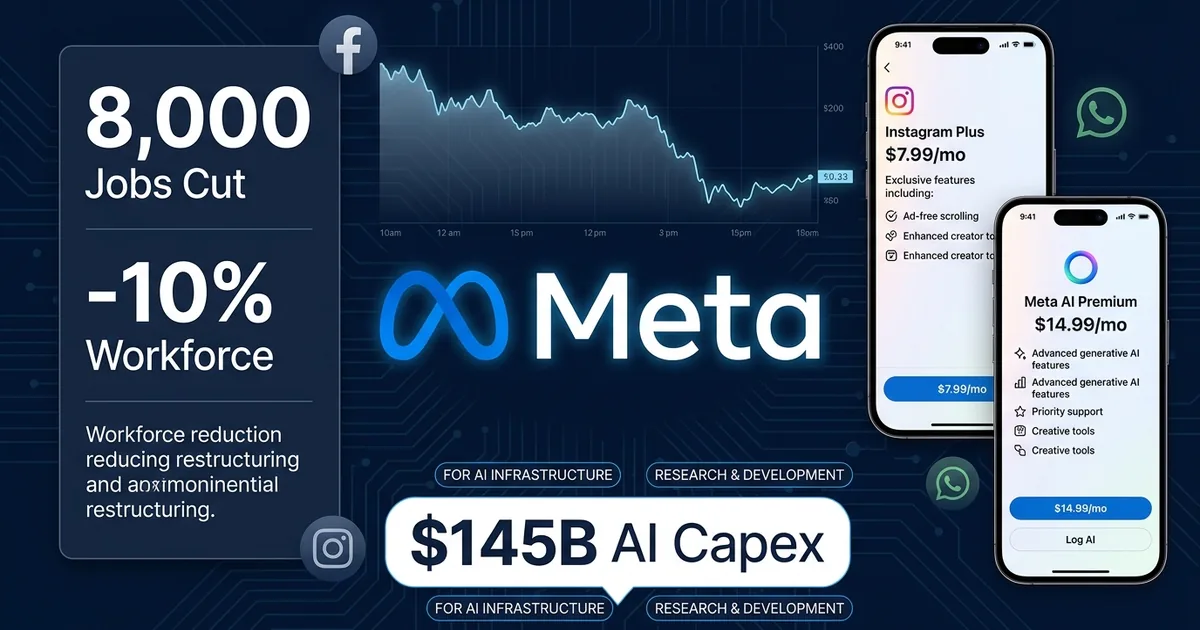
Meta is simultaneously firing 8,000 people and asking the remaining 3 billion users to pay up. The company executed its latest round of layoffs on May 20 while launching paid subscription plans for Instagram, Facebook, and WhatsApp globally just days later, a one-two punch that lays bare the math behind Mark Zuckerberg’s $145 billion AI bet.
The Layoffs Are Structural, Not Cosmetic
This is not a performance-based trim. Meta is cutting roughly 10% of its workforce across the company, with another 6,000 open requisitions canceled outright. The affected roles are being reorganized into what the company calls AI-focused “pods,” including an Applied AI Engineering group, an Agent Transformation Accelerator, and a Central Analytics division. About 7,000 employees are being transferred into these new structures, as The Next Web reported.
The cuts bring Zuckerberg’s total workforce reductions since 2022 to approximately 25,000 positions. When a company fires 25,000 people across four years while posting record revenue every quarter, the restructuring is not about survival. It is about permanently redefining how many humans are needed to run a platform that serves half the planet.
Record Revenue, Record AI Spending
The financial backdrop makes the layoffs even more striking. Meta posted $56.31 billion in quarterly revenue, a record, while simultaneously raising its 2026 capital expenditure guidance to between $125 billion and $145 billion, nearly all of it directed toward AI infrastructure including data centers, custom chips, and training compute.
Meta’s stock dropped 10% in May after JPMorgan downgraded the stock on ROI concerns around the capex surge. The market’s message is clear: investors want to see the AI spending translate into new revenue streams, not just cost savings from headcount reduction. Which brings us to the subscriptions.
The Subscription Play
Days after the layoffs, Meta launched consumer subscription plans globally. Instagram Plus and Facebook Plus run $3.99 per month, offering profile customization, enhanced reactions, and story insights. WhatsApp Plus costs $2.99 per month. These are modest feature bundles aimed at power users, not transformative product launches.
The more consequential move is the Meta AI subscription tiers being tested in select markets. Meta One Plus at $7.99 per month and Meta One Premium at $19.99 per month offer enhanced computing power for AI queries, expanded image and video generation, and priority access to new AI features, according to TechCrunch. Creator and business plans at $14.99 and $49.99 are testing in Saudi Arabia, Morocco, Thailand, and Bangladesh.
Following the Money
The subscription strategy is not going to offset $145 billion in AI capex anytime soon. At $3.99 per month, Meta would need roughly 100 million paying subscribers just to generate $5 billion in annual subscription revenue, a fraction of its advertising business. But the AI-tier pricing at $7.99 to $19.99 signals something more strategic: Meta is building the infrastructure to monetize AI capabilities directly, not just through better ad targeting.
The dual-track approach of cutting headcount while launching paid AI products reveals the operating thesis. Meta is betting that AI will simultaneously reduce the cost of running the platform (fewer humans needed for content moderation, customer support, and engineering) while creating new revenue streams that do not depend on advertising. If the bet works, the combination of lower costs and diversified revenue produces the margin expansion Wall Street demands.
The Broader Context
Meta’s moves mirror a pattern playing out across Big Tech. The tech sector has recorded more than 73,000 job cuts across 95 companies in the first four months of 2026, with every major company citing AI restructuring as the primary driver. Intuit cut 17% of its workforce the same week. Cloudflare, Oracle, Fidelity, and Wix have all followed suit.
The uncomfortable question none of these companies want to answer directly is whether AI will create enough new economic value to absorb the workers it displaces. Meta’s answer, so far, is to offer $3.99 sticker packs and $19.99 AI chatbot upgrades. The real revenue case for AI at Meta’s scale has not been made yet. The 8,000 people who lost their jobs are paying for it in advance.
What to Watch Next
The subscription tiers testing in select markets will determine whether Meta can build a meaningful non-advertising revenue stream. The company has tried subscriptions before, with limited success, most notably the Meta Verified blue-check program that generated modest uptake. The AI-tier pricing at $7.99 to $19.99 targets a different value proposition: compute access and capability, not status.
If Meta can convert even 2% of its monthly active users into paying AI subscribers at an average of $10 per month, that represents roughly $7 billion in annualized revenue. The number is speculative, but it illustrates why the subscription launch matters more than the consumer “Plus” plans. The AI tier is the one that could actually change the revenue composition of a company that has been 97% advertising-dependent for its entire public life.
The layoffs will continue. Zuckerberg has signaled that additional reductions are planned for the second half of 2026. The company that once prided itself on moving fast and breaking things is now moving fast and breaking headcount, betting that AI can fill the gap before the market loses patience.