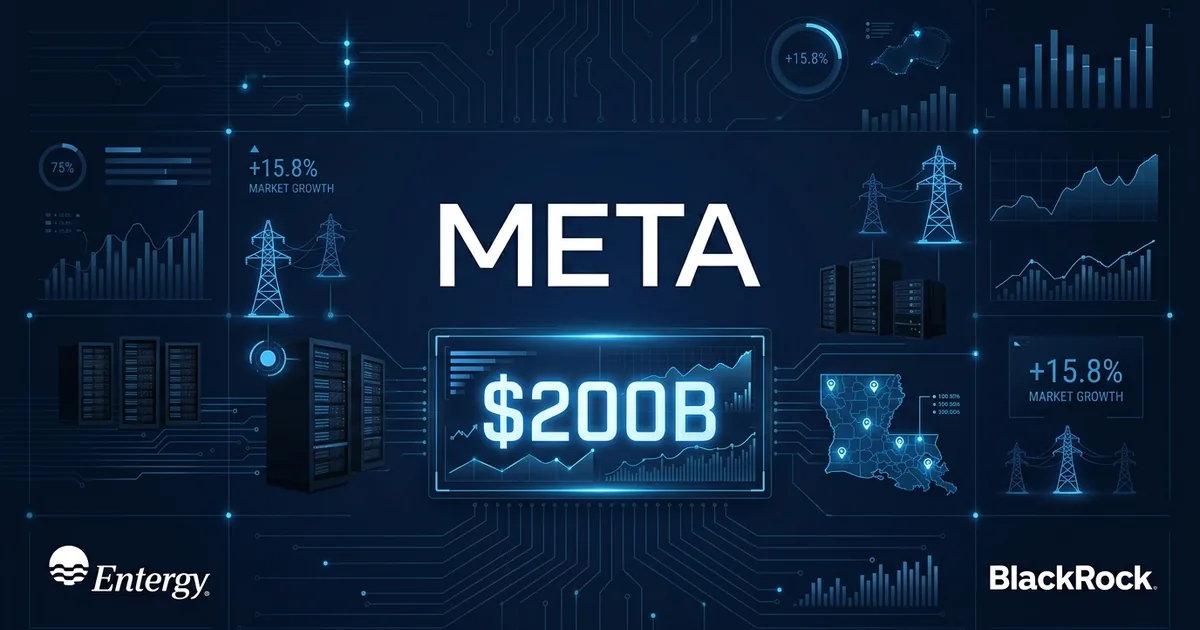
Meta is building the single largest artificial intelligence facility on Earth in rural Richland Parish, Louisiana, and the price tag has ballooned to over $200 billion. The project, codenamed Hyperion, signals that the AI infrastructure arms race has entered a phase where only a handful of companies can afford to compete.
A Campus the Size of a Small City
The Hyperion campus sprawls across 4,000 acres, roughly four times the size of Manhattan’s Central Park. When fully operational, the facility could consume up to 5 gigawatts of electricity at any given moment, a figure that would make it one of the single largest energy consumers in the United States. To put that in perspective, 5 GW is enough to power roughly 3.7 million average American homes.
Meta’s initial estimate for the project sat around $10 billion. That number now exceeds $200 billion, a twentyfold escalation that The Next Web reported reflects the true cost of training and running frontier AI models at global scale. The expansion speaks to how dramatically compute demand has outpaced even the most aggressive forecasts from just two years ago.
Ten Gas Plants and a Renewable Promise
Powering Hyperion requires an energy footprint that most sovereign nations would struggle to match. Meta reached a deal with Entergy in March 2026 for seven additional natural gas plants generating 5.2 gigawatts, stacking on top of three plants already in the agreement. That is ten dedicated gas-fired power plants for a single corporate campus.
Meta has committed to funding 2.5 gigawatts of new renewable energy resources as a counterweight, but the near-term reality is fossil fuel dependence. The tension between AI ambition and climate commitments is not theoretical here. It is measured in concrete and turbines.
The energy demands come at a time when data center power consumption is drawing scrutiny from regulators, utility companies, and communities who are being asked to absorb the grid impact of hyperscale computing. Ohio recently suspended a $1.57 billion data center tax break after voter backlash, a signal that the social license for these projects is not guaranteed. BTN covered Ohio’s data center tax break suspension last week, and the Louisiana project raises the same questions at a far larger scale.
BlackRock, Bonds, and Off-Balance-Sheet Engineering
The financial architecture is as notable as the physical one. Meta structured Hyperion as an off-balance-sheet joint venture, keeping the full $200 billion liability off its own books. BlackRock purchased more than $3 billion in bonds issued by the joint venture entity, effectively turning the world’s largest asset manager into a co-investor in Meta’s AI future.
This financing model accomplishes two things. It lets Meta build at unprecedented scale without triggering the kind of balance-sheet bloat that spooked investors when the company announced $145 billion in AI capex earlier this year. And it creates a new asset class: infrastructure debt backed by the revenue potential of frontier AI models that do not exist yet.
The bet is that the models trained in Hyperion will generate enough revenue to service the debt and justify the capital. If that thesis holds, every hyperscaler will adopt the same playbook. If it does not, BlackRock and Meta’s bondholders are holding paper backed by a very large building in rural Louisiana.
More Than 500 Permanent Jobs, and the Question of Who Benefits
Meta projects more than 500 permanent operational jobs and over 5,000 construction workers at peak activity. For Richland Parish, where the median household income sits well below the state average, those numbers represent a transformational economic event.
But the history of mega-projects in rural communities is mixed. Construction booms create temporary prosperity. Permanent jobs at data centers tend to be highly specialized and often filled by workers recruited from outside the region. The real beneficiary may be Meta’s shareholders, who gain compute capacity without proportional headcount growth, and Entergy, which gains a guaranteed buyer for a decade of natural gas generation.
What Hyperion Tells Us About the AI Spending Cycle
The $200 billion figure lands in a week where the broader AI trade is under pressure. Broadcom’s AI chip guidance miss triggered a $1.3 trillion semiconductor wipeout. The Nasdaq dropped 4% in its worst session since April 2025. Traders are now pricing in a potential Fed rate hike for the first time in this cycle.
Against that backdrop, Meta is doubling down. The company cut 8,000 jobs last week to fund AI subscriptions and compute. Hyperion is the physical manifestation of that bet: fewer people, more machines, more power, more capital allocated to inference and training infrastructure.
The question for investors is whether AI infrastructure spending is a generational platform shift comparable to the buildout of the internet backbone in the late 1990s, or whether it is a capital cycle that will end with overcapacity and writedowns. Meta is betting the former. At $200 billion, it is the most expensive bet in corporate history.