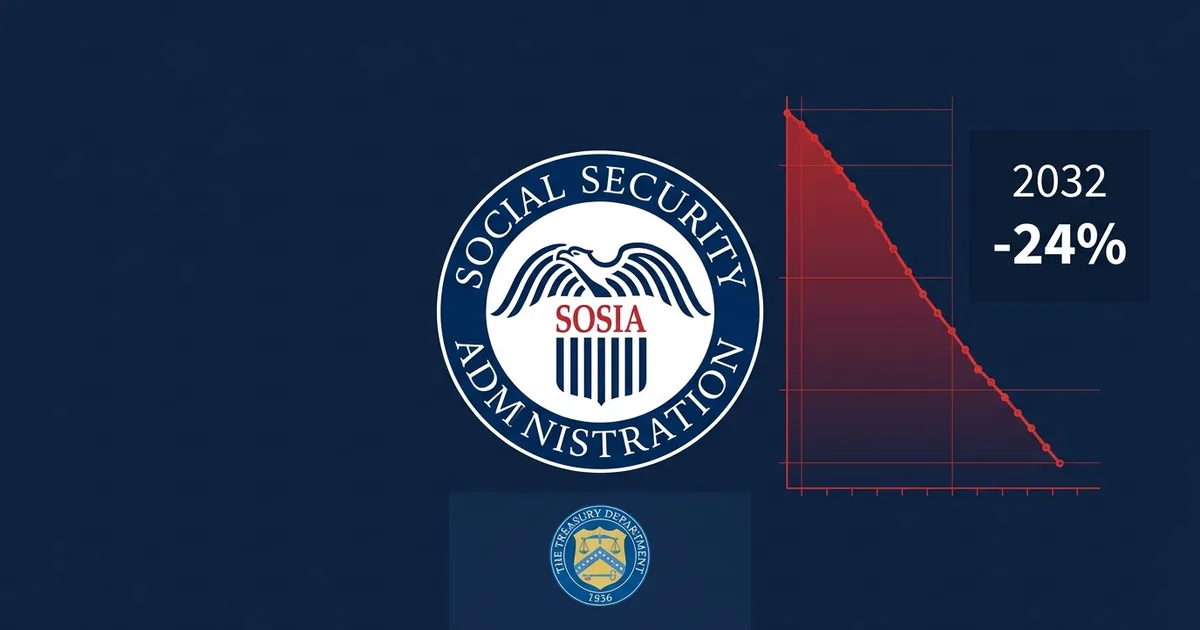
The Social Security retirement trust fund will run dry by 2032, triggering an automatic 24% benefit cut for 63 million Americans unless Congress acts first. That’s the finding from a new report by the Committee for a Responsible Federal Budget, which lands just ahead of the 2026 Social Security Trustees Report and puts a dollar figure on what insolvency actually looks like for retirees.
The Math Behind the Cliff
The CRFB report breaks the damage down to a state-by-state level, and the numbers are blunt. The average retiree would lose roughly $500 per month the moment the trust fund hits zero. Depending on the state, that monthly hit ranges from $459 to $556. Across the country, 54 million retired workers and another 9 million survivors and dependents are in the blast radius.
This isn’t a hypothetical stress test. The trust fund operates under a legal structure where benefits automatically get slashed to match incoming payroll tax revenue once the reserves are gone. No congressional vote required, no grace period, no phased reduction. The cut happens mechanically, and it happens to everyone drawing benefits at the same time.
For context, the average Social Security retirement benefit currently sits around $1,900 per month. A 24% cut drops that to roughly $1,444. For the millions of retirees who depend on Social Security for more than half their income, that’s not a budget adjustment. That’s a crisis.
The Administration’s Bet on Growth
Treasury Secretary Scott Bessent responded to the looming shortfall with a promise that sounds reassuring but lacks a specific mechanism. “The senior citizen does not pay more taxes and the senior citizen does not get less benefits,” Bessent told Fortune, framing the administration’s strategy around job creation and wage growth rather than the traditional policy levers of benefit restructuring or payroll tax increases.
The logic runs like this: if more people are working and earning higher wages, more payroll tax revenue flows into the trust fund, extending its life without touching benefits or tax rates. It’s a supply-side answer to a structural funding gap, and it carries real risks.
The Congressional Budget Office has repeatedly shown that even optimistic economic growth scenarios only delay trust fund exhaustion by a few years. They don’t eliminate the shortfall. The gap between projected obligations and projected revenue is too wide for growth alone to close, particularly as the ratio of workers to retirees continues to shrink. In 1960, there were roughly 5.1 workers per beneficiary. Today that ratio hovers near 2.8, and it’s heading lower as baby boomers age into the system.
Who Actually Pays
The politics of Social Security reform have paralyzed Washington for decades, and this report lands in a moment that makes action even less likely. Both parties treat benefit cuts as electoral poison. Republicans resist payroll tax increases. Democrats resist means testing or raising the retirement age. The result is a bipartisan agreement to do nothing until the cliff arrives.
But someone always pays. If Congress fails to act before 2032, the cost falls entirely on retirees through that automatic 24% cut. If Congress acts preemptively, the cost gets distributed differently depending on which lever gets pulled.
Raising the payroll tax cap, currently set at $168,600 in 2024, would shift the burden to higher earners. Gradually increasing the full retirement age would spread the cost across future retirees. Adjusting the benefit formula’s cost-of-living calculation would trim benefits more slowly over time. Each option has a different set of winners and losers, and each carries a different political price.
The CRFB report doesn’t endorse a specific fix, but it does make the cost of inaction concrete. A $500 monthly cut is not an abstraction. It’s a number that shows up in grocery budgets, rent payments, and prescription drug decisions for tens of millions of households.
The Market and Business Angle
Wall Street has largely treated Social Security’s funding gap as a slow-motion policy problem, not a market event. But the 2032 timeline changes that calculus. Six years is inside the planning horizon for insurers, healthcare systems, senior housing developers, and any business whose revenue depends on retiree spending power.
A 24% income cut across 63 million households would ripple through consumer spending in predictable ways. Healthcare stocks tied to Medicare Advantage plans, which supplement Social Security income for many retirees, could see enrollment shifts. Retailers and restaurant chains with heavy exposure to older demographics would feel the drag. The 30-year Treasury yield’s recent climb past 5% already reflects broader fiscal anxiety, and a Social Security crisis would add fuel to that trade.
Financial services firms are quietly positioning around the gap. Annuity sales have surged as pre-retirees hedge against benefit uncertainty, and wealth managers are building Social Security risk scenarios into retirement planning models. The advisory industry’s pitch is straightforward: if you can’t trust the government check, you need a private backup.
What Happens Next
The 2026 Trustees Report, expected in the coming weeks, will update the official depletion timeline. If it confirms or accelerates the 2032 date, pressure on Congress intensifies. If it pushes the date out slightly, as some economists expect given recent labor market strength, it could provide political cover for continued inaction.
Either way, the structural math hasn’t changed. The trust fund is burning through reserves faster than revenue replenishes them, and no plausible growth scenario closes the gap without policy changes. Bessent’s pledge sounds good on cable news, but the bond market, the insurance industry, and 63 million retirees need more than a promise. They need a plan.