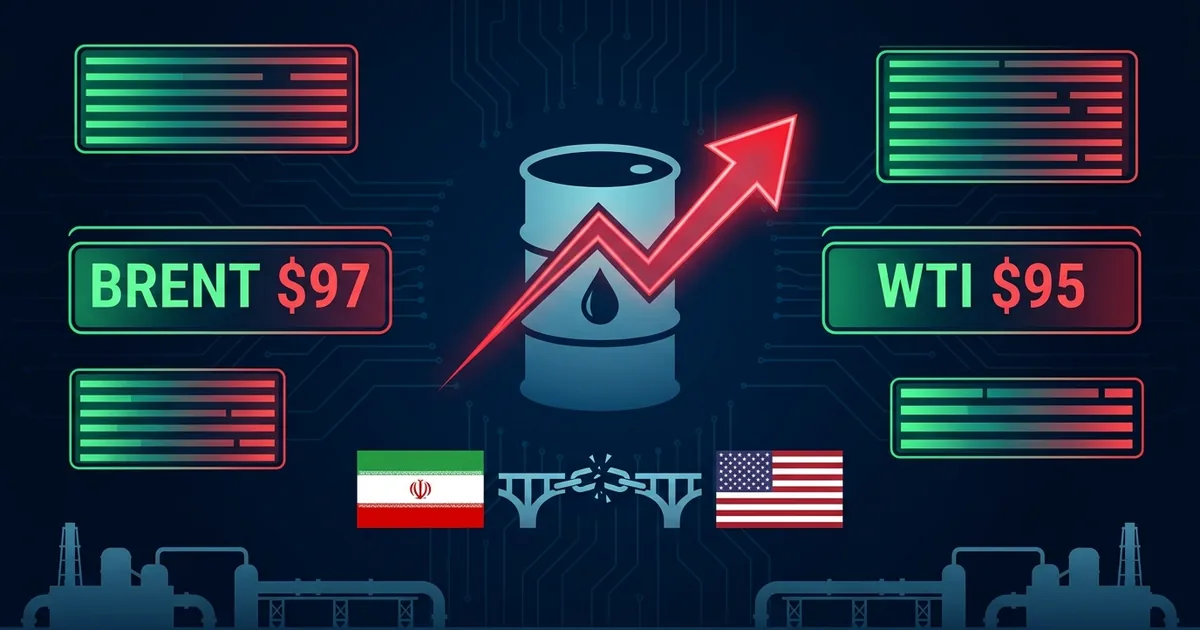
The fragile calm in global energy markets shattered on Monday when Iran announced it was suspending talks with the United States, sending Brent crude up more than 6% to roughly $97 a barrel and WTI past $95 in a single session. Wholesale gasoline prices jumped 4% alongside the crude spike, and the brief window of falling pump prices that drivers enjoyed over the past week slammed shut.
What Happened and Why It Matters
Iran’s semi-official Tasnim news agency reported that Tehran was cutting off negotiations with Washington in protest of Israel’s continued military operations in Lebanon. The announcement caught traders off guard because senior Trump administration officials had spent the previous week signaling that a ceasefire deal was imminent, a narrative that had pulled Brent down from triple-digit territory into the low $90s.
The reversal matters because it threatens to reopen the Strait of Hormuz chokepoint that handles roughly 20% of the world’s oil supply. As Al Jazeera reported in its coverage of the broader supply disruption fears, the closure of the strait earlier this year sent Brent to an intraday high of $126 in late April. Monday’s spike is a reminder that the market never fully priced in peace.
Follow the Money: Who Wins, Who Loses
Energy producers are the obvious beneficiaries. ExxonMobil, which just last week warned that crude could hit $160 if inventories keep drawing down, saw its shares edge higher in premarket trading. The broader S&P 500 Energy sector gained nearly 2% on Monday, outpacing every other sector except Technology.
The losers are airlines, shipping companies, and every consumer-facing business that runs on diesel and jet fuel. Refining margins had been narrowing on hopes of a peace dividend, and that thesis just got torched. For the average American driver, the math is brutal: every $10 move in crude translates to roughly 25 cents per gallon at the pump within two to three weeks.
The Ceasefire That Wasn’t
The pattern has become familiar. Trump officials leak optimism about an Iran deal, oil drops, markets rally, and then Tehran pulls back. This is the third time since March that a seemingly imminent ceasefire has collapsed at the last stage. Each reversal has produced a sharper price spike than the last, because the market’s willingness to price in future peace is eroding.
As the Deseret News detailed in its analysis of the market whiplash, the trajectory of the conflict has made a rapid resolution increasingly unlikely. Iran’s negotiating position has hardened in response to the Lebanon escalation, and the diplomatic runway is shorter than it was even a month ago.
What Traders Are Watching Next
Three signals will determine whether this spike holds or fades. First, any statement from Iran’s foreign ministry that walks back the Tasnim report would instantly reverse the move. Second, US strategic petroleum reserve releases could dampen the rally if the administration decides the political cost of $4-plus gasoline outweighs the diplomatic bargaining power. Third, OPEC+ production discipline remains the wild card: Saudi Arabia and the UAE have spare capacity, but they have shown no interest in using it while prices remain below the $110 threshold that stresses their own fiscal budgets.
The broader market took note. The S&P 500 and Nasdaq, which had just notched fresh all-time highs, pulled back on Monday as the energy shock rippled through risk assets. The 10-year Treasury yield ticked higher on inflation expectations.
The Bigger Picture
What investors should watch is not the daily price of a barrel but the structural shift in energy risk premiums. Before the Iran conflict, Brent traded in a $70 to $85 range that reflected manageable geopolitical risk. That range has been permanently repriced to $85 to $110, and every failed ceasefire pushes the floor higher. Companies that hedged their fuel costs in Q1 at sub-$80 levels are sitting on significant unrealized gains, while those that delayed are now paying spot prices that looked unimaginable six months ago.
Consumer Impact Is Already Here
The ripple effects extend well beyond trading floors. Airlines have been passing higher fuel surcharges through to ticket prices since March, and Monday’s spike will accelerate that trend. United Airlines and Delta both flagged fuel costs as their top margin risk in recent earnings calls. Trucking companies are adjusting diesel surcharge tables weekly instead of monthly, a cadence not seen since the 2022 spike.
For the Federal Reserve, the timing is particularly inconvenient. Oil-driven inflation had been moderating as ceasefire optimism built, giving the Fed room to hold rates steady. A sustained return to $100-plus crude complicates that calculus and raises the specter of stagflation concerns that the central bank spent most of Q1 trying to defuse.
The oil market is telling us something the diplomatic cables are not: peace in the Persian Gulf is not around the corner, and the cost of pretending otherwise just went up by another $5 a barrel.