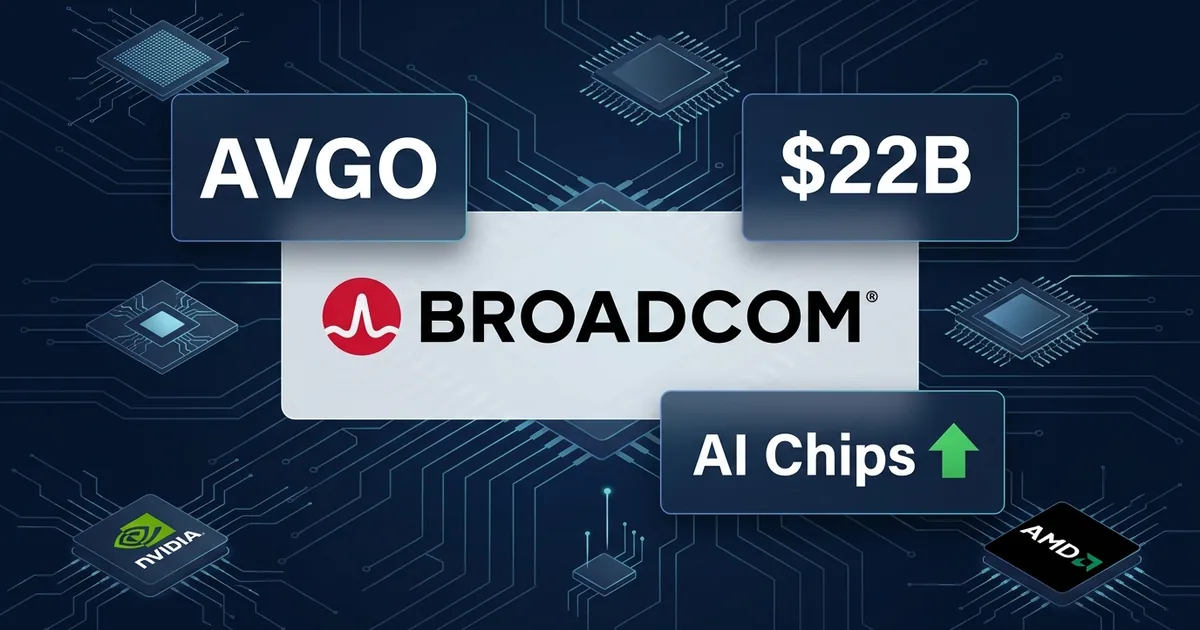
Broadcom reports fiscal second-quarter earnings on Wednesday, and the number that matters most is not revenue or margins: it is whether the $10.7 billion AI chip revenue target CEO Hock Tan set three months ago actually landed. With AVGO shares up more than 40% year to date and the stock trading at roughly 35 times forward earnings, the market has already priced in success. A miss would ripple across every AI infrastructure name on the Nasdaq.
The $22 Billion Quarter
Broadcom guided fiscal Q2 revenue to approximately $22 billion, representing 47% year-over-year growth. The Zacks consensus sits at $21.8 billion. Within that headline, AI chip revenue is expected to account for $10.7 billion, a figure that would make Broadcom the second-largest AI silicon vendor by revenue behind Nvidia and ahead of AMD.
The composition matters as much as the total. Broadcom’s AI business splits between two tracks: custom ASICs designed for hyperscaler clients like Google (which uses Broadcom’s TPU silicon) and Meta, plus its VMware software stack that now ships with AI workload optimization. The custom ASIC pipeline is where the growth lives, and analysts expect Hock Tan to provide Q3 AI revenue guidance that signals whether the full-year AI target of $44 billion is tracking or slipping.
Why This Earnings Print Is a Sector Event
Broadcom is not just reporting its own numbers on Wednesday. It is reporting the health of the custom AI chip market, and by extension, the capital expenditure intentions of the three or four hyperscalers that drive most of the world’s AI infrastructure spending.
If Tan confirms that the custom ASIC pipeline is accelerating, it validates the thesis that AI chip demand is broadening beyond Nvidia’s GPU monopoly into a diversified silicon supply chain. That is bullish for the entire semiconductor complex. If he hedges, or if the AI revenue comes in below the $10.7 billion bar, it raises uncomfortable questions about whether the hyperscalers are pulling back on custom silicon in favor of off-the-shelf GPU clusters.
The Margin Story
Broadcom has guided to a 68% adjusted EBITDA margin for the quarter. That number is remarkable for a company with $22 billion in revenue. It reflects two things: the VMware integration, which brought high-margin enterprise software into a hardware-heavy portfolio, and the pricing power that comes with being one of only two companies capable of fabricating custom AI accelerators at scale (the other being Marvell).
The margin question investors should watch is whether VMware’s contribution is holding steady or expanding. Broadcom acquired VMware for $69 billion in late 2023 and has spent two years converting its customer base to subscription licensing. That conversion is now largely complete, and the recurring revenue stream it produces is what gives Broadcom its valuation premium over pure-play chip companies.
The Competitive Landscape Shifted
This earnings call arrives in a competitive environment that has changed meaningfully in the past 90 days. Qualcomm announced a custom AI chip deal with ByteDance in late May, signaling that the ASIC market is attracting new entrants. Intel is pitching its foundry services for custom AI chips. And Nvidia’s Blackwell architecture is shipping in volume, raising the bar for what custom silicon needs to deliver to justify the design costs.
Tan has historically been disciplined about customer concentration. Three hyperscaler clients reportedly account for the vast majority of Broadcom’s AI revenue, and that concentration is both a strength (deep integration, high switching costs) and a vulnerability (one budget freeze away from a revenue air pocket). The June 2026 market outlook from HeyGoTrade flags Broadcom’s Wednesday print as one of the week’s two most consequential events alongside the Friday jobs report.
What to Watch Wednesday
The three numbers that will move the stock: AI chip revenue versus the $10.7 billion target, Q3 AI revenue guidance, and any commentary on new custom ASIC design wins beyond the current three-client base. A beat on all three could push AVGO past its all-time high. A miss on the first would likely trigger a 10-15% repricing that drags the entire AI chip complex lower.
For the broader market, Broadcom’s report is the last major AI infrastructure earnings print before the summer lull. It will set the tone for how investors value AI capex stories into the back half of 2026.