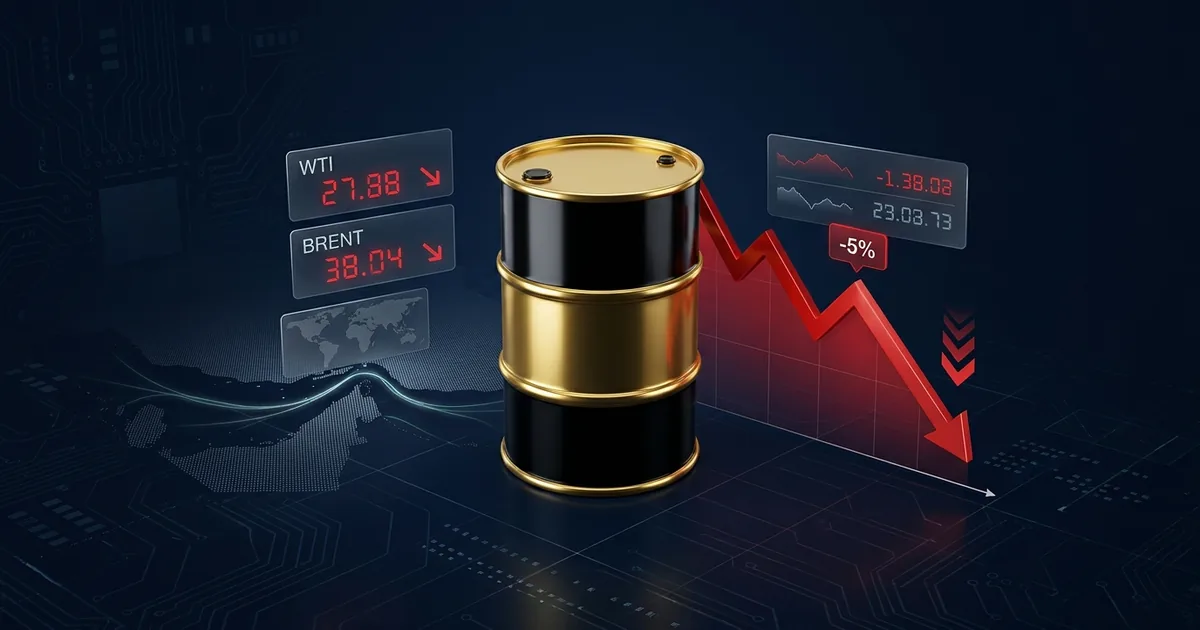
Crude oil sold off hard on May 27, with West Texas Intermediate dropping more than 5% to settle around $88.68 a barrel and Brent sliding a similar amount to about $94.29. The trigger was not a supply report or an inventory draw. It was a sentence from Washington.
Secretary of State Marco Rubio said the United States would give diplomacy with Iran “every chance to succeed,” and the oil market read it as a step back from the brink. The move is a reminder that for the first half of 2026, the single biggest variable in the energy complex has not been OPEC or US shale. It has been the gap between what Washington says about Iran on any given morning and what it does that afternoon.
A Headline Moved the Price, Not the Barrels
There is a useful tell in a sell-off this size happening on a comment rather than a fundamental. It means the market is carrying a large geopolitical risk premium, and any signal that the premium might shrink gets priced instantly. Rubio also noted that President Trump has “other options” if talks fail, an unsubtle reference to renewed military action, so the relief was partial. Traders bought the diplomacy and kept one hand on the panic button.
The whipsaw is the story. Crude has been swinging on alternating signals: US strikes on Iranian missile sites and on vessels that Washington says were trying to lay mines in the Strait of Hormuz, followed by talk of a framework agreement, followed by more strikes. CNBC reported that prices fell as traders weighed progress in the talks against the renewed hostilities, which is a polite way of saying nobody on a trading desk knows which way this breaks. That uncertainty is itself a cost, and it has been baked into the price of every barrel for months.
Why the Strait of Hormuz Sits Under Every Quote
The reason a State Department comment can knock 5% off crude is geography. Roughly a fifth of the world’s oil passes through the Strait of Hormuz, the narrow chokepoint between Iran and Oman. Any credible threat to close it, or to mine it, forces the market to price the tail risk of a supply shock that no amount of US production can quickly offset. When the threat eases, that premium drains out fast, and the move down looks violent precisely because the move up was built on fear rather than physical shortage.
This is the part that should worry anyone running a business exposed to fuel costs. The price is not being set by the things companies can model, like demand growth or refining capacity. It is being set by diplomacy with a binary range of outcomes. A framework deal could send crude sharply lower. A closed strait could send it sharply higher. There is not much comfortable middle ground, and that asymmetry makes hedging expensive and planning hard. The same Iran-driven volatility has been rattling equities and crypto for weeks, a dynamic our coverage tracked when stocks opened higher even as fresh Iran strikes tested record highs.
The Spillover Into Risk Assets
Oil is rarely the only thing moving when the Iran story shifts. Bitcoin slipped toward $75,000 in the same window, and equity futures have been taking their cues from the same headlines. When energy is the dominant macro driver, the correlation across asset classes tightens, because everyone is trading the same political variable through different instruments. A risk-on signal out of Washington lifts stocks and crypto and pressures crude’s risk premium at the same time. A risk-off signal does the reverse.
For investors, that correlation cuts against the usual diversification logic. Holding equities, crypto, and energy exposure does not spread the risk if all three are reacting to the same Strait of Hormuz headline. The hedge that actually works is harder to come by, which is part of why volatility itself has stayed elevated even on days when the direction looks clear.
What to Watch From Here
The market is now effectively long on a deal. A 5% drop on a single diplomatic comment tells you traders are positioning for de-escalation, which sets up an obvious risk: if the talks stall or the strikes resume, the snap-back higher could be just as fast as the fall. CNBC’s session tally put the drop at more than 5% as the Strait of Hormuz risk premium ebbed, and that fragile balance is the whole trade right now.
The cleaner read is that oil has become a proxy for US-Iran diplomacy, full stop. Until there is either a durable agreement or a definitive breakdown, expect crude to keep trading the headlines rather than the fundamentals, and expect every Rubio sentence to be worth a few dollars a barrel in either direction. For an energy market that prefers to obsess over inventories and rig counts, that is an uncomfortable place to be.