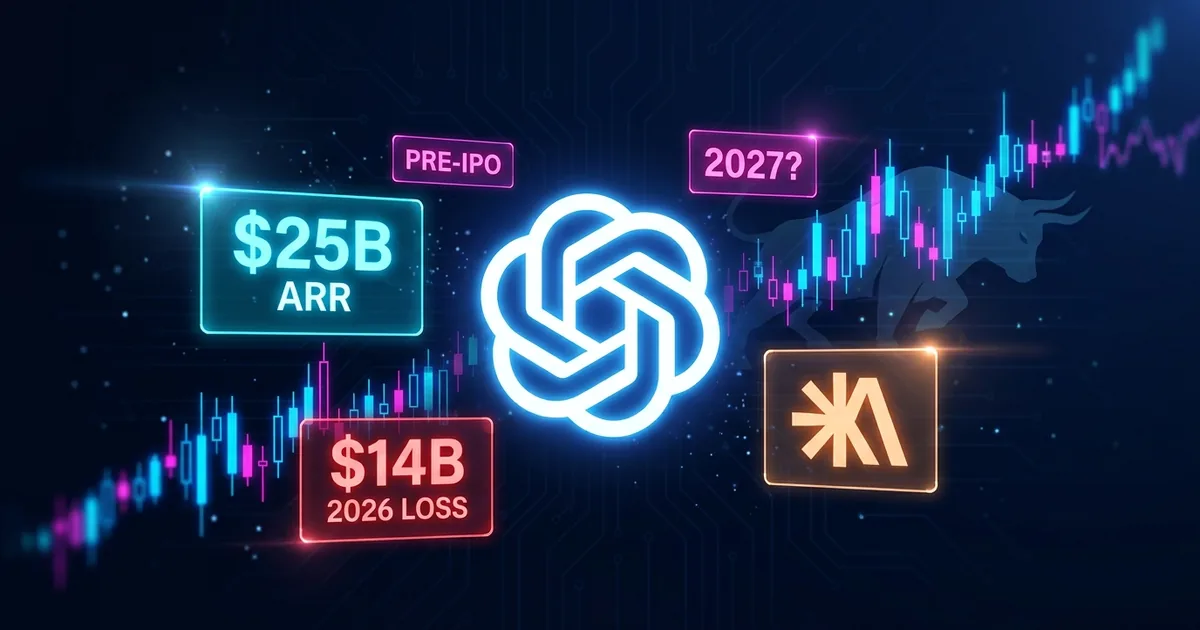
The biggest tech IPO of the decade is now also the biggest internal disagreement of the decade. OpenAI crossed $25 billion in annualized revenue in February, up from roughly $6 billion fourteen months earlier, and bankers across New York have been pricing what a 2026 listing could look like at a valuation north of $1 trillion. Inside the company, CFO Sarah Friar reportedly wants to push the long-rumored late-2026 listing into 2027, citing public-company reporting readiness. Internal projections point to a $14 billion loss in 2026 and no profitability before 2030. The math is staggering. The timing is contested. And rival Anthropic is now at $19 billion in annualized revenue, sitting one quarter behind in the same race.
The IPO timing question is the most consequential one in the AI capex narrative. The answer determines whether Microsoft, Oracle, and CoreWeave guidance holds up, whether the bubble argument has another twelve months of cover, and whether the next round of private funding gets done at the multiples the secondary market has been printing.
The Revenue Curve Is the Argument
Annualized revenue moving from $6 billion to $25 billion in fourteen months is the kind of growth the public market has not seen at scale since the late-1990s software cycle. The composition matters. The bulk of the revenue is now ChatGPT consumer subscriptions and ChatGPT Enterprise, with API revenue driving the residual and Microsoft revenue-share economics complicating the gross margin disclosure that any S-1 will eventually have to surface. The $25 billion figure is the public-facing argument. The number that will move the IPO timing decision is the rate of change against the cost curve.
Per Sacra’s coverage of the OpenAI revenue trajectory, the move from $6 billion to $25 billion includes a step-change in enterprise contract attach. ChatGPT Enterprise added Fortune 100 customers at a pace that exceeded internal forecasts, and the renewal cohort has been expanding rather than churning. The revenue is real. The question is whether it grows faster than the compute cost of serving it.
The $14 Billion Loss Is the Counterargument
Internal projections still point to a 2026 loss in the $14 billion range and no profitability before 2030. That is not a typo. It is the cost of compute, talent, and capital intensity required to run frontier model training and consumer-scale inference at the same time. The $14 billion projection is the private-company number. Once an S-1 is filed, that number becomes the public-company number, and the conversation shifts from secondary-market valuation discovery to discounted-cash-flow modeling under public-company disclosure rules.
The structural challenge is timing. If OpenAI files at a $1 trillion valuation while reporting a $14 billion annual loss and pushing profitability into 2030, the market either rerates the multiple lower or absorbs the loss as part of an AI-infrastructure thesis that holds together as long as the revenue line keeps printing 4x growth year over year. If the revenue line decelerates before profitability is in view, the trade unwinds and the IPO becomes an overhang on the entire AI public bench.
Why Friar Wants 2027
The CFO’s reported preference for 2027 over late 2026 is the most rational read of public-company readiness. Filing an S-1 requires three years of audited financials on a Sarbanes-Oxley basis, an internal-controls regime that satisfies the SEC’s accelerated-filer standards, and a forecasting and disclosure cadence that is materially different from the private-company quarterly board update. OpenAI’s audit and controls function has been scaling at the same pace as the rest of the company, which is to say not nearly fast enough to support a clean 2026 listing without significant operational risk.
The other consideration is the macro window. A 2027 listing puts the company in front of public investors after the AI capex cycle has had another year to either deliver the operating margin step-up the bull case requires or surface the deceleration the bear case predicts. From the CFO’s seat, the optionality of 2027 looks meaningfully better than the timeline pressure of 2026.
The Anthropic Pacing Problem
The competitive constraint is Anthropic, now at $19 billion in annualized revenue and growing at a rate that closes the gap to OpenAI inside two quarters on the trajectory. Anthropic has not signaled an IPO timeline, and the company’s funding posture suggests it is comfortable staying private into 2027 or later. That posture removes one of the standard pressure mechanisms for OpenAI to list, which is competitive currency for talent and acquisitions. If Anthropic stays private, OpenAI does not need to list to compete with it. If Anthropic files, the calculus shifts immediately.
The IPO calendar implication runs through the HawkEye 360 IPO that just reopened the 2026 listing window, and the broader bench of AI-adjacent names that have been waiting for a comparable transaction. A 2027 OpenAI listing pulls forward roadshow timing for the smaller AI-infrastructure names, including the foundation-model bench, the inference and serving layer, and the AI-enterprise-application middle tier. A 2026 listing compresses that calendar dramatically and forces other operators to either accelerate or wait until after OpenAI prices.
The Microsoft, Oracle, and CoreWeave Read
The companies most exposed to OpenAI’s IPO timing are the ones that have already booked the revenue. Microsoft’s Azure compute revenue, Oracle’s training-cluster commitments, and CoreWeave’s infrastructure attachment to OpenAI’s training and inference workloads all carry forward visibility that is structurally tied to OpenAI’s continued private-market funding capacity. A 2027 listing extends that visibility on a runway that lets Microsoft, Oracle, and CoreWeave each compound the revenue line without forcing the kind of public-company disclosure that would surface customer concentration risk on their own filings.
Per CNBC’s coverage of the OpenAI revenue print, the numbers were originally floated by company executives in February and have since been validated through multiple secondary-market funding rounds. The disclosure pattern itself is informative. OpenAI has been managing its public communications about revenue and profitability with an eye toward eventual S-1 filing, which means the public-private gap is narrower than most pre-IPO companies. That makes a 2026 filing more feasible than the average company at this scale, but more feasible is not the same as ready.
What 2027 Means for the Bubble Argument
If the listing slips into 2027, the AI capex bubble argument gets another year of cover. The case rests on revenue growth continuing at 3x to 4x annually, capex commitments translating into operating margin expansion in 2027, and the public-market multiple absorbing the $14 billion loss without panic. None of those are automatic. All of them are easier to defend with twelve more months of growth runway and a less compressed roadshow window.
The case for 2026 is mostly external. Bankers want the deal. Existing investors want partial liquidity. The Trump administration would like a marquee American AI listing as part of the broader industrial-policy story. None of those pressures will move Friar’s analysis if the audit, controls, and disclosure infrastructure is not actually ready. The CFO seat in a pre-IPO tech company is the one seat where the tape and the timeline have to actually agree, and Friar’s reported posture is the cleanest signal that internal readiness is not at the same level as external demand.
Three Reads From Here
First, whether the next round of secondary-market funding prices at the implied $1 trillion or higher valuation, which would either pull the IPO timing forward or extend the private-company runway. Second, whether Anthropic’s posture changes, particularly whether the company files an S-1 of its own and forces OpenAI to compete on a public timeline. Third, whether the next two quarters of revenue prints validate or decelerate the 4x growth curve, which is the single load-bearing assumption underneath every IPO timing scenario.
The most consequential pre-IPO timing decision in tech is happening in real time, and the CFO has reportedly already cast her vote. Whether the rest of the company agrees with her is the story that will define the AI calendar for the next twelve to eighteen months.