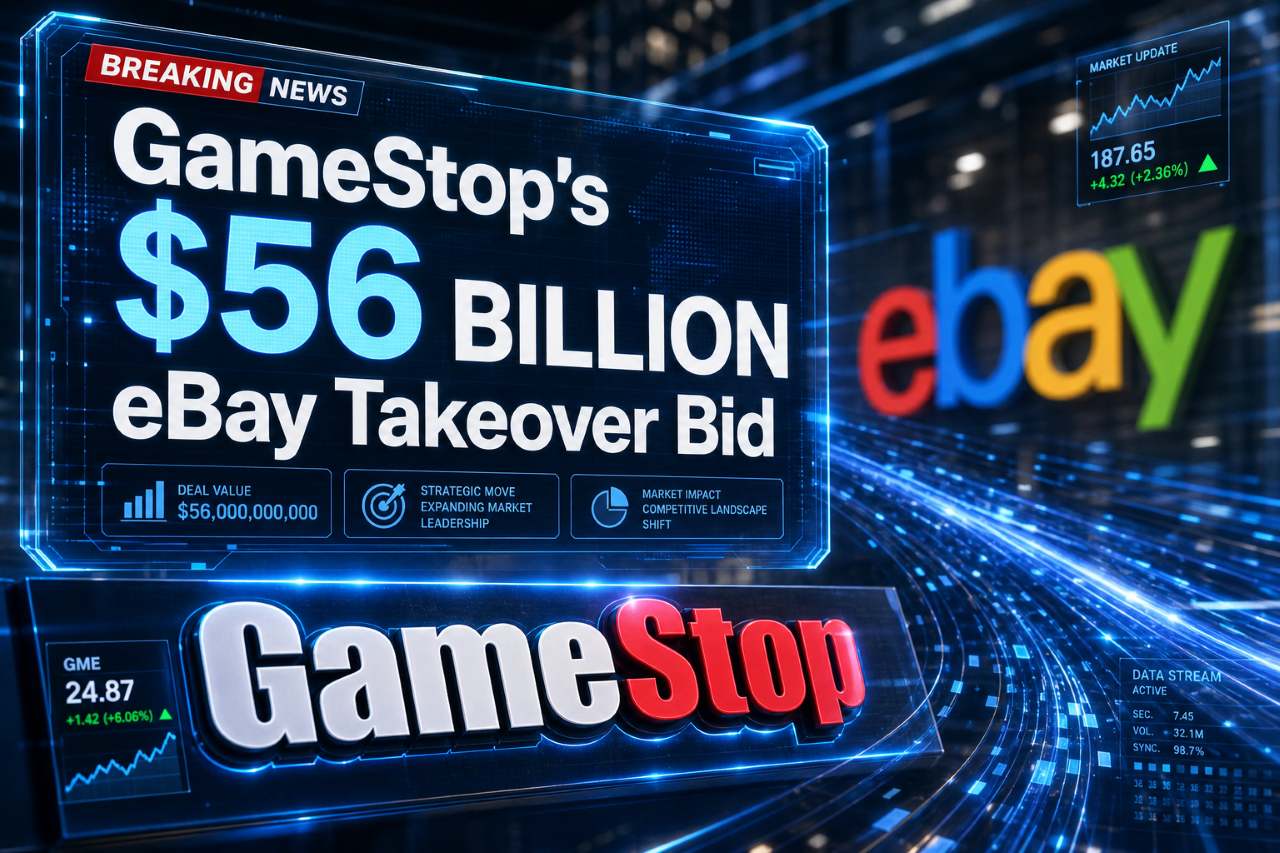
Ryan Cohen has run out of patience for the slow lane. On Sunday night, GameStop submitted an unsolicited $56 billion proposal to acquire eBay at $125 per share in a roughly even split of cash and stock, complete with a TD Bank commitment letter for $20 billion in debt financing and a quietly accumulated 5% stake already on the books. By Monday morning, eBay shares were up nearly 10% in pre-market trading, but pinned well below the offer price, a tell that Wall Street thinks this deal is more aspiration than acquisition.
That gap, the difference between $125 and where eBay is actually trading, is the entire story. It is also where the next several weeks of M&A theater will play out.
The Deal On Paper
The structure is classic Cohen: bold, public, designed to put the target’s board in a corner. The $125 offer represents a roughly 20% premium to eBay’s Friday close. Half cash, half stock, with TD Bank committing about $20 billion in debt to finance the cash portion. Cohen has already built a 5% stake in eBay through GameStop, giving him a foothold inside the cap table before the bid even landed.
In a letter to eBay’s board, Cohen pitched the combination as a path to $2 billion in annualized cost cuts and a chance to turn eBay into a stronger competitor against Amazon by leveraging GameStop’s roughly 1,600 stores as physical fulfillment and customer-acquisition nodes. The full proposal letter detailing the cash-and-stock structure indicates Cohen is prepared to take the bid directly to shareholders if eBay’s board declines to engage.
That is corporate-raider language. Cohen is signaling he is willing to go hostile.
The Skepticism Problem
There is a reason eBay shares opened a meaningful distance below $125. Investors are pricing in a long list of doubts.
eBay’s market capitalization sits well above GameStop’s, by a factor of roughly four. That is not a normal acquisition profile. Cohen is essentially proposing that the smaller, slower-growing video-game retailer issue a substantial slug of stock to absorb a larger, profitable, cash-generating e-commerce platform. Existing eBay holders have to weigh whether they want to swap a relatively pure marketplace exposure for a hybrid retail-and-marketplace bet engineered by a CEO whose reputation was built in meme-stock activism, not e-commerce operations.
Then there is the cash portion. The TD Bank commitment is real, but $20 billion is a substantial leveraged-finance lift in a market where credit spreads on speculative-grade paper are jittery on Iran, oil, and inflation. The financing path is not trivial.
And then there is the antitrust angle. Combining a mass-market e-commerce platform with a brick-and-mortar retailer technically does not raise the kind of horizontal-overlap concerns that drew regulator pushback on Microsoft-Activision, but it would still pull a hard look from the FTC, especially given the Trump administration’s mixed signals on tech M&A.
What Cohen Is Really Buying
If you take Cohen’s logic at face value, the deal is less about retail and more about marketplace dynamics and data. eBay sits on decades of buyer-seller relationship history, payments infrastructure, and a global authenticated brand spanning sneakers, watches, trading cards, and collectibles. That last piece, collectibles, is where GameStop’s customer base lives.
Cohen has spent the past three years trying to convert GameStop’s meme-era cash war chest into a real business. He has cut headcount, rationalized stores, pushed into trading cards, and parked the balance sheet in a mix of treasuries and equities. He has not, however, found organic growth. GameStop’s revenue continues to grind lower year over year, even as cost discipline keeps the company nominally profitable.
Buying eBay solves the growth problem in one move, but only if the integration math works. The $2 billion in promised synergies is the kind of round number that gets thrown around in early letters and quietly walked back during definitive-agreement drafting. The track record on retail acquisitions of this size is brutal. The integration of two very different cultures, a marketplace company built on engineering and trust-and-safety on one side, and a brick-and-mortar gaming retailer rebuilt around a single founder on the other, would be a multi-year undertaking.
The Real Audience Is Index Investors
Here is the under-discussed angle. Cohen’s letter is not really aimed at eBay’s board. It is aimed at the index funds and large active managers who own both names. A persuasive synergy story plus a 20% premium plus a public bid puts pressure on Vanguard, BlackRock, and the rest of the long-only base to engage. Even if the board says no on day one, Cohen has set the agenda.
This is the playbook he ran at GameStop in 2020 and at Bed Bath and Beyond before that. Force the conversation in public. Use the letter as a recruiting document for the next round of activist supporters. If a deal does not materialize, the next move is a proxy fight or a board seat. Either way, Cohen is on the inside of eBay’s strategic conversation, where he was not on Friday.
This is also the same broader capital-allocation conversation playing out across the S&P 500, where boards are being graded on every dollar they return or deploy. Apple’s record $100 billion buyback authorization last week reset the bar for what shareholders expect from a cash-rich incumbent. eBay, with a buyback program of its own and a long history of being labeled a “value trap” by sell-side analysts, is now squarely inside that conversation whether the board wants to be or not.
What To Watch Next
Three things over the next two weeks.
First, the eBay board response. A formal rejection plus a poison-pill activation would tell you Cohen is going hostile. A “we will engage” response would tell you eBay management thinks the price is at least worth talking about, even if the structure is not.
Second, the financing detail. If the leveraged-finance market starts pricing the TD Bank commitment skeptically, the deal’s economics tighten quickly. Cohen’s commentary on issuing GameStop stock to fund the takeover if cash markets balk gives him a fallback, but a stock-heavier deal compounds the dilution problem for GME holders.
Third, white-knight bidders. eBay has been a perennial conglomerate-spinoff candidate for a decade. If Cohen has put it in play, do not be surprised to see Walmart, a private-equity consortium, or even Amazon’s antitrust counsel sniff around the periphery. Once a target is in motion, alternatives appear.
For now, the read is straightforward. eBay’s stock movement signals that the market thinks Cohen’s bid is real enough to matter and ambitious enough to fail. That is exactly the kind of gap where activist M&A gets interesting. The next move, like most things in the Cohen playbook, will be public and loud. Watch the boardroom.