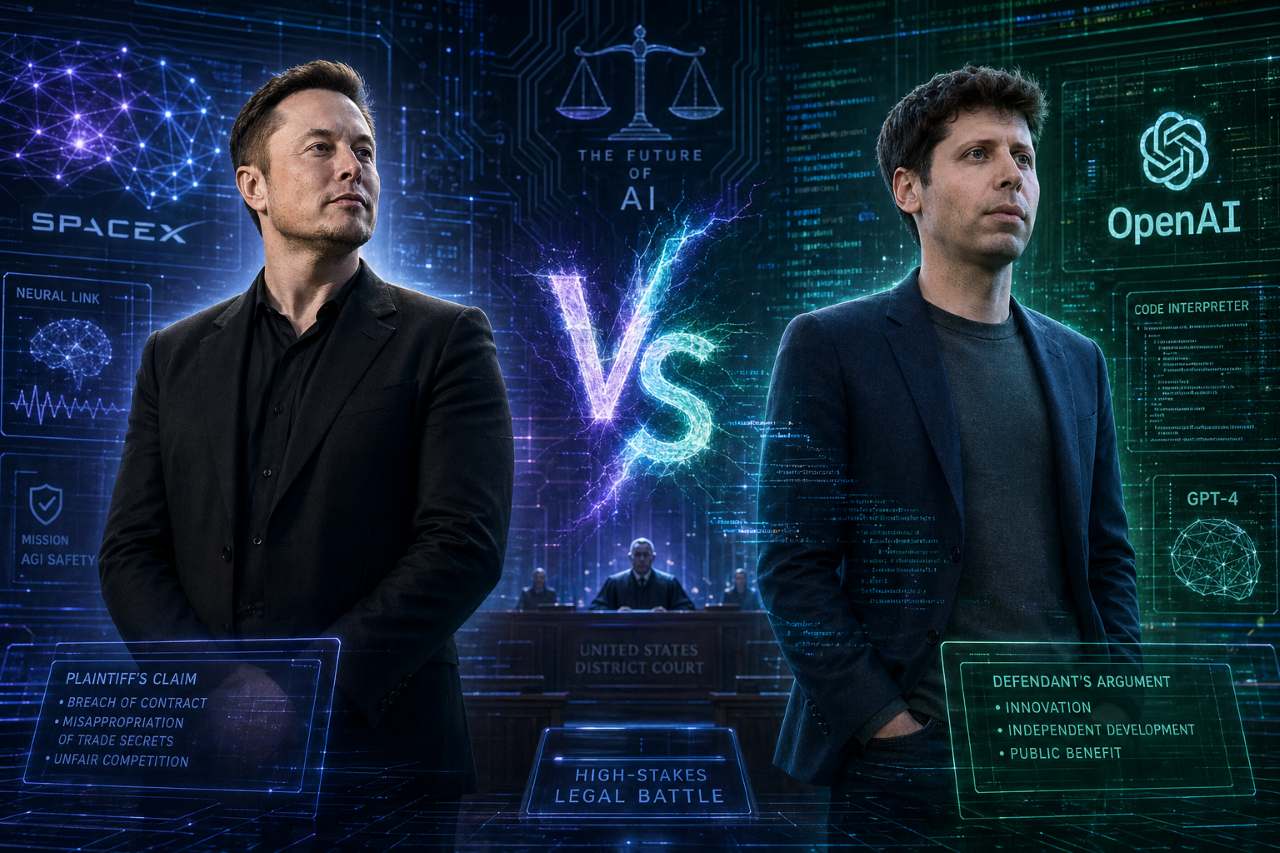
The two most powerful men in artificial intelligence have spent the last three years insulting each other on social media. On Tuesday, they finally had to stop typing and start testifying. In a federal courtroom in Oakland, California, Elon Musk took the stand in his civil case against Sam Altman, OpenAI, and OpenAI president Greg Brockman, accusing them of looting a charity that Musk himself helped found and fund. Microsoft is named as a co-defendant on a separate aiding-and-abetting claim. Judge Yvonne Gonzalez Rogers is presiding. The jury was seated Monday. The trial is scheduled to run three weeks.
This is a business case dressed up as a moral one, and the stakes are enormous.
What The Lawsuit Is Really About
When Musk co-founded OpenAI in 2015, the entity was structured as a 501(c)(3) nonprofit with a stated mission of building safe artificial general intelligence for the benefit of humanity. Musk personally contributed roughly $44 million in early funding. The structure was a deliberate counterpoint to Google’s commercial AI ambitions, which Musk publicly considered a threat to civilization.
In 2019, OpenAI created a capped-profit subsidiary that allowed it to raise venture capital at scale. Microsoft invested $1 billion that year and another $10 billion in early 2023. The capped-profit structure was unusual and, critics say, legally novel. In 2024, OpenAI began telegraphing a full conversion to a for-profit corporation, a structural change that would unlock a public offering and would, depending on whose math you trust, transfer between $50 billion and $150 billion in value from the original nonprofit shell to the new commercial entity.
Musk’s lawsuit, originally filed in 2024, alleged that this restructuring violated the founding charter. Most of the original 26 claims have been dismissed. Two remain: unjust enrichment and breach of charitable trust. A third claim alleges Microsoft aided and abetted the alleged misconduct. Those three are what the jury will decide.
Day One: Musk On The Stand
On Tuesday, Musk testified in unusually direct language for a courtroom setting. He repeatedly used the phrase “loot a charity” to describe what he believes Altman and Brockman did. He told the jury that Altman had personally promised him in writing that OpenAI would never become a for-profit company. OpenAI’s lawyers, in opening arguments, pointed out that Musk himself had previously proposed converting OpenAI into a for-profit entity controlled by Tesla, an offer that was rejected by the OpenAI board.
That is the case in a single exchange. Musk says the founding mission was sacred. OpenAI says Musk wanted to commercialize it on his own terms and is suing now because he did not get what he wanted then. The jury has to decide which version is closer to the truth and whether the harm, if any, rises to legal liability.
The Social Media Sideshow
Before jury selection began, Judge Gonzalez Rogers delivered a sharp admonishment to Musk after OpenAI’s lawyers complained that he had spent the previous evening posting about the trial on X, calling Altman “Scam Altman” and accusing him directly of stealing a charity. The judge made clear that further commentary outside the courtroom could result in sanctions.
Whether Musk listens is an open question. He has a long history of treating judicial decorum as a suggestion. The court is unlikely to gag him formally. But every additional X post becomes evidence that opposing counsel can use to argue Musk is more interested in damaging Altman publicly than in vindicating any genuine legal claim.
Microsoft’s Exposure
The most overlooked aspect of the case is Microsoft’s position. The aiding-and-abetting claim, if it survives the trial, could create liability for Redmond on the theory that it knowingly funded a structurally improper conversion. Microsoft has invested more than $13 billion in OpenAI and is the company’s largest external shareholder. A loss in this trial would not unwind the investment, but it could result in damages and would create a powerful precedent that future AI investors will have to navigate.
Inside Microsoft’s legal team, the strategy has reportedly been to keep a low profile and let OpenAI’s lawyers do most of the heavy lifting. Given the size of the exposure, that is a defensible approach. But every day the trial keeps Microsoft’s name in the news cycle is a day investors discount the value of the stake.
What A Verdict Could Mean
Three outcomes are possible. A defense win, where the jury concludes the conversion was lawful and Musk has no standing to claim damages. This is the consensus expectation. A split decision, where the jury finds breach of charitable trust but assigns minimal damages, allowing OpenAI to continue its for-profit conversion with reputational damage but no structural change. Or a plaintiff win on both substantive claims, which would force a renegotiation of the for-profit conversion and potentially require OpenAI to compensate the original nonprofit shell.
The third outcome is the one that should make every AI investor nervous. If the jury validates Musk’s argument, the legal precedent could ripple outward to other AI labs that have used similar capped-profit or hybrid nonprofit structures. Anthropic’s public-benefit corporation status is different but not unrelated. Plaintiffs’ lawyers across the country are watching this case the way they once watched the early Big Tobacco trials.
The Market Context
The trial arrives at a punishing moment for OpenAI. The company is already under pressure from a Wall Street Journal report this week that it missed internal revenue and user-growth targets in early 2026. Oracle, CoreWeave, and SoftBank, all major OpenAI partners, took meaningful stock hits Tuesday. A protracted trial that keeps Altman on the witness stand and out of business meetings is the last thing OpenAI’s commercial team needs.
For Musk, the trial is essentially free downside protection. He has already shifted Tesla’s strategic focus toward xAI and Grok. Damaging OpenAI’s reputation, even without winning the verdict, helps his competitor. As detailed by reporting at CNBC, the trial timeline runs through mid-May, which means the courtroom drama will extend into the heart of Big Tech earnings season.
What To Watch
Three things over the next three weeks will determine how this case actually moves markets. First, Altman’s testimony, expected next week. Anything inconsistent with previously sworn statements becomes a real legal problem. Second, Microsoft’s ability to keep its name out of the daily news cycle. Every story that pairs “Microsoft” with “lawsuit” hurts the stock. Third, Judge Gonzalez Rogers’s rulings on what evidence the jury can see, particularly internal OpenAI emails from the 2018-2019 period that allegedly include candid discussions of the conversion strategy.
This trial is not just about whether Elon Musk wins damages from Sam Altman. It is about whether the legal architecture that has underwritten the most valuable AI lab in the world holds up under cross-examination. By Memorial Day, we will know how it ends. Until then, every new filing, every witness, every X post from Musk becomes a potential market-moving event.
This is the most consequential AI trial since the early Authors Guild copyright cases. And it is just getting started.