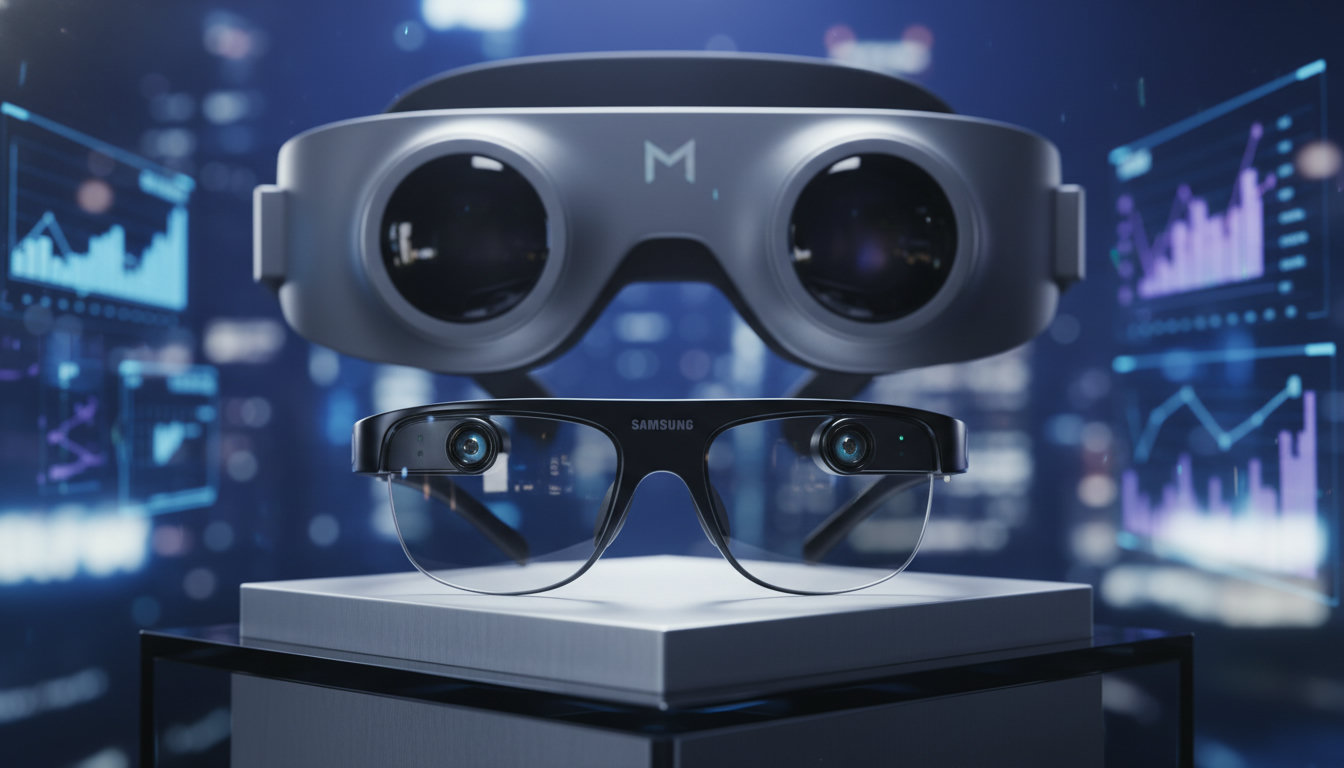
Samsung confirmed its Galaxy smart glasses will launch in August 2026 at a $600-900 price point. The device runs Android XR with Gemini AI built in.
The South Korean tech giant faces an uphill battle. Samsung will compete with the likes of Meta, which dominates the space at the moment. Meta's Ray-Ban partnership already controls 74% of the smart glasses market, according to IDC's latest wearables report.
Three Different Models Signal Samsung's Hedged Bet
Samsung isn't putting all its chips on one design. The company's first-generation Galaxy Glasses are expected to carry model numbers SM-O200P and SM-O200J. These are likely slight variations of the same device, possibly representing different styles. Both models will ship without displays.
They are expected to include a camera, along with built-in speakers and microphones, similar to Meta's Ray-Ban AI glasses. A third model, the SM-O500 codenamed "Haean," appears more ambitious. Based on the model number, it is likely another smart glasses device, but the higher numbering could indicate more advanced features.
The advanced model could be Samsung's answer to Meta's upcoming display-equipped glasses. Samsung could launch more advanced Galaxy Glasses in 2027. They will likely feature an in-lens display, similar to the Meta Ray-Ban Display.
Android XR Platform Arrives Just as Apple Retreats
Timing matters in tech battles, and Samsung caught a break. Apple reportedly shifted its smart glasses timeline to 2028 while focusing on lighter Vision Pro models. That gives Samsung a two-year window to establish Android XR as the default alternative.
Google announced the Android XR operating system on December 12, 2024, in New York City, with plans to launch it on Samsung's Moohan headset the following year. Viewed as the successor to Glass, Cardboard, and Daydream, the operating system was developed in collaboration with Samsung and Qualcomm and is heavily integrated with Gemini, Google's generative AI-powered chatbot.
The platform's killer feature: The smart glasses with Android XR, on which Samsung and Google are working, will put the power of Gemini, Google's AI assistant, one tap away, providing helpful information for users like directions, translations, or message summaries without having to reach for a phone.
Samsung's Display Tech Could Lock In Apple and Meta
Samsung began scaling up LEDoS development earlier this year following a broader internal reorganization in late 2024. The company formed a dedicated micro-LED team within its Compound Semiconductor Solutions (CSS) business unit, led by veteran display expert Yoon Seok-ho, who previously spearheaded micro-LED projects.
The play here is classic Samsung: become everyone's supplier while competing with them. The move pits Samsung against US tech giants such as Apple Inc. and Meta Platforms Inc., both of which are preparing their own AR glasses and are seen as potential future clients for Samsung's new displays.
LEDoS (LED on Silicon) displays solve the biggest technical hurdle in smart glasses: fitting high-resolution screens into frames people will actually wear. Samsung's CSS division now treats these microdisplays as "strategic growth areas" in official shareholder communications.
$600 Entry Price Targets Mass Market, Not Early Adopters
The Galaxy Glasses are expected to launch with a price range of $600 to $900, placing them firmly in the premium segment of the smart glasses market. Compare that to Meta's $299 Ray-Ban glasses or Samsung's own $1,800-2,800 Moohan headset launching this October.
The pricing strategy reveals Samsung's real target: smartphone upgraders, not VR enthusiasts. Their release is anticipated to coincide with other flagship Samsung products, such as the Galaxy Z Fold 8 and Galaxy Watch 9, further reinforcing Samsung's ecosystem.
Battery life remains the wildcard. The Galaxy Glasses are expected to feature a 245mAh battery, delivering an estimated 6 to 8 hours of usage depending on the intensity of activities. If Samsung hits the high end of that range, it beats Meta's 4-hour average.
Fashion Partnerships Signal Samsung's Distribution Play
Samsung has already announced a partnership with eyewear fashion brands Gentle Monster and Warby Parker for smart glasses. Gentle Monster operates 71 stores across Asia. Warby Parker runs 245 locations in North America.
That's 316 retail points where customers can try on smart glasses. Meta's Ray-Ban partnership leverages Luxottica's 7,000 stores globally. Samsung needs every distribution advantage it can find.
The enterprise angle looks stronger. It's a plan to bring Samsung AR and Google AR tools into real workplaces, where they can support teams that already rely on Galaxy devices, Android apps, and cloud-based communication tools. Samsung's Knox security platform already manages 70 million corporate devices.
The Real Competition: Multimodal AI Everywhere
The smart glasses will incorporate multimodal AI capabilities, including voice, vision, and gesture recognition. This aligns with Samsung's broader AI strategy, which includes development of HBM 4 memory chips for high-performance AI applications.
But Samsung faces competition beyond traditional hardware rivals. OpenAI is expected to unveil its first ChatGPT hardware product late next year. The device isn't a smartphone or a pair of glasses, but it should offer multimodal AI experiences similar to the Ray-Ban Meta AI glasses.
The next 18 months will determine whether smart glasses become the "next smartphone" or another Google Glass. Samsung's betting $2.8 billion they know which way this breaks.