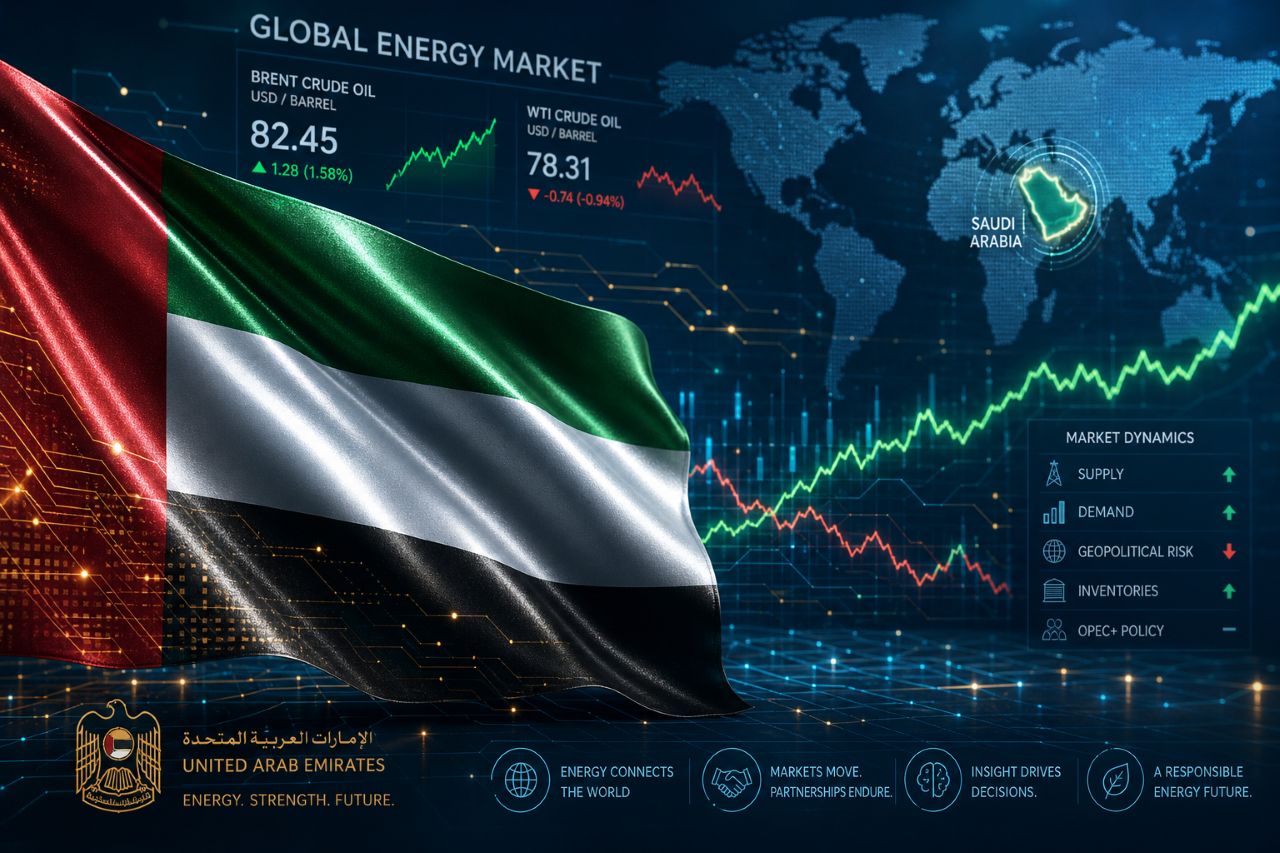
For nearly six decades, the United Arab Emirates was a quiet but indispensable member of the cartel that effectively set the price of the world’s most strategic commodity. On May 1, that ends. The UAE will formally exit both OPEC and OPEC+, ending a relationship that began before the federation itself existed as a country. And the most telling detail in the announcement, the one that turns a procedural change into a power story, is that the Emiratis did not bother to consult Saudi Arabia in advance.
That is not how this is supposed to work inside the cartel. And that tells you everything about where global oil power is headed.
A Shock Move With Sixty Years Of Frustration Behind It
The UAE’s exit was not impulsive. It was the loudest possible statement in a quota fight that has been simmering for three years. Abu Dhabi has invested tens of billions of dollars in expanding production capacity, with a stated goal of 5 million barrels per day by 2027. Inside OPEC, that target has been a political problem. The cartel has spent the last two years trying to throttle output to defend prices against weakening Chinese demand and surging non-OPEC supply from the United States, Brazil, Guyana, and Argentina. The UAE has sat in those meetings, agreed to quotas it considered punishingly low, and watched its expensive new wells produce a fraction of what they were built to produce.
The Iran war made the contradiction unsustainable. With the Strait of Hormuz half-shut and prices spiking on every fresh threat, the Emiratis have been losing both volume and price upside while bearing the geopolitical risk of operating in a war zone. Quitting OPEC frees the UAE to ramp on its own timeline. Whether the war ends quickly or drags into 2027, Abu Dhabi will set the price of its own barrels.
What It Means For Oil Prices
In the short term, not much, and that is the surprise. Brent jumped to nearly $113 in early Asian trading after the announcement, then quickly trimmed gains as traders absorbed a key fact: most of the UAE’s incremental capacity is shut in by the Hormuz crisis anyway. The country’s energy minister was blunt about it, telling reporters he did not expect significant near-term market impact. Translation: the new freedom is theoretical until the shipping lanes reopen.
The medium term is where the analysis gets interesting. OPEC’s central tool, the one that has terrified hedge funds for fifty years, is spare capacity. Saudi Arabia and the UAE were the only two producers that could meaningfully open or close the taps to defend a price floor or punish a cheater. With the UAE out, that buffer shrinks by roughly 1 million barrels per day. The cartel can still influence the market. It just cannot influence it as quickly or as decisively. Analysts at Rystad Energy argue OPEC will survive the loss. Other shops are less certain. What everyone agrees on is that volatility goes up, not down.
The Saudi Problem
Riyadh is the loser here, and not just because it lost a partner. It lost the appearance of unity, which has always been OPEC’s most valuable asset. For decades, the cartel sold itself to traders as a coordinated bloc that could speak with one voice. The UAE’s unilateral exit, executed without a heads-up call to Crown Prince Mohammed bin Salman, signals that the Gulf consensus is fraying. Watch Iraq and Kuwait closely. Both have grumbled about quotas for years. Both have rebuilding programs that need higher production volumes to fund domestic spending. If either follows Abu Dhabi out the door, OPEC stops being a cartel and becomes a Saudi-led affiliate group.
For investors, that uncertainty has a price. Oil futures volatility just permanently reset higher. Energy companies with exposure to the Gulf, from supermajors to oilfield services firms, will spend the next several quarters explaining to shareholders how they are positioned for a fragmented production landscape.
The Washington Angle
The Trump administration has been pushing for higher oil production for nearly a year, both to pressure Iran and to give consumers some relief at the pump. The UAE’s move is, on paper, a win for that agenda. More UAE barrels, eventually, means lower global prices. But the politics are messier than the math. Saudi Arabia is a treaty-level partner, and a public diplomatic snub of Riyadh by Abu Dhabi forces the White House into a delicate balancing act. Expect carefully crafted statements from Treasury and State that praise both governments without picking a side.
Energy hawks in Congress, meanwhile, will read the exit as further proof that OPEC’s grip is loosening and that U.S. shale should be celebrated rather than regulated. Expect new bills aimed at fast-tracking permits and pipeline approvals, especially in the Gulf of Mexico and the Permian Basin.
What To Watch Next
Three numbers will tell you whether the UAE’s exit is a market-moving event or a footnote. First, the spread between Brent and WTI. If it widens significantly over the next month, that is the market pricing in a structurally weaker OPEC. Second, OPEC+ Russia’s response. Moscow has its own reasons to hate quota constraints, and a sympathetic Russian statement would put real pressure on Riyadh. Third, the Strait of Hormuz. Until shipping normalizes, the UAE’s new freedom is mostly symbolic.
For now, the cartel is still a cartel. But it is a smaller, less coordinated, and considerably less predictable one. For a market that has spent the spring trying to price war risk on top of recession risk, that is one more variable nobody asked for. Detailed coverage of the energy market reaction is available at CNBC, where analysts have begun modeling a structurally weaker cartel as a permanent condition rather than a temporary disruption.
Whether traders believe the UAE’s “no immediate impact” framing is another question entirely. The forward curve already does not.
The Bottom Line
Sixty years of OPEC has rewarded one habit above all others: never break ranks publicly. The UAE just did exactly that, and the cartel does not have a credible response. Saudi Arabia can punish Abu Dhabi by flooding the market with its own barrels, but that drives prices into a hole that hurts every member, including itself. It can negotiate quietly, but the public humiliation is already done. It can do nothing, which is the most likely outcome and also the one that confirms OPEC’s diminished status.
For energy investors, the practical implication is simple. The era of stable, cartel-managed crude prices is over. The era of geopolitical-risk-driven oil prices, with structurally higher volatility and structurally weaker producer coordination, has begun. Position accordingly.