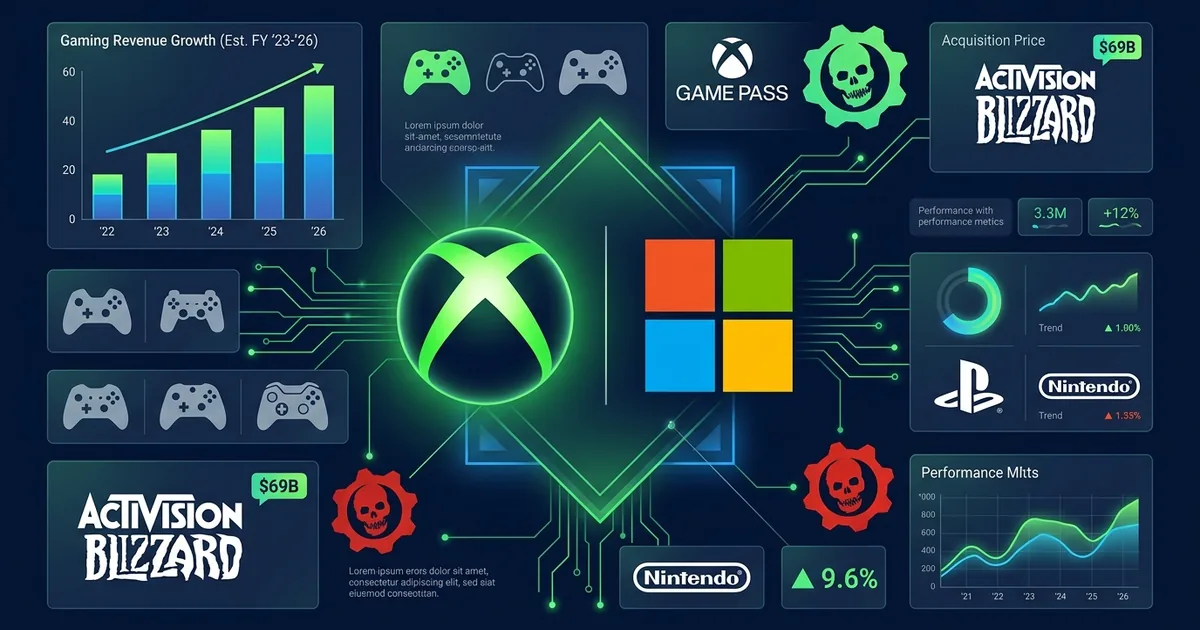
Microsoft’s Xbox Games Showcase kicks off today at 1 PM ET, and the stakes extend well beyond what games get announced. Nearly two years after the $69 billion Activision Blizzard acquisition closed, Microsoft is still trying to prove that its gaming division can be a growth engine rather than a cost center. Summer Game Fest 2026, which wrapped its opening salvo this week with dozens of reveals, set the stage.
Summer Game Fest Delivered the Appetizer
The Summer Game Fest kickoff show on June 6 served as the industry’s annual pre-E3 showcase, and the announcements had a clear business subtext. Capcom revealed Resident Evil: Veronica, a remake of the 2000 cult classic. Sega brought back Virtua Fighter with Virtua Fighter Crossroads, slated for 2027. Square Enix showed the finale of its Final Fantasy VII trilogy.
For Microsoft specifically, Windows Central tracked every Xbox and PC reveal from the show: Star Wars: Zero Company confirmed an August 27 release across Xbox, PC, and PS5, while Monster Hunter Wilds announced a major expansion called Ascendance coming in 2027.
But the main event is today’s Xbox Games Showcase, where Microsoft is expected to deliver the first in-depth look at Gears of War: E-Day, the franchise reboot that could anchor Xbox’s holiday 2026 lineup.
The Business Case for Gears of War: E-Day
Gears of War is not just a game franchise. It is a test of whether Microsoft’s first-party studios can produce system-selling exclusives at a pace that justifies the Activision acquisition premium. The Gears franchise has sold over 40 million copies lifetime, and E-Day, a prequel set 14 years before the original game, represents the first new mainline entry since 2019.
Microsoft needs E-Day to do what Halo Infinite could not: demonstrate that Xbox Game Studios can ship a polished, high-profile exclusive on time and at quality. The Halo franchise has struggled since Infinite’s launch, with 343 Industries restructured and rebranded. If Gears delivers, it reinforces the thesis that Microsoft’s studio portfolio, now the largest in gaming, can compete with Sony’s PlayStation Studios and Nintendo’s first-party output.
$69 Billion Later, Where Does Xbox Stand?
The Activision Blizzard acquisition gave Microsoft Call of Duty, World of Warcraft, Candy Crush, and Overwatch, among other franchises. The deal was the largest in gaming history and one of the largest tech acquisitions ever. But Kotaku’s Summer Game Fest coverage noted that Xbox’s content pipeline remains a question mark beyond its acquired studios.
Microsoft’s gaming revenue hit $5.5 billion in Q3 FY2026, up 11% year over year, driven largely by Game Pass subscriptions and the Activision portfolio. But the company has also shuttered studios, including Tango Gameworks and Arkane Austin, raising questions about whether the “quantity over curation” approach to studio acquisitions is sustainable.
The competitive landscape has shifted as well. Sony’s PlayStation 5 Pro continues to dominate the premium console market. Nintendo’s Switch 2 launched to record-breaking demand. And the PC gaming market, where Microsoft has the strongest cross-platform position through Windows and Game Pass, is seeing increased competition from Steam, Epic, and cloud gaming services.
Game Pass Is the Real Business Story
The showcase will likely feature new Game Pass announcements, and that is where the financial story lives. Game Pass, Microsoft’s Netflix-for-games subscription service, now has over 40 million subscribers. At $17.99 per month for the Ultimate tier, that is a recurring revenue stream approaching $8.6 billion annualized.
Microsoft has been steadily raising Game Pass prices and restructuring tiers to improve unit economics. The company eliminated the cheapest tier in 2024, pushed new releases into a premium “Standard” tier, and has been investing in AI-driven game recommendations and cloud streaming to reduce churn.
The strategic question is whether Game Pass can become gaming’s dominant platform the way Office 365 became the dominant productivity platform: a subscription moat that makes the underlying hardware secondary. If it can, the $69 billion Activision price tag starts to look reasonable. If subscribers plateau, it looks like Microsoft overpaid for content that could have been licensed rather than owned.
Why This Matters for Microsoft’s Broader Portfolio
Gaming is Microsoft’s fourth-largest business segment, behind cloud, productivity, and personal computing. But it is also the segment with the most uncertainty. CEO Satya Nadella has described gaming as a “pillar” of Microsoft’s consumer strategy, alongside LinkedIn and the broader Microsoft 365 ecosystem.
Today’s showcase will not resolve whether that thesis is correct. But it will signal how aggressively Microsoft plans to invest in first-party content, how central Game Pass remains to the go-to-market strategy, and whether the Activision acquisition is yielding the creative output that the $69 billion price implied. For a company trading at 34 times forward earnings, every pillar needs to pull its weight.