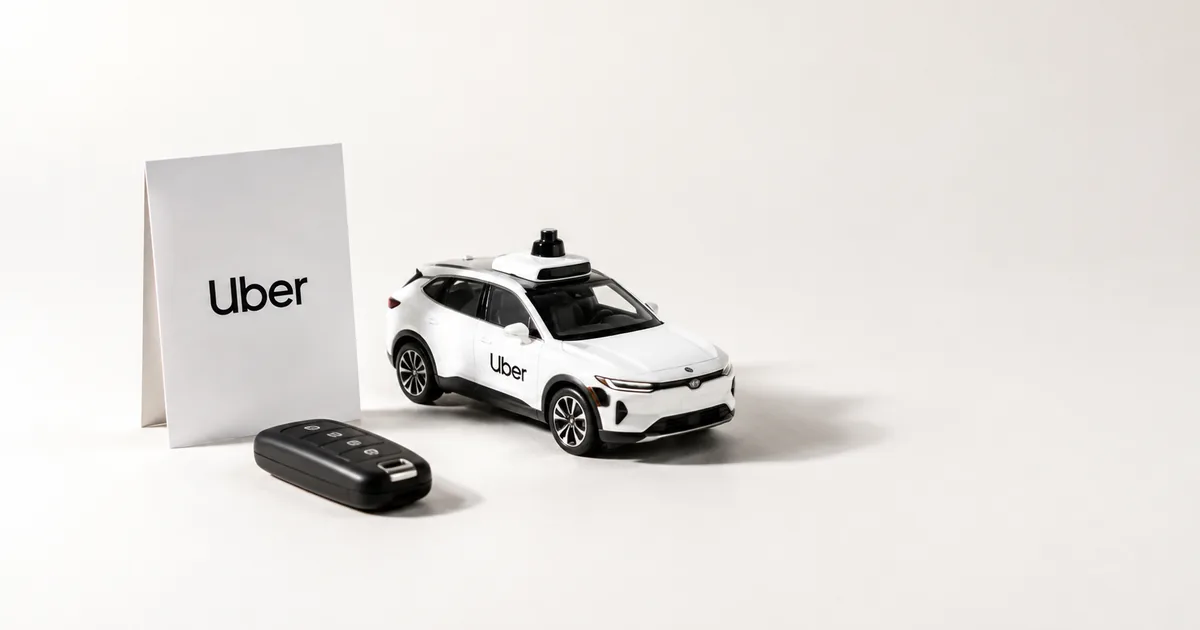
Uber told staff on Wednesday it is eliminating about 3,300 roles, roughly 10% of its workforce and its deepest cut since the pandemic, and framed the decision as clearing room to “build the autonomous future.” The shares rose about 2%.
Almost every account of the day repeated that framing without testing it, and the untested part is the whole story. Uber does not build autonomous vehicles. It sold its self-driving unit to Aurora in 2020 and has spent the years since buying access to other companies’ autonomy, more than 30 partnerships and over $10 billion of commitments, of which roughly $2.5 billion sits in equity stakes rather than technology. What 3,300 people are being asked to fund is not an engineering programme. It is optionality on somebody else’s engineering, purchased in a market where Uber’s single most capable supplier has already given notice.
What the Cut Actually Is
Strip the narrative off and the restructuring is coherent. Chief executive Dara Khosrowshahi told employees the company had become complex after years of fast growth, and the mechanics reflect that: the number of managers falls by about 20%, some of them move to individual-contributor roles, and the count of “micro-teams” where a manager oversees one or two people is cut in half. Skift reported the management-layer detail alongside the headline number, and TechCrunch confirmed the 10% figure the same afternoon.
Critically, this is not a demand story. Uber’s ride-hailing business is still growing, which is what separates this from 2020 and why the market read it as margin expansion rather than distress. Al Jazeera noted the same contrast: the largest headcount reduction since the pandemic, arriving without the collapse in bookings that justified the last one. A company delayering while growing is doing something defensible. Companies accrete managers in good years and it is legitimate, if painful, to remove them.
What $10 Billion Actually Buys
The problem is the second half of the sentence. Uber’s autonomy strategy is a portfolio of supplier relationships, catalogued in TechCrunch’s running tracker of its AV deals: WeRide, Lucid, Nuro, Rivian, Wayve, Nissan and roughly two dozen others. The logic is that Uber wants to be the app you open to hail a driverless car regardless of who built it, and demand aggregation is a genuinely strong position when supply is fragmented.
The commitments are real and dated. Uber and Rivian announced a deal for up to 50,000 autonomous R2 robotaxis, with a first phase of 10,000 vehicles beginning in San Francisco and Miami in 2028 and reaching 25 cities by 2031. Wayve and Nissan are preparing a Tokyo pilot for late 2026. None of that produces revenue in the quarter these 3,300 people are leaving.
Uber is paying, today, for vehicles that arrive in 2028, from suppliers who are free to sell to anyone, in a business where its best partner is building a rival storefront.
The Partner That Is Leaving
Then there is Waymo, and this is the part the layoff coverage skipped almost entirely. Waymo robotaxis came off Uber’s app in Phoenix on June 29, ending a nearly three-year arrangement at its contracted end date. A month later, Uber and Waymo agreed to end their exclusivity in Austin and Atlanta, with Waymo giving notice it will launch its own app in both cities in January 2028. Waymo vehicles stay on Uber through at least May 2028 under the existing contract, and reporting on the split described internal tension including conflicting policy positions the two companies were pushing in different states.
Read those two facts together. Uber’s aggregation thesis says fragmented supply needs a demand aggregator. Waymo is the most advanced autonomous operator in the United States, and it has concluded it does not need one. If the best supplier in the category can reach riders directly, the aggregator’s leverage rests on the suppliers who cannot, which is a weaker book of business than the strategy implies. Uber has also been pushing hard at the regulatory layer, where permit ceilings have moved fast enough to reshape a market in weeks rather than years.
Our View
The cut is defensible. The framing is not, and Khosrowshahi should stop using it.
Removing a fifth of the management layer at a company that grew into bureaucracy is ordinary, and doing it while the core business is expanding is better governance than waiting for a downturn to force it. Uber’s board is entitled to that decision and the market priced it fairly.
What is not defensible is attaching those 3,300 jobs to an autonomous future Uber has chosen not to build. The company made a deliberate strategic decision six years ago to be a buyer rather than a builder of autonomy, and buying is cheaper precisely because it does not require the headcount. If the savings are funding equity stakes and vehicle commitments, say that: this is capital allocation, and the people leaving are financing a portfolio of bets on suppliers, one of which is actively becoming a competitor. Calling that “building the autonomous future” borrows credit for engineering work that is happening at Waymo, Rivian and Wayve, on their payrolls.
The honest version is less inspiring and more investable. Uber is a marketplace with strong unit economics deciding to run leaner while it waits to find out whether it still owns the customer relationship in 2028. That is a real question, Waymo has already answered it for itself, and no amount of narrative about the autonomous future changes who is writing the software.