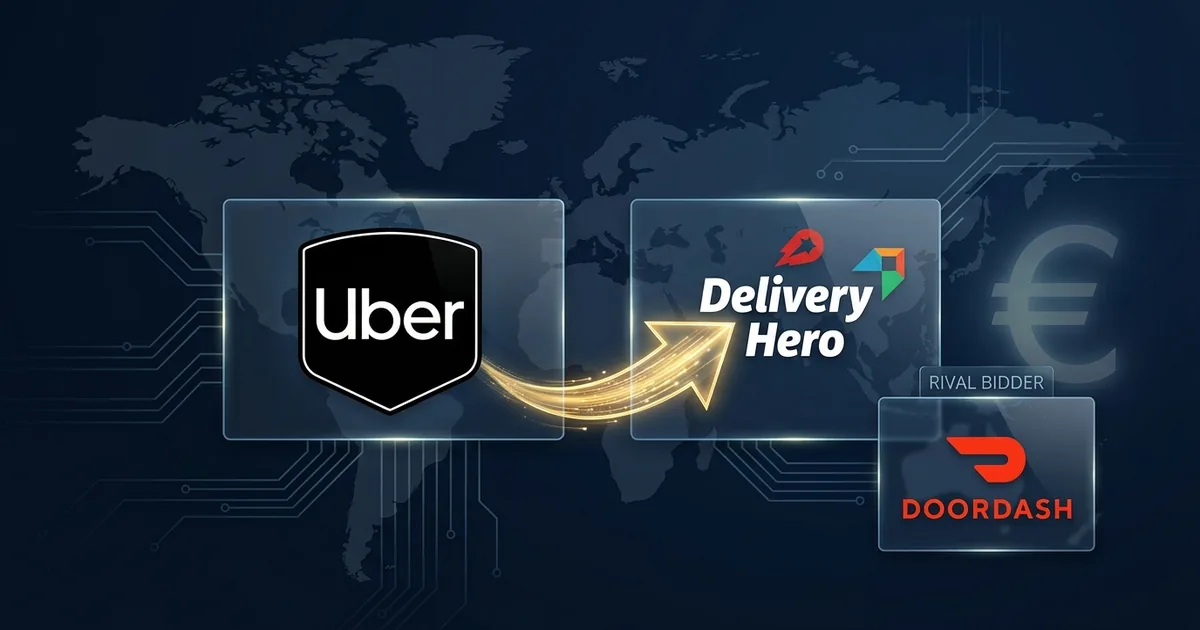
Uber Technologies has put an indicative offer of 33 euros a share on the table for Delivery Hero, the Berlin-based delivery group, a bid that values the target at roughly 10 billion euros, or about $11.5 billion. The number is striking. What it buys, and who else wants it, is the part worth slowing down for.
From a Toehold to the Biggest Shareholder
This did not start on Saturday. Uber spent months building a position in Delivery Hero, nearly tripling its stake to 19.5% with another 5.6% held through derivatives, which made it the company’s largest shareholder before it ever named a formal price. Delivery Hero confirmed the approach, which PYMNTS pegged at roughly $11 billion, and the market’s reaction was the giveaway: the stock jumped about 10%, trading through an offer that actually sits below where shares had closed.
When a target rallies past a bid rather than toward it, the Street is telling you it expects a higher number. At least one major shareholder has reportedly pushed back on the price as too low, and Uber’s board has been weighing a sweetened offer. That is a classic squeeze. The toehold gives Uber both a seat at the table and a financial cushion, because every euro it eventually overpays is partly a euro it pays back to itself on the 19.5% it already owns.
What Uber Is Actually Buying
Look past the logos and the logic gets clearer. Delivery Hero is not a Western business. Its value sits in Glovo across southern Europe and Latin America, Foodpanda across Asia, and Talabat across the Middle East, a portfolio concentrated in exactly the emerging markets where food delivery is still growing fast rather than fighting over saturated cities.
That is the strategic itch Uber is scratching. Uber Eats is a mature, profitable machine in the United States and Western Europe, but maturity is the problem when investors price you for growth. Buying Delivery Hero is buying a runway in regions Uber would otherwise take years and billions to win on its own, and doing it while the target is publicly in play and arguably cheap. We have tracked how Uber keeps reshaping its delivery arm, from robot deliveries on UK sidewalks to this continent-spanning land grab, and the throughline is consistent: own the last mile everywhere, not only where the margins are already fat.
DoorDash Is Not a Spectator
The complication is that Uber is not bidding alone. DoorDash has separately expressed interest in Talabat, Delivery Hero’s Middle Eastern crown jewel, and has explored a full takeover of its own, according to CNBC’s reporting on the contested situation. That changes the math for Uber. A rival willing to carve off the most valuable regional unit can force Uber to either pay up for the whole company or watch the asset it covets get picked apart.
For Delivery Hero’s board, two suitors is the best possible position. For Uber, it is the difference between a tidy bolt-on and a bidding war that strains the very growth-versus-discipline balance its own shareholders reward.
The Most Expensive Land Grab in Food Delivery
At roughly $11.5 billion, this would rank among the largest deals the food-delivery industry has ever seen, and it tells you how the economics have shifted. The sector spent its first decade torching cash to buy market share, and the survivors are now consolidating that share into regional monopolies rather than competing it away. Uber paying a double-digit-billion premium for Delivery Hero runs on the same logic that drove DoorDash’s acquisition of Wolt and a decade of European roll-ups: in a business with thin margins and brutal unit economics, scale is the only durable moat. The people who lose in that math are rarely the shareholders. They are the couriers whose pay gets standardized downward and the restaurants whose commission rates suddenly have nowhere left to negotiate.
Brussels Is the Real Counterparty
Even if Uber wins the auction, the harder negotiation may be with regulators. A combined Uber Eats, Glovo, and Foodpanda would concentrate an enormous share of food delivery across multiple European markets, and European competition authorities have spent years signaling they will not wave through platform roll-ups that thin out consumer choice. The house view here is blunt: fewer delivery platforms means more pricing power over the restaurants that list, the couriers who ride, and the diners who order. Consolidation that looks like efficiency from a deal desk often looks like a squeeze from the curb.
That tension, between the deal-room case for scale and the public case for competition, is the one to watch over the coming weeks. Uber has the stake, the strategic motive, and the balance sheet to win Delivery Hero. Whether it can win the asset at a price its investors tolerate, fend off DoorDash, and clear Brussels without crippling concessions is a far longer list. The offer on the table is 33 euros. The real cost of this deal will be settled well above it.