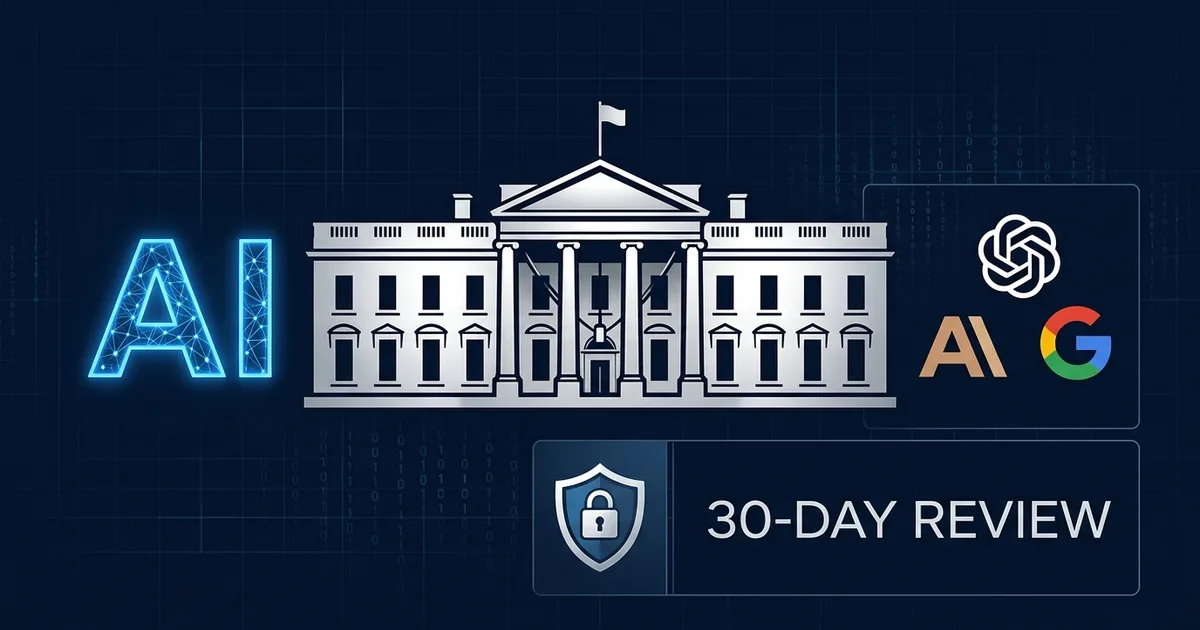
President Donald Trump signed a new executive order on Tuesday that asks AI companies to voluntarily submit their most powerful models for government testing up to 30 days before releasing them to the public. The order stops short of mandatory licensing or preclearance, but it establishes the first formal framework for federal evaluation of frontier AI systems before they reach consumers, researchers, and enterprise customers.
What the Order Actually Requires
The executive order creates a voluntary testing framework where companies like Anthropic, OpenAI, and Google can submit frontier models to government evaluators for security, safety, and capability assessment up to 30 days before public deployment. The emphasis is on “voluntary.” The order explicitly bars the creation of a mandatory licensing or preclearance requirement for new AI models, making this a request backed by political pressure rather than regulatory force.
The government’s testing will focus on three areas: cybersecurity capabilities (can the model be used to discover or exploit vulnerabilities), biosecurity risks (can it provide actionable information about biological threats), and national security implications (can it be weaponized or used for intelligence gathering at scale).
Federal agencies are directed to develop standardized benchmarks for evaluating AI models on these dimensions, to create an “AI cybersecurity clearinghouse” for sharing vulnerability information, and to strengthen the government’s own defenses against AI-enabled attacks.
The 90-Day Draft That Became 30 Days
An earlier version of the order would have given the government up to 90 days to review advanced models before release, a timeline that drew sharp pushback from AI companies and industry lobbyists, according to NPR. The final version cuts that window to 30 days, a compromise that reflects the tension between security oversight and the commercial pressure to ship models quickly in a market where release cadence is measured in weeks.
The reduction from 90 to 30 days was reportedly the result of direct conversations between White House officials and executives at the major AI labs. For companies racing to release new model families, even a 30-day delay represents a competitive risk if rivals choose not to participate.
Why It Matters for Business
The voluntary framework creates an interesting game-theory problem for AI companies. Participation signals responsibility and builds political goodwill, which matters when the same administration is considering everything from export controls to procurement rules that favor “trusted” AI vendors. Non-participation avoids the delay but risks being labeled as uncooperative by regulators who will eventually have enforcement tools.
For enterprise customers evaluating AI vendors, the order introduces a new dimension to due diligence. A model that has passed federal pre-release testing carries a de facto government endorsement, even if the program is technically voluntary. That distinction could influence procurement decisions at agencies, defense contractors, and regulated industries like finance and healthcare.
The order also comes at a moment when the Trump administration previously canceled an earlier AI executive order over concerns it would stifle innovation, then reversed course with this more industry-friendly version. The back-and-forth illustrates how difficult it is to balance AI safety oversight with the economic reality that US AI companies are generating tens of billions in revenue and are central to the country’s competitive positioning against China.
The Bigger Regulatory Picture
The executive order lands in a regulatory environment that is moving faster than most AI companies anticipated. The EU AI Act is entering enforcement. China has its own pre-release testing requirements for generative AI. And Congress has multiple AI bills in committee that range from light-touch disclosure rules to comprehensive licensing frameworks.
For the AI industry, the question is no longer whether government oversight is coming. It is whether the oversight will be collaborative or adversarial, voluntary or mandatory, and whether the US approach will be compatible with the frameworks emerging in Brussels and Beijing.
Trump’s order bets on collaboration. Whether that bet holds depends entirely on whether the major labs actually participate, and whether the 30-day window proves workable in practice. If OpenAI, Anthropic, and Google sign on, the voluntary program could become a de facto standard. If they don’t, expect the next order to have teeth.