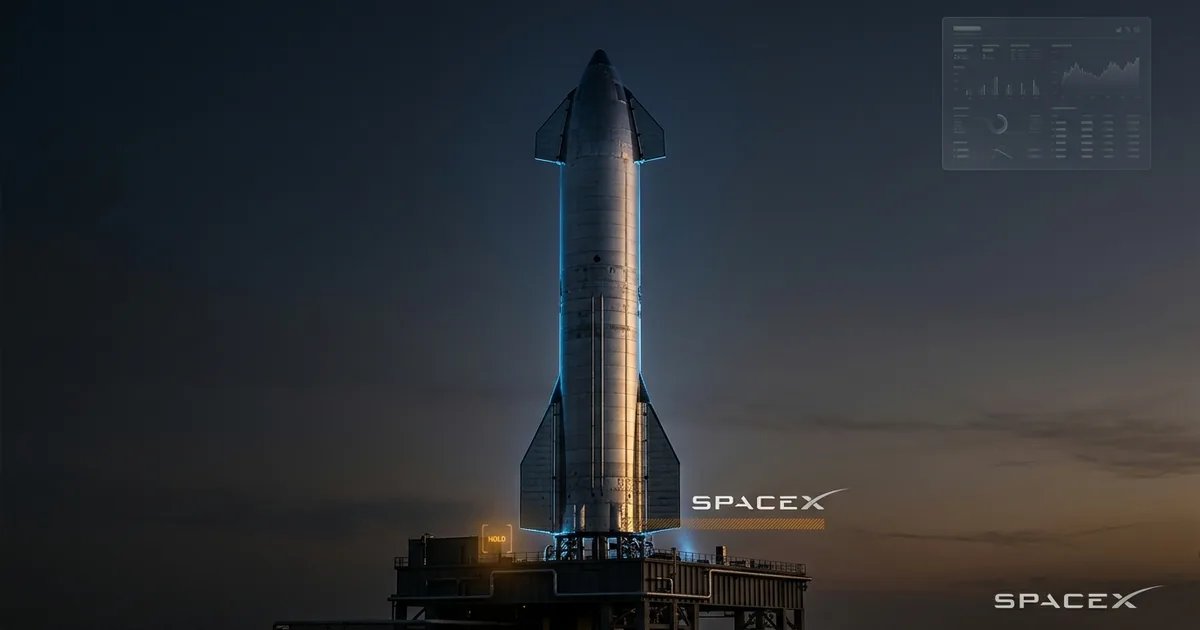
The Federal Aviation Administration grounded SpaceX’s next-generation Starship on May 27 and ordered a mishap investigation, just five days after the rocket’s debut flight. The timing is the part Wall Street will fixate on. SpaceX is widely reported to be lining up one of the largest public offerings in history, and the world’s most valuable private company just had its flagship vehicle parked by a regulator.
This is not a catastrophic failure by SpaceX’s own iterative standards, but it is a regulatory pause, and a pause has a cost when the clock is running toward a listing.
What Actually Happened on Flight 12
The first Starship V3, the largest version of the megarocket yet, lifted off from the company’s Starbase site in South Texas on May 22. The booster separated as planned, but its engines failed during the descent burn, and instead of the controlled splashdown SpaceX was targeting in the Gulf of Mexico, the booster came down hard. The FAA reported no injuries and no damage to public property, which matters both for the investigation and for the optics.
The upper stage, notably, did its job. The Starship spacecraft continued around the world, deployed 20 mock satellites, and finished with a fiery splashdown in the Indian Ocean. So the mission was a partial success: the payload-delivery half of the system worked, the reusable-booster half did not. For a program whose entire economic promise rests on full reusability, that is the half that needed to work.
Why a Grounding Is a Business Event, Not Just an Engineering One
The FAA said it will oversee the company-led investigation and must approve SpaceX’s final report and corrective actions before another Starship can fly. In plain terms, SpaceX does not control its own return-to-flight timeline. The regulator does. TechCrunch reported that the agency ordered SpaceX to investigate the V3 booster failure, and the open question is how long the review takes, not whether the rocket eventually flies again.
That distinction matters because Starship is not a side project. It is the vehicle meant to anchor Starlink’s next-generation satellite deployment, NASA’s lunar lander plans under Artemis, and the long-horizon Mars ambition that underpins a chunk of SpaceX’s narrative valuation. Every week Starship sits grounded is a week of deferred Starlink capacity and a data point for anyone trying to price the risk in the company’s mission profile. Spaceflight Now reported that the FAA requires the investigation to close before launches resume, which puts the cadence question squarely in regulatory hands.
The IPO Backdrop Changes the Calculus
Here is where the deal-room lens sharpens. SpaceX is reportedly preparing a public listing that bankers have floated at well above $1 trillion, potentially as soon as next month, a process our coverage detailed when the company’s trillion-dollar IPO plans first took shape. A grounded flagship rocket in the window before an offering is exactly the kind of headline that bankers building a valuation model do not want.
The counterargument is that SpaceX has trained the market to expect this. The company’s development philosophy is to fly, fail, fix, and fly again, and a booster mishap on a brand-new vehicle variant is closer to the plan than to a crisis. Investors who understand the iterative model will likely treat the grounding as noise. But an IPO opens the stock to a far broader pool of buyers who do not grade SpaceX on the test-flight curve, and a regulator-imposed pause reads very differently to a retail investor than to a propulsion engineer. The grounding will not derail the offering. It does add a line to the risk section.
What to Watch
The number that matters now is the length of the investigation. A quick turnaround, with corrective actions approved in weeks, lets SpaceX frame Flight 12 as a routine iteration on the path to reusability. A drawn-out review that slips toward the listing window starts to weigh on the story the company wants to tell new shareholders. Either way, the episode is a reminder that the most valuable private company on the planet still answers to a federal regulator, and that the gap between a test-flight setback and a market-moving event narrows sharply the closer you get to ringing the opening bell.