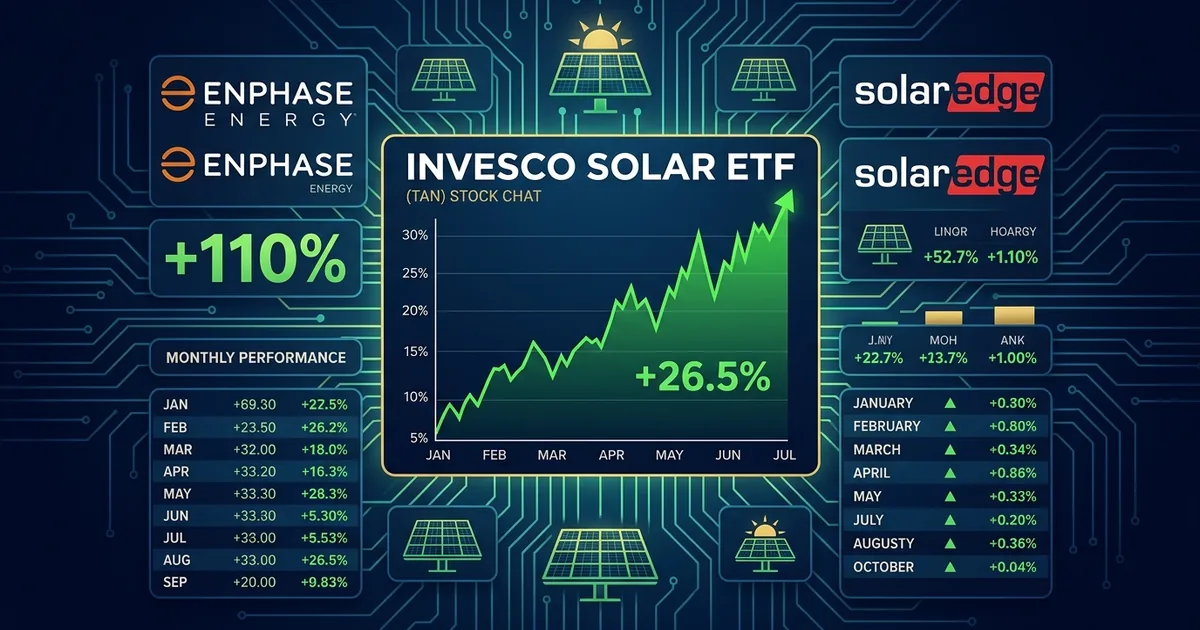
The Invesco Solar ETF surged roughly 26.5% in May, its strongest monthly performance in more than a decade, and the individual names underneath tell an even wilder story. Enphase Energy rallied more than 110%. SolarEdge jumped nearly 79%. After years of getting crushed by high interest rates and policy uncertainty, residential solar is suddenly the hottest corner of the market.
The Numbers That Matter
TAN, the benchmark Invesco Solar ETF, is on track to close May with its best monthly gain since September 2013, when it climbed about 27%. The rally has been broad rather than concentrated. Enphase Energy, the microinverter maker that had lost more than two-thirds of its value from 2023 peaks, surged past $71 per share after touching a fresh 52-week high of $72.21. SolarEdge Technologies, which had been left for dead below $30 earlier this year, popped 22% in a single session on May 15 and has nearly doubled from its 2026 lows.
Goldman Sachs lifted its Enphase price target to $57 on May 20, citing a recovery in residential solar installations and improving unit economics. The stock promptly blew through that target within a week.
What Is Driving the Rally
Three forces converged at once. First, residential solar demand in the United States has genuinely recovered. Installation volumes in Q1 2026 exceeded analyst expectations, and the forward pipeline looks stronger than at any point since the post-pandemic boom. The IRA’s residential clean energy tax credits remain intact, and homeowner adoption is accelerating as electricity prices climb and battery storage economics improve.
Second, the AI data center buildout is creating a secondary demand channel that barely existed two years ago. Microsoft committed to sourcing 100% clean energy for its data centers by 2030, and hyperscalers across the board are signing long-term power purchase agreements that include solar capacity. When the biggest tech companies in the world are competing for renewable energy contracts, the entire solar supply chain benefits.
Third, short interest in solar names had reached extreme levels. Enphase and SolarEdge were among the most heavily shorted stocks in the S&P 500 heading into May. As 24/7 Wall Street reported, the mid-May rally triggered a cascade of short covering that amplified the upside. When shorts unwind in a sector with thin float and high conviction, the moves get violent.
Why This Rally Is Different
Solar stocks have been a graveyard for momentum traders since late 2023. Rising interest rates crushed residential economics, the IRA’s implementation timeline created uncertainty, and Chinese panel oversupply hammered margins across the value chain. SolarEdge issued multiple profit warnings. Enphase saw installation volumes flatline. The solar ETF lost nearly half its value from 2023 to early 2026.
What changed is that the fundamental headwinds reversed simultaneously. Rate expectations have stabilized. The IRA credits are flowing. And the AI power demand story gave institutional investors a new reason to own solar exposure they had abandoned.
The Bigger Picture
The broader market context matters here. The S&P 500 closed its ninth consecutive week of gains on May 29, with the Nasdaq settling at 26,972. Technology led the charge, but the solar rally outperformed every other subsector in the market during May. That kind of relative strength, coming from a beaten-down sector with recovering fundamentals, is exactly the setup that attracts momentum capital.
The question now is whether the rally can sustain itself through a summer that will test both installation volumes and policy stability. The IRA credits are not going anywhere in the near term, but the political environment around clean energy subsidies remains volatile. For investors who have been waiting for a bottom in solar, May 2026 delivered the kind of month that forces a reassessment.
Whether it marks a durable inflection or a short-squeeze sugar high depends entirely on what Q2 earnings look like.
The Policy Wild Card
The Inflation Reduction Act’s residential clean energy credits remain the single most important policy variable for solar stocks. The credits are legislatively secure through 2032, but the political environment surrounding clean energy subsidies has grown more volatile under the current administration. Any credible threat to IRA funding would immediately reprice the entire sector downward.
For now, the legislative math favors stability. The credits have broad bipartisan support in the districts where solar installations are concentrated, and rolling them back would destroy jobs in red and purple states that benefit disproportionately from clean energy manufacturing investment. But politics and math do not always align, and solar investors have learned the hard way that policy risk is never fully priced in.
The May rally rewarded patience and conviction in a sector most of Wall Street had written off. The next test is whether the fundamentals can keep pace with the expectations the stock prices now embed.