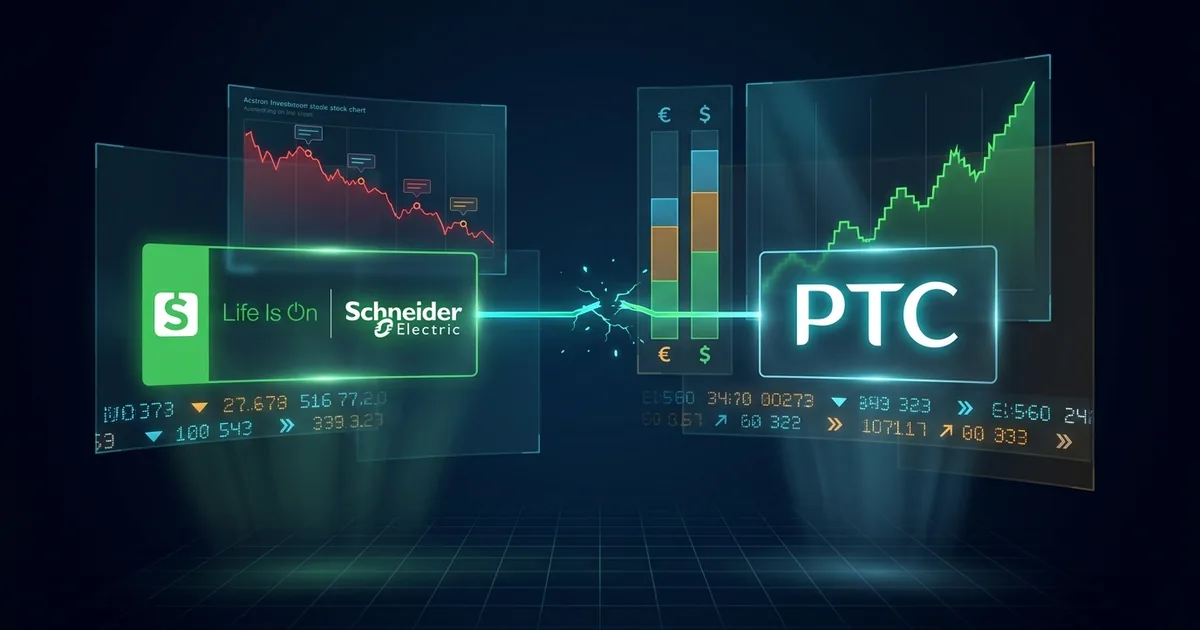
The pitch. “The acquisition of PTC represents an important step forward in our ambition to lead the new era of Energy and Industrial Intelligence.” Olivier Blum, Schneider Electric chief executive, Monday.
The answer. Schneider shares fell 9.97% to €272.80 in Paris the same day. About €15 billion of market value, gone by the close. Another 1.4% went on Tuesday morning.
Schneider Electric agreed on Monday to pay $205 a share in cash for PTC, the Boston engineering-software company. The Boston Globe put the equity value at $22.6 billion, a 42.3% premium to PTC’s Friday close. In dollars, that premium is roughly $6.7 billion. Schneider then lost about €15 billion of its own value in a single session, by TIKR’s count, or close to $17 billion at the exchange rate in the deal’s own terms.
That is more than twice the premium. Every account of the deal has led with the 10% drop and the argument over industrial AI. None has put the two numbers next to each other. Read plainly, investors decided the transaction costs Schneider more than the entire amount it is paying above PTC’s market price.
The Math Schneider Published
The case for the price sits in Schneider’s own deck, and it leans on the softest line in it. Here are the terms as Schneider disclosed them, summarized by MarketBeat, alongside the market’s reply.
| Line item | Figure |
|---|---|
| Price per PTC share | $205 cash |
| Premium to PTC’s October 2 close | 42.3%, roughly $6.7 billion (BTN calculation) |
| Schneider market value lost on October 5 | About €15 billion, close to $17 billion |
| Price vs. 2027 adjusted EBITA, before savings | 21 times |
| Same multiple with full run-rate targets | 13 times |
| Annual cost savings target | €250 million, with €250 million in one-time costs |
| Revenue target from cross-selling | €800 million |
| Funding | €16 to €17 billion senior debt, €5 to €6 billion new shares |
| Share buybacks | Paused through 2027 and 2028 |
| Expected close | Third quarter of 2027 |
Most of the distance between 21 times and 13 times is that €800 million of cross-selling revenue. The cost savings alone only bring the multiple to about 17 times, according to TIKR’s breakdown, and they cost as much to achieve as they save in a year. Revenue from cross-selling is the line in any merger deck that most often fails to arrive. Schneider’s own projection is that the deal earns more than its cost of capital “by year five, including full run-rate synergies.” Year five, with everything going right.
Shareholders also pay twice. They absorb up to €6 billion of new stock, and they give up two years of buybacks while the debt comes down. Net debt roughly doubles to €32 billion to €33 billion, by TIKR’s estimate.
JPMorgan’s Phil Buller cut the stock from overweight to neutral on Tuesday and his target from €345 to €310, according to a dpa-AFX note on the downgrade. His reasoning is the more useful part. He called PTC a good asset and the selloff exaggerated, but said his thesis rested on organic growth in energy management, and this deal pulls Schneider deeper into industrial automation, the less attractive half of the business. He now prefers Legrand. Reuters Breakingviews columnist Liam Proud put the same worry more sharply: the deal “takes an unambiguous AI winner and mixes in a possible loser.”
This is not Schneider’s first run at the category. It took control of AVEVA in 2017 and bought out the rest in 2023, and its talks with Bentley Systems, another US engineering-software maker, ended without a deal in May 2024. PTC is the target it finally landed, at the top of the price range.
Two Markets, Two Verdicts
Picture the trader who bought PTC at Monday’s close of $192.26. If the deal closes on schedule, that trader collects $205 a share sometime around the third quarter of 2027, a gross return of about 6.6% for waiting roughly a year. That is a thin cushion over risk-free money at a moment when the 10-year Treasury yield is sitting near its highest level since 2002. Nobody accepts that spread on a deal they expect to fall apart. The arbitrage desk is saying the transaction will happen. Schneider expects a review by the Committee on Foreign Investment in the United States and does not anticipate major issues, and PTC holders need only a simple majority to approve it.
Put the two prices together and the message is uncomfortable for Schneider’s owners. One market says this deal is going to close. The other says Schneider is overpaying. Both can be right at once, and that is the worst combination for the people funding it.
Our view: the strategy is defensible and the price is not, at least not on the evidence Schneider has shown. Pairing the company that supplies power and cooling to the AI build-out with the software that designs factories and products is a coherent idea. Paying 21 times earnings for it, and justifying the gap with cross-selling revenue nobody can audit, is a request for trust that Schneider has not earned on this file. Blum should publish the €800 million revenue target as dated annual milestones with a named owner, and the board should tie long-term pay to hitting them. Shareholders are funding this deal twice, through dilution and through the buyback pause. If the revenue plan is real, putting dates on it costs nothing.
Schneider reports third-quarter results on October 16. That is the first chance for Blum to answer the €15 billion question with numbers instead of a vision statement.