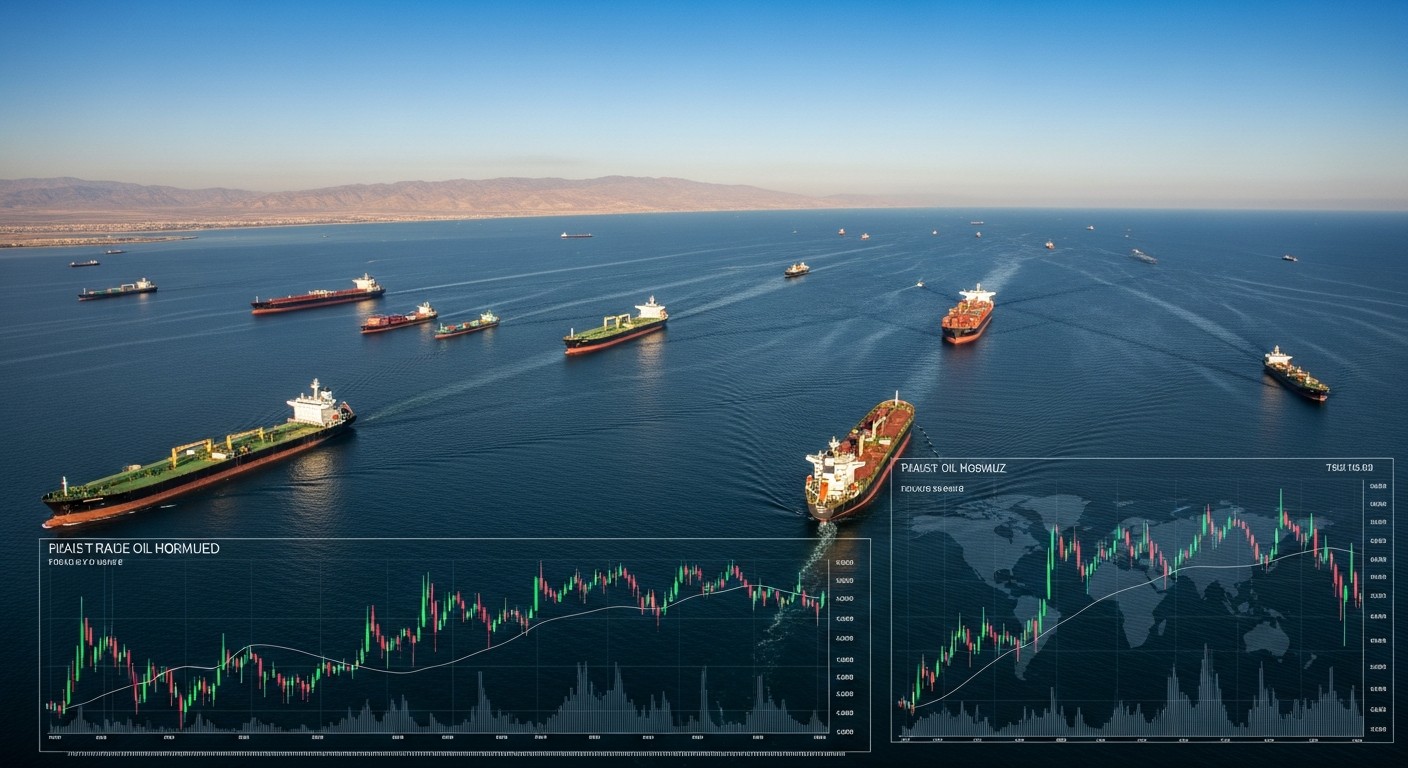
Wall Street got exactly what it wanted on Friday, and it reacted accordingly. The S&P 500 punched to a fresh intraday record, the Nasdaq Composite printed its own high, and the Dow tacked on roughly 1% after President Donald Trump’s two-week Iran ceasefire held and Tehran declared the Strait of Hormuz “completely open” for commercial shipping. Brent crude, which had been the market’s trap door for most of the last month, fell more than 10% on the week.
The relief rally is real. Whether it’s durable is a different story.
The Relief Rally, By The Numbers
For risk assets, this was the cleanest setup in weeks. The S&P 500 climbed back above 7,000 and notched another record close. Tech led, with the Nasdaq 100 vaulting higher as software names that had been clipped during the Hormuz closure ripped back. Small caps, the purest play on “the world is not ending,” joined in, and the Russell 2000 outperformed. Volatility collapsed. The VIX, which had spiked above 30 during the peak of the blockade chatter, rolled back down toward the high teens.
Credit traders noticed, too. High-yield spreads tightened, emerging markets caught a bid, and the dollar slid against every major peer as global investors rotated out of the haven trade. Even gold, the tourist favorite of the war-premium crowd, gave some back. This is what a textbook risk-on tape looks like when a geopolitical tail risk gets pulled off the board, or at least moved further down the table.
Oil’s Whiplash Moment
Energy was the other half of the trade, in reverse. Brent and WTI both sank as Iranian Foreign Minister Abbas Araghchi confirmed passage through Hormuz would resume, and U.S. officials signaled the blockade of Iranian ports would stay in place only as long as Tehran keeps its end of the truce. Roughly a quarter of the world’s seaborne oil moves through that strait on any given day, which is why a fully shut Hormuz is a once-in-a-generation event and why its reopening is worth several dollars a barrel almost automatically.
Energy equities got the expected haircut. ExxonMobil, Chevron, and the oilfield services names that had been the quarter’s quiet winners gave back gains. Refiners, by contrast, held up better. Cheaper crude and open shipping lanes are, for most of the downstream complex, a tailwind on margins rather than a body blow.
The Fine Print On Hormuz
Here is the part investors would be smart to read closely.
Iran’s declaration that the Strait is “completely open” came with a caveat from Tehran, with Araghchi saying passage is possible “via coordination with Iran’s armed forces.” Trump’s camp framed it differently, insisting the U.S. naval blockade on Iranian ports “will remain in full force” until a broader peace deal is signed. Neither side is wrong, exactly, and neither side is lying. They are simply describing two versions of the same agreement, which is the kind of ambiguity that makes shipping underwriters nervous and lets Lloyd’s charge war-risk premiums that pad the margin sheet for another quarter.
In practice, tankers are moving. Brokers in Singapore and Fujairah reported a jump in fixtures this week. But the ceasefire is structured as a short-term pause, brokered with assistance from Pakistani Prime Minister Shehbaz Sharif, and it expires unless extended. That is not a peace treaty. It is a commercial ceasefire with a clock on it, and the clock is already ticking.
Trump’s Playbook, Revisited
If this all feels familiar, it should. Trump’s second-term foreign policy has settled into a rhythm traders are starting to price: maximum public pressure, private dealmaking, a televised breakthrough, and a market rally that lets him claim the win. The Iran arc fits the pattern exactly. The threat of strikes on “Iran’s whole civilization” was extreme. The pullback, conditional on Hormuz, was surgical. The optics, predictably, favor the White House.
The risk for investors is the same risk that always accompanies this kind of diplomacy. It is personality-driven. There is no institutional framework to fall back on if the principals walk. When “deal guy” governance works, it produces fast outcomes like the one lifting stocks today. When it breaks, it breaks abruptly. The S&P does not like abruptness.
What Could Break The Rally
Three things are worth watching.
First, the ceasefire itself. A two-week pause is a test balloon. If Iran is caught hedging on the Strait, or if the parallel Israel-Lebanon truce Trump announced this week frays, the whole structure can unwind inside a single news cycle. Oil would be the first to react. Equities would follow, and the rotation back into defensives could be violent.
Second, the blockade. The U.S. is still squeezing Iranian ports, which means Iran’s export economy is effectively on pause. That is a political cost Tehran cannot absorb indefinitely. Expect a fight over sequencing. Iran wants the blockade lifted in exchange for Hormuz, the U.S. wants the blockade in place until a real agreement is inked. If that trade breaks down, so does the truce.
Third, the Fed. Lower oil helps the disinflation story, which feeds rate-cut expectations, which is a meaningful chunk of this rally’s math. A reversal in crude flips that back the other way. Markets have a habit of treating peace as a permanent input when it is often a temporary one, and the current price structure is leaning hard on the permanent version.
The Bottom Line For Investors
The truce is good news. The Strait reopening is better news. Records in the S&P and Nasdaq are, on balance, the correct response to a world where roughly a quarter of seaborne oil just got un-stuck.
But a two-week pause is a two-week pause. Investors using this week’s rally to add exposure to economically sensitive sectors, semis, industrials, small caps, and transports, should be honest with themselves about what they are pricing. They are pricing the continuation of a political arrangement that has an explicit expiration date stapled to it.
For now, Wall Street is betting that Trump gets an extension. That is a rational bet. It is also a bet, not a fact, and the difference between the two tends to show up in portfolios only after the tape has already turned.