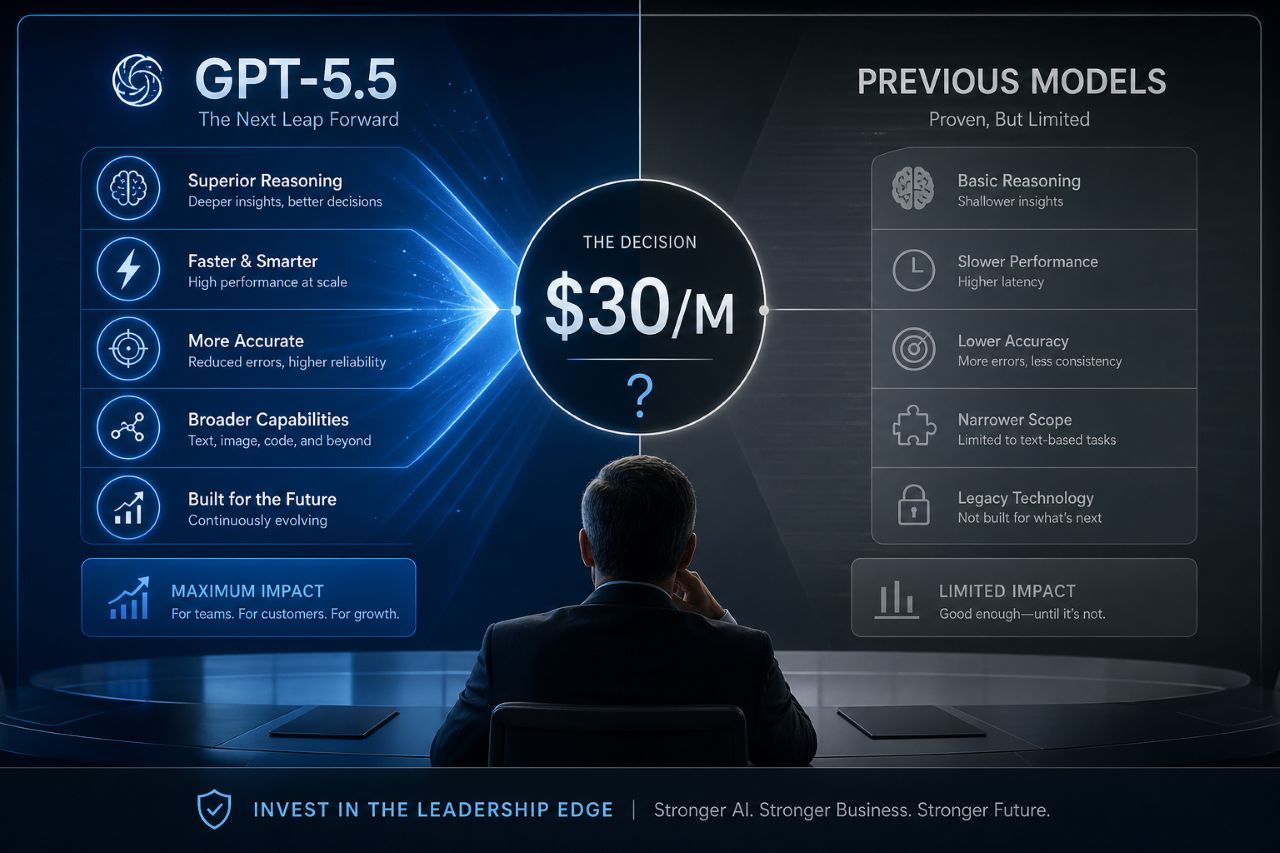
OpenAI dropped GPT-5.5 on April 23, 2026, calling it a “new class of intelligence.” Greg Brockman, OpenAI’s president, told reporters it’s “a big step towards more agentic and intuitive computing.” But here’s what matters: at double the API price of GPT-5.4, does this model actually deliver enough value to justify the cost?
After digging through the benchmarks, early deployment data, and real-world testing from companies already using it, the answer is more nuanced than OpenAI’s marketing suggests.
The Numbers That Actually Matter
GPT-5.5 improves on 9 of the 10 shared benchmarks, with +11.7pp on ARC-AGI-2, +8.1pp on MCP Atlas, and +7.6pp on Terminal-Bench 2.0. Those might sound like abstract metrics, but Terminal-Bench 2.0 measures real coding ability — the kind that determines whether your engineering team ships features faster or burns money on API calls.
For API developers, gpt-5.5 will soon be available in the Responses and Chat Completions APIs at $5 per 1M input tokens and $30 per 1M output tokens, with a 1M context window. gpt-5.5-pro in the API for even higher accuracy, priced at $30 per 1M input tokens and $180 per 1M output tokens.
Here’s the twist: according to benchmarking service Artificial Analysis, the model uses about 40 percent fewer tokens, bringing the net price hike down to roughly 20 percent. That changes the math significantly.
Where GPT-5.5 Dominates (And Where It Doesn’t)
Coding: The Killer App
Terminal-Bench 2.0 shows GPT-5.5 scoring 82.7% — that’s not just incrementally better, it’s a different tier of capability. In our early testing, GPT-5.5 delivers its strongest performance on complex, multi-step agentic coding task and resolves real-world coding challenges previous GPT models couldn’t.
GitHub Copilot moved fast on this. GPT-5.5, OpenAI’s latest GPT model, is now rolling out on GitHub Copilot. But here’s the catch: Note that this model is launching with a 7.5× premium request multiplier as part of promotional pricing.
Knowledge Work: Your New Digital Employee
On GDPval, which tests agents’ abilities to produce well-specified knowledge work across 44 occupations, GPT-5.5 scores 84.9%. On OSWorld-Verified, which measures whether a model can operate real computer environments on its own, it reaches 78.7%.
Think about that. The model can operate computer environments autonomously at nearly 80% success rate. We’re not talking about chatbots anymore — we’re talking about digital workers.
The Achilles’ Heel: Hallucinations
On Artificial Analysis’ AA Omniscience benchmark, which rewards factual recall and penalizes wrong answers, GPT-5.5 posts the highest accuracy of any model at 57 percent. But its hallucination rate sits at 86 percent, compared to 36 percent for Claude Opus 4.7 and 50 percent for Gemini 3.1 Pro Preview.
That’s a red flag for any business use case where accuracy matters more than speed. If you’re deploying this for legal analysis or medical documentation, that 86% hallucination rate should make you pause.
The Real Business Case
Forget the benchmarks for a second. Here’s what businesses are actually seeing:
The most striking gain is the token consumption reduction, directly tied to the Tool Search feature. GPT-5.4 selects the right tools without needing everything in the prompt. The number of tool calls increases, but total consumption drops because the model is more surgical in its selections.
One investment fund using GPT-5.4 (the previous model) reported: the performance gains on modeling tasks are real (87.3% on the Investment Banking Modeling benchmark, up from 68.4% for GPT-5.2), but the cost-to-benefit ratio only makes sense for high-stakes tasks where a reasoning error costs more than the API bill itself.
The Competition Isn’t Standing Still
GPT-5.5 tops the Artificial Analysis Intelligence Index with 60 points, three points ahead of Claude Opus 4.7 and Gemini 3.1 Pro Preview, which are tied at 57. At medium compute, GPT-5.5 matches the score Claude Opus 4.7 puts up at maximum for a quarter of the cost: around $1,200 instead of $4,800. Google’s Gemini 3.1 Pro Preview hits comparable numbers even cheaper, at around $900.
But benchmarks don’t tell the whole story. Our tests and developer feedback suggest Gemini mainly shines at everyday versatility across Google products and at vision tasks, while the latest OpenAI and Anthropic models tend to outperform it on coding and agentic work.
Should You Switch? The Decision Framework
Here’s the brutal truth: GPT-5.5 is remarkable technology wrapped in complicated economics. The 2x price increase is real, but so is the efficiency gain. Whether it makes sense depends entirely on your use case.
Switch to GPT-5.5 if:
- You’re building agentic coding systems where The gains are especially strong in agentic coding, computer use, knowledge work, and early scientific research—areas where progress depends on reasoning across context and taking action over time.
- Your workflows involve complex, multi-step tasks where GPT-5.5’s ability to “understand what you’re trying to do faster” translates to real time savings
- Token efficiency matters more than raw per-token cost (high-volume applications)
- You need state-of-the-art performance on Terminal-Bench or similar coding benchmarks
Stick with GPT-5.4 if:
- Your use cases are straightforward Q&A or content generation
- Hallucination rates are a dealbreaker (financial analysis, legal work)
- You’re cost-sensitive and the 20% effective price increase doesn’t justify the performance gains
- You’re waiting for API access — No. Not as of April 24, 2026. OpenAI says API access is “coming very soon,” without a date.
The Bottom Line
GPT-5.5 represents a specific bet: that businesses will pay premium prices for models that act more like digital employees than question-answering machines. Instead of carefully managing every step, you can give GPT-5.5 a messy, multi-part task and trust it to plan, use tools, check its work, navigate through ambiguity, and keep going.
The model delivers on that promise — with caveats. The hallucination problem remains unsolved. The pricing requires careful ROI analysis. And despite OpenAI’s “new class of intelligence” rhetoric, this is evolution, not revolution.
But here’s what should keep enterprise leaders up at night: ChatGPT also has more than 900 million weekly active users and over 50 million subscribers. Your competitors are already using this. The question isn’t whether AI will transform your business — it’s whether you’ll be the one driving that transformation or playing catch-up.
GPT-5.5 isn’t magic. It’s a tool. But in the hands of teams who understand its strengths and limitations, it’s a tool that can deliver measurable business value. Just make sure you’re measuring the right things.