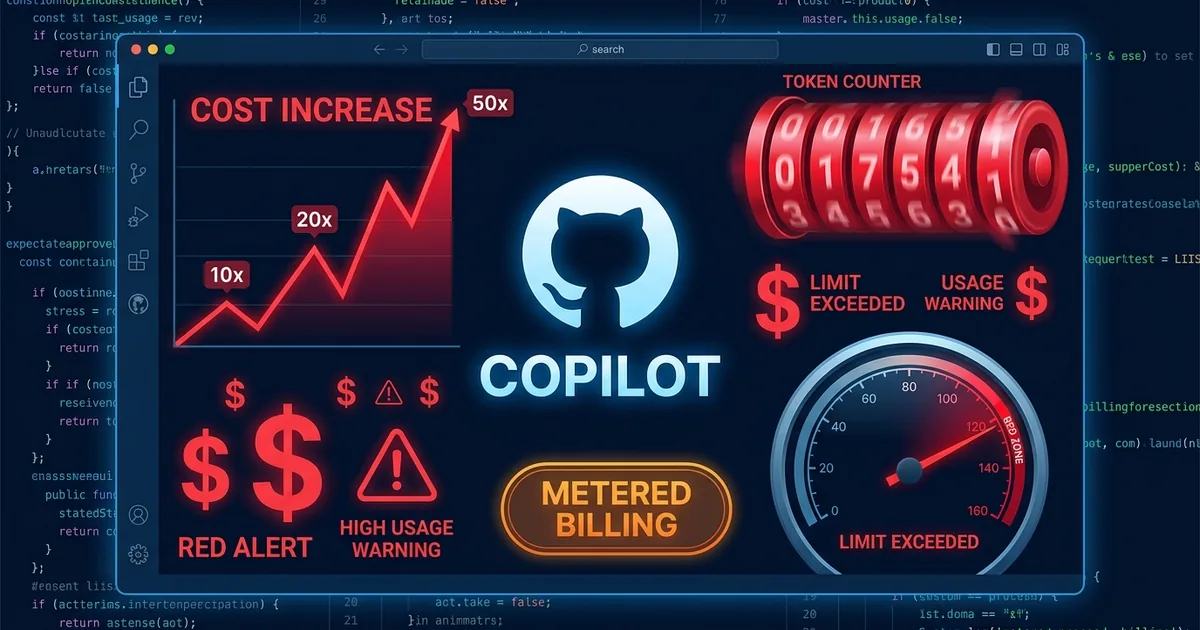
June 30 marks the end of GitHub Copilot’s first full 30-day token billing cycle, and the bills are arriving at 10x to 50x what developers used to pay.
From Flat Rate to Open Meter
GitHub flipped Copilot to usage-based billing on June 1, 2026, replacing the $10 to $39 monthly flat-rate plans that had made the AI coding assistant a no-brainer line item for individual developers and enterprise teams alike. Every Copilot plan now includes a monthly allotment of GitHub AI Credits, with usage calculated based on token consumption, including input, output, and cached tokens, at published per-model API rates. One credit equals one cent. Every interaction that uses Copilot’s chat, agent mode, code review, or the CLI draws from that balance.
The problem is that GitHub’s own research published in May found that agentic coding tasks can consume roughly 1,000 times more tokens than standard single-turn queries. Developers who leaned into Copilot’s most powerful features, the multi-step autonomous tasks and premium frontier model access via GPT-5.6 and Claude Opus 4.8, are now staring at bills that make the old flat rate look like a rounding error.
The Numbers Are Brutal
Developers across GitHub’s community forums and social media are reporting projected bills jumping from $29 to $750 and from $50 to $3,000 for the same workflows they ran last month. The cost driver is not casual autocomplete suggestions. It is the agentic sessions: multi-file refactors, automated code reviews via GitHub Actions, and long-running autonomous tasks that churn through tokens at industrial scale.
The Register reported that developers began threatening to flee the platform within days of the transition, and the backlash has only intensified as the first billing cycle approaches its close. Without a hard spending cap set before July 1, when the second metered cycle begins, there is no default limit on what developers may be charged.
Why GitHub Made the Switch
The business logic, from GitHub’s perspective, is straightforward. Flat-rate pricing on a product whose marginal cost scales with model inference volume is a money-losing proposition at scale, especially as the underlying AI models get more capable and more expensive to run. GitHub was reportedly subsidizing heavy Copilot users at a loss, and the gap widened every time a new frontier model was added to the platform.
The shift to metered billing aligns GitHub with the broader trend across AI infrastructure: OpenAI, Anthropic, Google, and every major model provider charge by the token. GitHub is simply passing that cost structure through to end users rather than absorbing it. The framing on GitHub’s blog announcement emphasized transparency and predictability, but developers experienced neither when they opened their usage dashboards this month.
The Competitive Opening
The timing creates an immediate opportunity for competitors. The AI coding market has attracted billions in venture capital, with Cursor’s valuation doubling to $50 billion earlier this year and Apple integrating multi-model agentic coding into Xcode 27 at WWDC. Developers who built muscle memory around Copilot now have a financial incentive to evaluate alternatives that still offer flat-rate or bundled pricing.
The enterprise calculation is different but equally disruptive. Companies that standardized on Copilot for engineering teams of hundreds or thousands of developers now face procurement conversations where the total cost is unpredictable. IT leaders who approved a known monthly line item cannot approve an open-ended metered commitment without spending controls that GitHub has not yet shipped.
What Happens Next
July 1 marks the start of the second billing cycle, and GitHub has signaled that spending caps and improved usage dashboards are coming but has not committed to specific dates. The window between now and whenever those controls ship is the danger zone: developers who do not manually set budget limits face another month of uncapped token charges.
The deeper question is whether metered billing will reshape how developers use AI coding tools entirely. If the cost of running an agentic coding session on a complex refactor is $50 to $100 per run, developers will start treating those sessions the way they treat cloud compute, as a resource to be budgeted, monitored, and optimized rather than used freely. That behavioral shift would be the most consequential outcome of the pricing change, turning AI-assisted coding from an always-on capability into a sometimes capability gated by budget approval.
For GitHub, the bet is that the productivity gains are valuable enough that developers will pay the real cost once they see it clearly. For developers, the first bill will determine whether that bet is right.