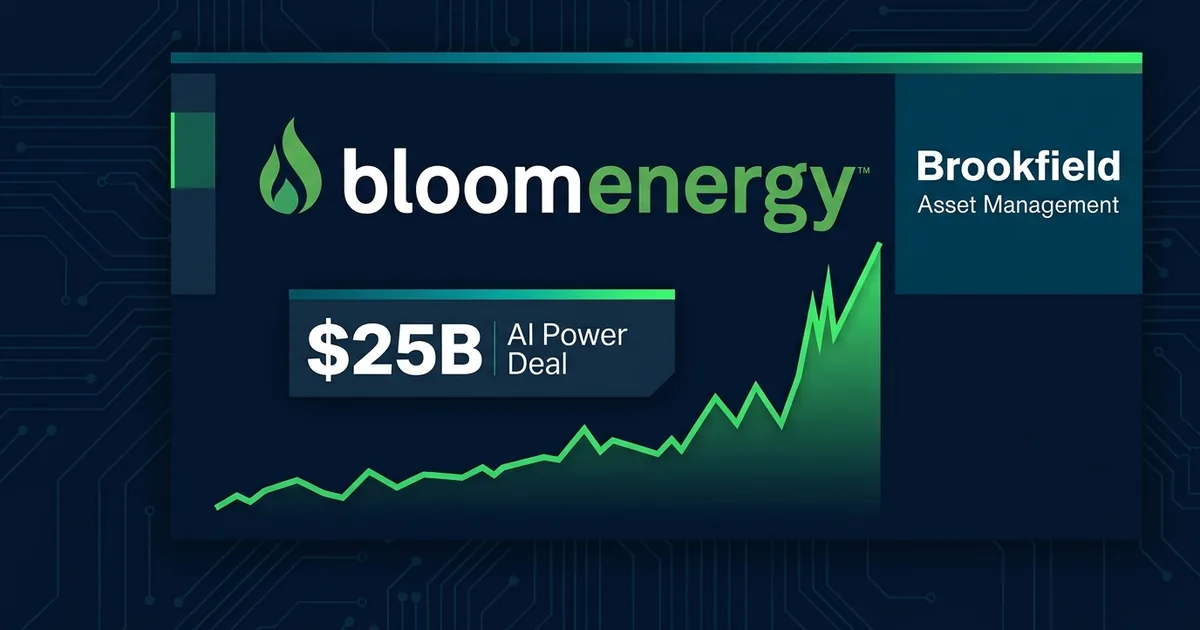
Bloom Energy just landed the kind of deal that turns a fuel cell company into an AI infrastructure play overnight. Brookfield Asset Management quintupled its power financing partnership with Bloom from $5 billion to $25 billion on Tuesday, and the market rewarded the move with a 20% single-day stock surge that pushed shares past $330 in after-hours trading.
The Deal That Changed Bloom’s Trajectory
The expanded partnership, first announced by Bloom Energy and Brookfield on July 1, will finance and deploy Bloom’s solid oxide fuel cell systems at hyperscale data center campuses across the United States. The original $5 billion commitment launched in October 2025 was already ambitious. Multiplying it by five signals that Brookfield sees Bloom’s on-site power generation as a critical piece of the AI infrastructure puzzle, not a niche experiment.
The logic is straightforward: AI data centers need power faster than the grid can deliver it. Utility interconnection queues now stretch three to five years in most U.S. markets. Bloom’s fuel cells can be deployed in months, not years, generating electricity on-site from natural gas or hydrogen without waiting for a substation upgrade or a new transmission line. For hyperscalers racing to bring GPU clusters online before their competitors, that speed premium is worth paying for.
Why the Market Moved
Bloom Energy shares closed up 10% at $302.70 during the regular session before climbing another 9% to $330.57 after hours. The move reflects more than the headline number. A $25 billion financing commitment effectively de-risks Bloom’s revenue pipeline for years, giving the company a captive demand channel that insulates it from the traditional boom-bust cycles of the clean energy sector.
The AI power bottleneck is real and growing. GE Vernova recently disclosed that its gas turbine order book is sold out through 2031, a signal that conventional power generation capacity cannot keep pace with data center demand. That shortage creates an opening for alternative power providers like Bloom, whose modular fuel cell architecture can scale incrementally without the multi-year permitting and construction timelines that constrain traditional power plants.
Bloom Is Not Alone in the AI Power Rush
The Brookfield expansion landed the same week that Britain’s National Grid Ventures committed $1.75 billion for a 35% stake in Joulent, a U.S. energy platform developing contracted power infrastructure for large-load AI demand. National Grid’s investment will support Joulent’s flagship Project Kilby, a 2.67-gigawatt gas-fired facility in West Texas built to supply a Microsoft-operated data center under a 20-year power purchase agreement.
Meanwhile, KKR’s Helix Digital Infrastructure launched last month with $10 billion in commitments from KKR, Kuwait’s sovereign wealth fund, Nvidia, and Vistra to build integrated power and data center infrastructure. Former AWS CEO Adam Selipsky is running the operation, a hire that signals how seriously institutional capital is taking the AI power thesis.
The Business Model Shift
What makes the Bloom deal structurally different from a traditional energy financing is the customer profile. Hyperscale data center operators sign long-term power purchase agreements with predictable consumption curves, unlike the intermittent demand patterns that plague residential and commercial energy projects. For Brookfield, that translates into infrastructure-grade cash flows backed by the balance sheets of the world’s largest technology companies.
For Bloom, the partnership effectively converts a hardware company into a power-as-a-service platform. Instead of selling fuel cells as capital equipment and hoping customers reorder, Bloom can deploy systems under Brookfield-financed contracts where the revenue accrues over years, not quarters. That recurring revenue model is exactly what Wall Street rewards with higher multiples.
What Comes Next
The competitive question is whether Bloom can maintain its deployment speed advantage as the market scales. Nuclear microreactors, modular gas turbines, and battery storage systems are all competing for the same data center power budgets. Bloom’s solid oxide fuel cells offer higher electrical efficiency than conventional generators, typically 60% versus 40% for a combustion turbine, but they come with higher capital costs per kilowatt.
The $25 billion Brookfield commitment suggests that, for now, the speed-to-power argument is winning. In a market where every month of delay in bringing a data center online represents hundreds of millions in lost AI training and inference revenue, the company that can deliver electrons fastest holds the advantage. Bloom just locked in the capital to prove it can.