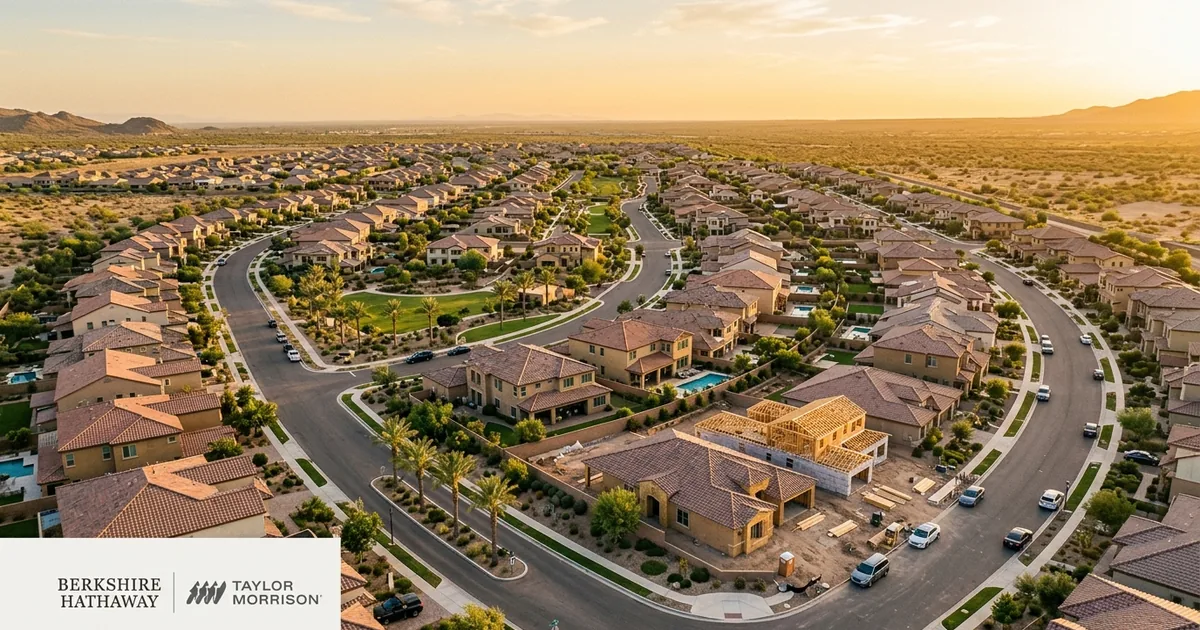
Warren Buffett’s successor just made his opening move. Berkshire Hathaway announced on Monday that it will acquire homebuilder Taylor Morrison for $72.50 per share in cash, a deal valued at approximately $6.8 billion in equity and $8.5 billion including debt. Taylor Morrison shares surged 23% on the news, and the acquisition marks the first significant purchase under CEO Greg Abel, a signal that Berkshire’s dealmaking appetite has survived the leadership transition intact.
The Deal Terms
The $72.50 per-share price represents a 24% premium to Taylor Morrison’s closing price of $58.50 on May 29. The deal is expected to close in the second half of 2026, subject to shareholder approval and regulatory clearance. Berkshire is paying all cash, which is exactly what you would expect from a company sitting on one of the largest cash piles in corporate history.
Abel’s statement was characteristically understated. “We are excited to welcome Taylor Morrison into Berkshire’s portfolio,” he said, adding that “over time, we expect to unify our site-built homebuilding operations into a combined platform.” That last phrase matters: Berkshire already owns Clayton Homes, the nation’s largest manufactured-housing company. Taylor Morrison builds site-constructed homes in 11 states, giving Berkshire a two-pronged position across both the manufactured and traditional housing markets.
Why Housing, Why Now
The timing is a statement about where Berkshire sees value. The US housing market has been structurally undersupplied for a decade, and demographic tailwinds from millennial family formation are accelerating demand at exactly the moment when construction costs have stabilized after years of inflation-driven spikes. Mortgage rates remain elevated, but that has not killed demand; it has shifted the market toward new construction, where builders can offer rate buydowns that existing homeowners cannot.
Taylor Morrison is a premium play. The company operates in high-growth Sun Belt markets including Arizona, Texas, Florida, and the Carolinas, where population inflows continue to outpace housing starts. Its average selling price runs above $500,000, positioning it in the move-up buyer segment that is less sensitive to rate fluctuations than the entry-level market.
Real Estate News reported the deal as a vote of confidence in the US housing market, noting that Berkshire’s willingness to pay a 24% premium suggests the company sees significant upside in the sector over the next five to ten years.
The Abel Signal
Every first major acquisition by a new CEO carries outsized symbolic weight. Abel chose housing over technology, energy, or financial services. That tells you something about Berkshire’s priorities under its new leadership: real assets with predictable cash flows, operating in markets with structural supply deficits, at prices that leave room for compounding.
The deal also reveals Abel’s integration philosophy. Unifying Clayton Homes and Taylor Morrison into a single homebuilding platform would create a company with reach across every price point and construction method in the residential market. The operational synergies, from shared procurement to unified land acquisition, are tangible in ways that many tech acquisitions are not.
Market Reaction and Competitive Impact
Taylor Morrison’s 23% jump was the headline, but the ripple effects hit the broader homebuilder sector. Shares of D.R. Horton, Lennar, and PulteGroup all ticked higher on the theory that Berkshire’s entry validates current valuations and could trigger further consolidation. The homebuilder ETF (XHB) rose 1.2% on Monday.
For Berkshire’s own sprawling portfolio of businesses, the Taylor Morrison addition fits the classic Buffett template: buy a well-run business in a sector you understand, pay a fair price, and hold it effectively forever. Abel is running the same playbook, just with his own signature on the check.
What Investors Should Watch
The key question is whether the 24% premium will hold up through the regulatory review process and what multiples other homebuilders will command in the wake of this deal. If Berkshire is willing to pay $8.5 billion enterprise value for Taylor Morrison, then comparable builders with similar margins and market positions are likely undervalued at current trading levels.
The housing thesis is straightforward: America needs more homes than it is building, the companies that build them generate substantial free cash flow, and Berkshire just confirmed that with the largest homebuilder acquisition in years. ## The Bigger Picture
Berkshire’s move into traditional homebuilding comes at an inflection point for the sector. The US is estimated to be short roughly 4 million housing units, a deficit that cannot be closed without significant new construction over the next decade. Builders with established land banks and efficient construction pipelines are positioned to capture outsized share of that demand, particularly in Sun Belt states where zoning is more permissive and population growth shows no sign of slowing.
For the market, the message is clear: the Abel era is open for business, and Berkshire’s cash is going to work.