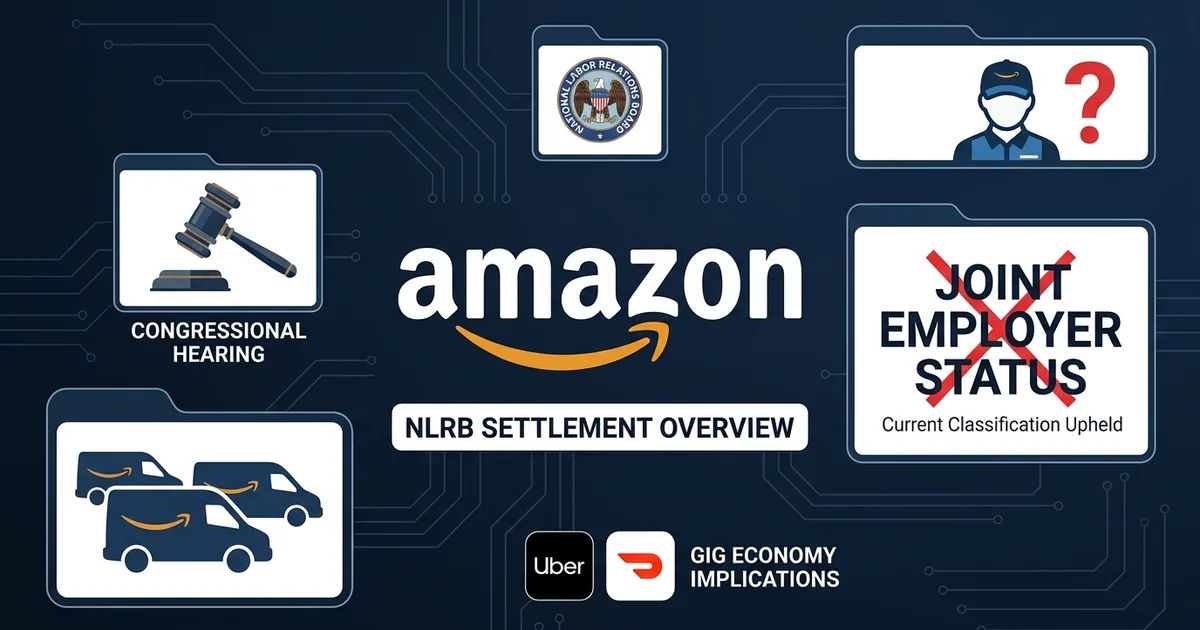
The Trump administration’s labor board just offered Amazon a way out of one of the most consequential employment cases in American corporate history, and the price was remarkably cheap. Crystal Carey, the National Labor Relations Board’s general counsel, defended her proposed settlement of the landmark Amazon delivery driver case before a House subcommittee on June 4, and the terms revealed how dramatically the regulatory landscape has shifted.
What Amazon Gets, and What Workers Lose
The proposed settlement would require Amazon to provide roughly two weeks’ worth of pay to dozens of drivers employed by Battle-Tested Strategies, one of Amazon’s former “delivery service partners.” In exchange, Amazon would not be required to admit to any unfair labor practices. More critically, the company would not be found liable as a joint employer of the drivers.
That last point is the real prize. If the NLRB had ruled Amazon was a joint employer, it would have established precedent applying to the company’s entire delivery network of roughly 275,000 drivers across thousands of delivery service partners. The business model that allows Amazon to control almost every aspect of how packages are delivered, from routing algorithms to uniform requirements to performance metrics, while classifying the drivers as employees of small independent contractors, would have faced a direct legal challenge.
Instead, Amazon gets to keep its contractor structure intact for what The American Prospect described as the cost of a rounding error on a single quarter’s earnings.
The Conflict of Interest Question
Representative Ilhan Omar pressed Carey on the most uncomfortable aspect of the settlement: Carey’s own professional history. Before becoming the NLRB’s general counsel under the Trump administration, Carey represented Amazon as a private attorney. She told the subcommittee she was not required to recuse herself from the case, a position that drew sharp criticism from labor advocates and congressional Democrats.
The optics are difficult to defend. The government’s top labor prosecutor, whose former client is the target of the government’s case, proposed a settlement that the target’s critics describe as a giveaway. Whether or not a formal recusal obligation exists, the arrangement raises the kind of revolving-door questions that have prompted broader congressional scrutiny of the NLRB’s direction under the current administration.
A Broader Rollback of Joint Employer Standards
The Amazon settlement does not exist in isolation. In April 2026, the NLRB’s Republican majority reinstated the joint employer standard from Trump’s first term, rolling back a Biden-era rule that had significantly broadened which companies could be held jointly liable for labor violations by contractors, franchisees, and staffing agencies.
The Biden rule, had it survived, would have exposed companies across the franchise and gig economy to joint employer claims whenever they exercised “indirect” or “reserved” control over working conditions. That standard threatened business models at McDonald’s, Uber, Lyft, DoorDash, and dozens of staffing firms, not just Amazon.
The rollback means companies can maintain granular control over how contractors perform work, including setting schedules, monitoring performance in real time, dictating appearance standards, and controlling routing, without triggering joint employer liability. The practical effect is that the workers most subject to corporate control are the ones least protected by labor law.
What This Means for Amazon’s Business Model
Amazon’s delivery service partner program is one of the most sophisticated contractor structures in American business. The company recruits small business owners to start delivery companies, provides them with branded vans, routes, and technology, sets performance standards, and can terminate the relationship if those standards are not met. The drivers wear Amazon uniforms. They drive Amazon-branded vehicles. They follow Amazon’s routing software. But legally, they work for someone else.
This structure saves Amazon billions annually in labor costs, benefits obligations, and liability exposure. If joint employer liability had attached, Amazon would have faced potential obligations around collective bargaining, benefits parity, and direct liability for workplace injuries and wage violations across its entire last-mile delivery fleet.
BTN covered Amazon’s broader business strategy shifts in the context of the company’s competitive positioning. The delivery network is foundational to that positioning, and keeping it structured as a contractor model rather than a direct employment model is worth far more than two weeks of backpay.
The Bigger Picture for the Gig Economy
The NLRB settlement, combined with the joint employer rollback, sends a clear signal to every company operating a franchise, contractor, or platform-labor model: the current regulatory environment will not challenge your classification structure. For investors in companies like Uber, DoorDash, and Instacart, that is a material reduction in regulatory risk.
For the workers, the picture is different. An estimated 59 million Americans perform some form of gig or contract work. The legal framework that determines whether they receive benefits, collective bargaining rights, and employer-side protections just got significantly narrower. The Amazon settlement is not just about a few dozen drivers in one warehouse. It is a template for how the largest companies in the economy will manage labor costs for the foreseeable future.