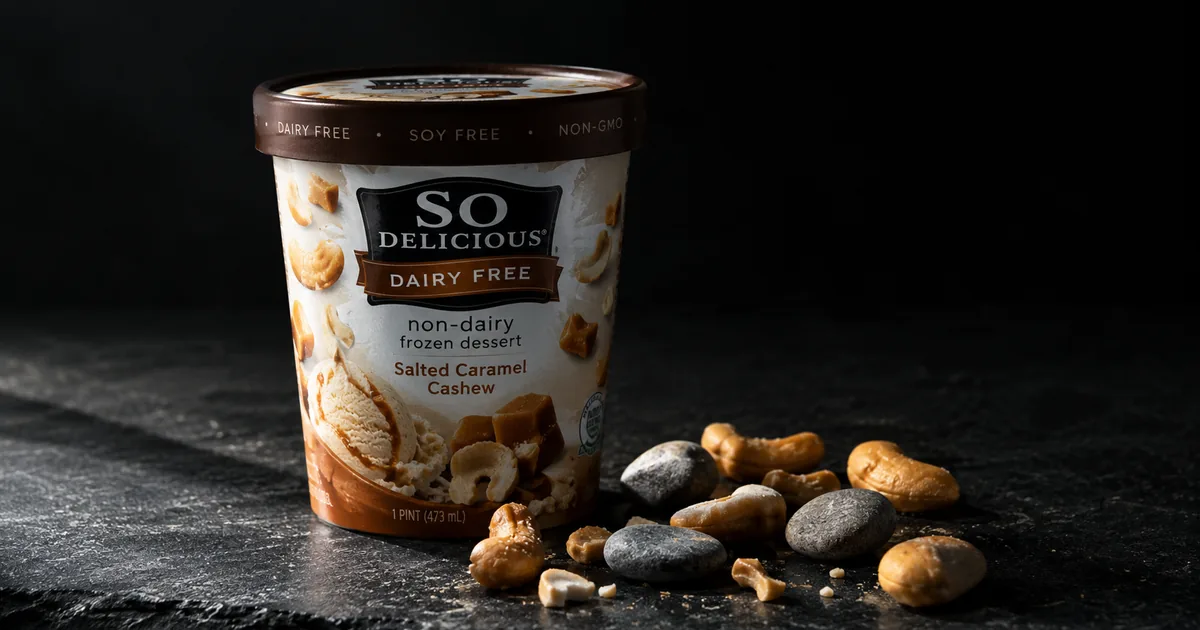
On September 15, Danone USA recalled its So Delicious Dairy Free Salted Caramel Cluster pints nationwide because the cashew pieces in them might contain small stones and other hard objects. On December 15 of last year, Danone USA recalled its So Delicious Dairy Free Salted Caramel Cluster pints nationwide because the cashew pieces in them might contain small stones and other hard objects. Same brand, same flavor, same SKU 136603, same UPC 744473476138, same defect, nine months apart.
The coverage has treated this as a consumer alert, and Fox Business was typical in running the SKU, the dates and the refund line without reaching back nine months. What almost nobody has pointed at is the line sitting on the FDA’s own page for the first recall, which records that the company has already corrected the issue and that the recall has been completed. That file was closed. The fix was reported, accepted, and filed away, and then the identical failure walked back onto shelves at Target and Walmart.
Two Notices, Neither of Which Says What Went Wrong
The striking thing about reading the two announcements side by side is how little either one tells you. The September notice covers pints with best-by dates on and before April 3, 2028, and attributes the problem to “potential presence of foreign materials, such as small stones and other hard objects, within the cashew inclusions.” The December notice covered best-by dates before August 8, 2027 and said the same thing in the same words.
Neither names a supplier. Neither identifies a root cause. Neither explains what “corrected” meant the first time. Danone is a company with a large and sophisticated quality organization, and it has now issued two nationwide recalls of the same item for the same reason without once putting on the public record what part of its cashew supply chain is producing rocks.
The scale of the first one was not trivial either. The FDA classified the December recall as Class II, its second-highest risk tier, covering 4,665,608 units. That is not a narrow lot pulled from three states. That is a nationwide sweep of nearly five million pints, followed by a correction the company reported as done, followed by the same problem again.
The Detection Method Is the Tell
Danone says the September problem was identified through consumer complaints. That single clause is the most important disclosure in the notice, and it has gone unremarked.
Inclusion contamination of this kind is a screening problem with well-established answers. Nut pieces going into a frozen dessert line are a classic candidate for metal detection, optical sorting, density separation and sieving, precisely because field stones travel with tree nuts from the orchard and nobody expects the grower to remove every one. The point of the control is that it catches them before the pint is filled. When the detection mechanism is instead a customer biting down on something hard and calling a consumer care line, the control either is not there, is not calibrated for the object it needs to catch, or is not being verified often enough to matter.
Do this twice with the same product and the natural inference is that the December corrective action addressed the contaminated lots rather than the process that let stones through. Pulling product is containment. It is not a fix, and the difference between the two is exactly what a closed recall file is supposed to establish.
What Danone Owes the Record
Our position is straightforward. A second identical recall of a product the company told regulators it had corrected is a disclosure problem before it is a food-safety problem, and Danone has not met it.
“We are working with retail partners to remove the product and offering refunds” is the right operational answer and a wholly inadequate public one. The questions Danone should answer, and has not: what was the root cause identified in December, what corrective action was implemented, what effectiveness checks were run, and why did none of them surface stones in product that carried best-by dates running to April 2028, which means it was manufactured after the first recall closed. Those are not gotcha questions. They are the standard contents of a corrective-action report that already exists inside the company.
There is a commercial argument for answering them, not just an ethical one. So Delicious sits in a plant-based category where the entire price premium over private label is trust: the shopper is paying more for a dairy-free pint on the assumption that the brand behind it is running a tighter operation than the store label next to it. Two identical foreign-object recalls inside a year is a direct attack on that proposition, and silence compounds it, because a buyer at Target or Walmart reviewing shelf space next spring will be looking at exactly the same public record we are.
The FDA has not classified the September recall yet, and when it does the more interesting question will not be the tier. It will be whether the agency treats a repeat of a closed Class II as something more than a fresh incident, or whether this one also gets marked corrected and completed on the strength of what the company reports about itself.