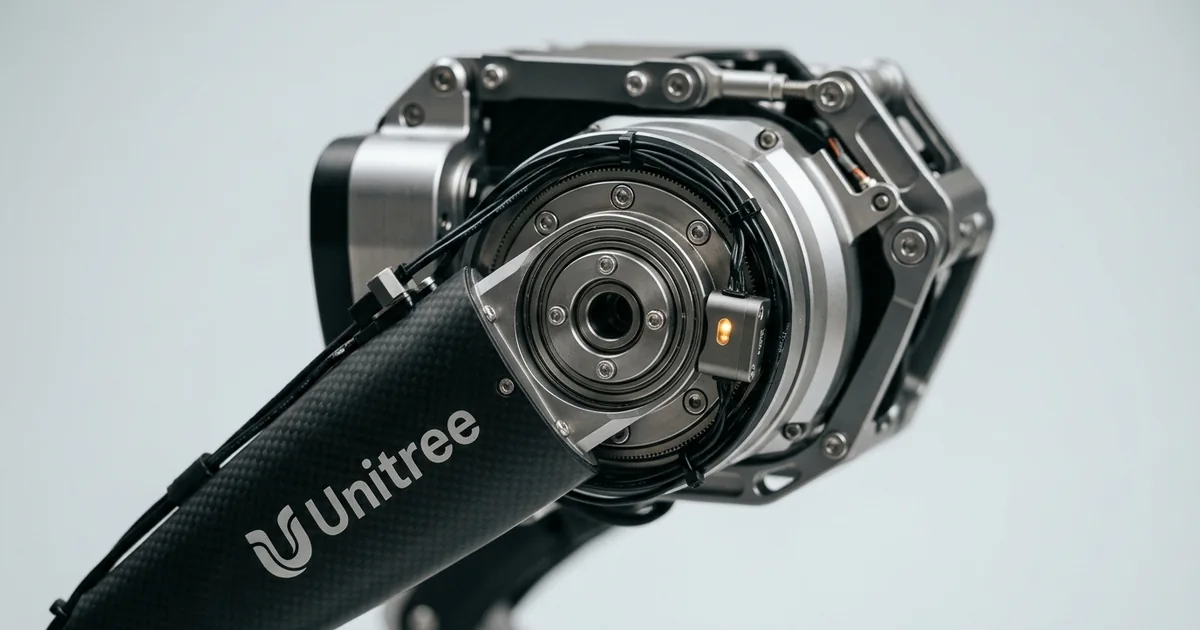
Unitree Robotics opened at 1,100 yuan in Shanghai on Wednesday against an offer price of 150.8 yuan, a 629% jump that briefly valued a company with $252 million in annual revenue at roughly $66 billion. The first humanoid robot maker ever listed in mainland China is now worth more than Baidu, and the number that should worry people is not the pop. It is the multiple left standing after the pop.
The Numbers Behind the Debut
The Hangzhou company, registered as Yushu Technology, raised 6.1 billion yuan, about $904 million, after targeting 4.2 billion. Retail demand oversubscribed the book more than 8,000 times, a record for Shanghai’s STAR Market. Caixin reported the shares soared 629% on debut, the largest first-day gain for any new listing this year, before the stock gave back a chunk of that into the close. Bloomberg and Fortune pegged the finish nearer 460% above the offer, while CNBC clocked the backflipping robot maker at 542%. The spread between those figures is itself a decent summary of the session.
Underneath the frenzy is a real business, which is what makes this harder to dismiss than the usual STAR Market moonshot. Revenue climbed to 1.70 billion yuan in 2025 from 392.77 million in 2024, and the company booked a net profit of 278.21 million yuan. Unitree is growing more than fourfold a year and it makes money, which puts it ahead of most Western robotics startups on both counts.
Run the arithmetic anyway. At the peak market capitalization of 445 billion yuan, investors paid roughly 260 times trailing sales and something on the order of 1,600 times trailing earnings. Nvidia at the height of its own re-rating never came close to that. You can believe Unitree is the best humanoid manufacturer on earth and still notice that the price assumes it will be the only one.
Why This Company and Not an American One
Unitree shipped more than 5,500 humanoid robots in 2025, which Xinhua reported gave it a 32.4% share of the global market, alongside cumulative quadruped shipments above 33,000 units and close to 60% of that segment. Those are manufacturing numbers, not demo-reel numbers, and no US competitor is publishing anything comparable. Agility Robotics and Tesla’s Optimus program are both still counting units in the hundreds.
The cap table explains the rest. Alibaba, Tencent, Ant Group and Meituan were all in before the listing, DeepSeek joined the IPO placement, and state-backed institutions filled out the rest. Beijing designated embodied AI a strategic priority, and China’s capital markets responded the way they respond when the state names a winner. CNN’s account of the blockbuster debut traced that same lineage of platform money and policy support.
This is industrial policy expressed as a share price. The valuation is not purely a market judgment about robot demand; it is partly a wager that the Chinese state will keep clearing the runway. That makes it more durable than a pure retail bubble in one respect and considerably more fragile in another, because policy priorities can be redirected faster than factories can be rebuilt.
Two days before listing, Unitree unveiled a humanoid it calls Superman, claiming a two-meter standing jump and a top speed of 12.66 meters per second. The timing was not subtle. Neither was the message: the hardware lead is real, and it is being marketed at retail investors as much as at industrial buyers.
The Part Nobody Has Priced
Here is the gap between the story and the spreadsheet. Unitree’s revenue comes overwhelmingly from research labs, universities and developers buying relatively cheap quadrupeds and entry-level humanoids. That is a genuine market and Unitree dominates it. It is also a market measured in tens of thousands of units, and it is nowhere near large enough to support a $66 billion valuation.
The valuation requires the industrial deployment story, humanoids doing repetitive labor in warehouses and on factory floors at scale, and that market does not meaningfully exist yet for anyone. CNBC put the question directly in a piece asking whether China’s backflipping robots can actually make money. Battery life, hands capable of fine manipulation, safety certification for working near people, and a cost curve that beats human labor in the target geography: all four remain unsolved, and the last one is the one that decides everything.
Speculative first-day pops are not new, and readers who watched SpaceX close its record Nasdaq debut in June have seen how quickly the framing shifts from validation to overhang once the lockups approach. What is different here is the ratio of narrative to revenue. SpaceX had contracted backlog. Unitree has market share in a category that has not yet found its paying customer.
What Happens From Here
Watch the second and third print, not the first. The interesting numbers will be the post-IPO quarterly disclosures showing whether humanoid revenue is shifting from labs toward industrial buyers, and whether gross margin holds as Unitree scales into lower-priced units. If industrial orders start showing up in the mix, the multiple has something to grow into. If revenue stays concentrated in research budgets, this becomes a case study in what happens when a state priority, a retail mania and a genuine manufacturing lead arrive in the same week.
The robots are real, and so is the lead. The price is a separate question, and Shanghai just answered it very loudly, before anyone had the data to answer it properly.