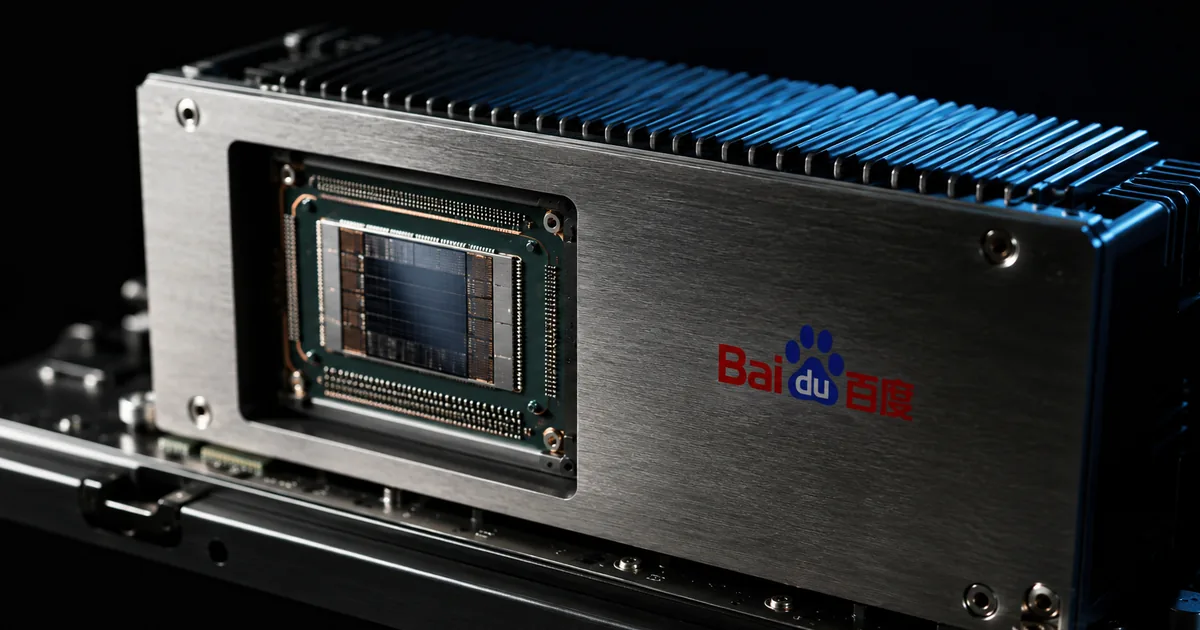
Baidu reported second-quarter revenue of RMB 31.3 billion on Tuesday, down 4% from a year earlier and short of the roughly RMB 32 billion analysts expected, and the American depositary shares slipped about 3% before the US open. Inside that miss sits one of the most spectacular growth numbers any large-cap technology company has printed this year: GPU Cloud revenue up 283% year over year, accelerating from 184% in the previous quarter. Both facts are true, and the relationship between them is the actual story.
The Crossover Chief Executive Robin Li Wanted
Baidu crossed a threshold this quarter that its founder has been pointing at for three years. AI-powered Business revenue reached RMB 12.5 billion, up 25%, and for the first time accounted for half of what the company calls Baidu General Business revenue. Robin Li framed it in the results release as the company “strengthening the foundations for our next phase of AI-driven growth,” and by his own metric the transition has now happened.
Here is what the general business actually splits into:
- Online marketing services: RMB 13.1 billion, down 19% year over year. Still 52% of general business revenue, and still shrinking.
- AI-powered Business: RMB 12.5 billion, up 25%. Now 50%, having crossed over for the first time.
- AI Cloud Infrastructure: RMB 7.3 billion, up 50%, with GPU Cloud inside it up 283%.
The crossover is real. It also happened partly because the denominator collapsed. When your legacy segment falls 19%, the replacement business reaches parity faster than the underlying build would suggest, and a milestone that arrives through subtraction is worth less than one that arrives through addition.
What 283% Growth Actually Costs
Search advertising, at Baidu’s scale, was one of the highest-margin businesses in Chinese technology. Serving an ad against a query costs close to nothing once the index exists. Renting out GPU capacity is the opposite: it requires buying accelerators at whatever price the supply chain sets, powering them, cooling them, and depreciating them across a useful life that the next hardware generation keeps shortening.
So the company is replacing high-margin revenue with capital-intensive revenue and calling the mix shift a transformation. Mechanically it is a transformation. Financially it is a downgrade in business quality, and the income statement shows it plainly. Net income came in at RMB 2.3 billion, about $342 million, for a net margin of 7%. That is not the margin structure of a company that owns a search monopoly. It is the margin structure of a company that rents out other people’s silicon.
The comparison that matters is not Baidu against its own prior year. It is Baidu against where the margin in this value chain actually accrues, which is upstream at the chip vendor. Selling GPU hours is a volume business with a price floor set by whoever else in China has capacity to rent. It grows fast precisely because it is easy to enter.
The Model Layer Is Where This Gets Decided
An infrastructure business is defensible only if something differentiated runs on top of it. Baidu’s answer is ERNIE, and ERNIE’s position is stronger than its critics allow and weaker than the cloud numbers imply. ERNIE 5.1 shipped in May 2026 and put a Chinese model in the global top five, which is a genuine achievement.
The trouble is cadence and strategy. Alibaba’s Qwen line moved through 3.5 in February and 3.6 in April before previewing a 2.4-trillion-parameter 3.8-Max in July, and DeepSeek shipped a V4-Flash API whose agentic scores beat its own larger model. CNBC documented how the release tempo among Chinese labs compressed after DeepSeek’s breakout. Against that clock, one flagship release in the first half of 2026 is a slower beat than the field.
ERNIE is also closed-weight while its two most aggressive domestic rivals are open. Whatever the merits for monetization, the open-weight competitors are accumulating the developer habits and the deployment surface, and those compound. A cloud business whose differentiator is a hosted proprietary model is a cloud business betting that the model stays ahead.
The Constraint Nobody Controls
The 283% number carries a dependency that no amount of demand solves. Chinese GPU cloud capacity is a function of chip access, and chip access is a policy variable set in Washington. We covered the terms of that arrangement when the Trump-Xi summit put H200 supply to Alibaba, Tencent and ByteDance on the table, and the shape has not changed since: Chinese hyperscalers can grow compute revenue only as fast as an export-control regime lets them accumulate accelerators.
That makes GPU Cloud growth a poor guide to durable earnings power. It is a measure of how much capacity got deployed against a backlog of unmet domestic demand, and backlogs clear. The South China Morning Post read the quarter as the cloud surge failing to offset the advertising slump, which is arithmetically right and slightly too kind. The advertising slump is structural, driven by Chinese consumer weakness and by AI-mediated search taking queries away from the ten blue links that Baidu monetized for two decades. The cloud surge is cyclical and capacity-gated.
Seven Percent
Investors marking Baidu against its narrative rather than its numbers have been doing so for six quarters now, and the pre-open reaction suggests fewer of them are willing to keep it up. A 7% net margin and a shrinking top line is a valuation problem no growth rate inside the mix can fix on its own.
The honest framing is that Baidu is executing its stated strategy and the strategy is expensive. Li told investors AI has become the core driver of the company, and the segment data backs him. What the segment data also shows is that the core driver of the company is now a lower-margin, more capital-hungry, more politically exposed business than the one it replaced. That may still be the right trade, because the alternative was managing a declining search franchise to zero. It is simply not the trade the 283% headline is selling. The number to watch next quarter is not GPU Cloud growth. It is whether that 7% margin goes up.