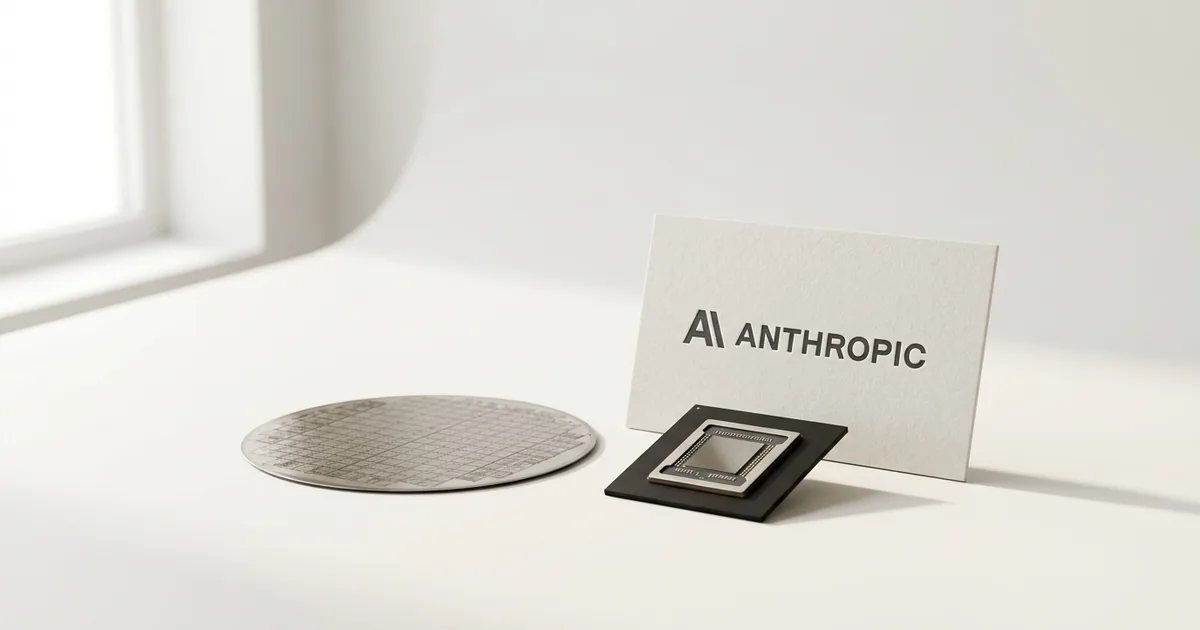
Anthropic confirmed this week that it is standing up an in-house custom silicon team to design accelerators for Claude, and the job listing attached to the confirmation pays $320,000 to $485,000. That salary band is the actual news. Research flirtations do not get compensation bands that compete with Apple and Google for physical-design engineers.
What Was Confirmed and What Was Not
Business Insider reported the effort first and Anthropic confirmed it publicly, telling TechCrunch it is building an internal team to design custom AI chips and co-design hardware alongside the models that run on it. The postings span front-end design, pre-silicon verification, physical design, design-for-test, analog and mixed-signal work, foundry and technology, design infrastructure, and packaging with signal and power integrity, according to TechRepublic’s read of the listings. That is not a skunkworks. That is the org chart of a company that intends to tape out a part.
What Anthropic did not say is more interesting. There is no announced part, no announced node, no announced timeline, and no announced volume commitment. The Information has reported that Samsung is being scouted as a possible manufacturing partner, which remains unconfirmed by anyone with a name attached. And the company was careful to say it is keeping a multi-chip approach, continuing to buy from Nvidia, AMD, Amazon Web Services and Google.
That last line is the diplomatic one, and it is doing a lot of work.
The Line Item This Is Really About
For a frontier lab, compute is not an expense category. It is the cost of goods sold.
Every token Claude generates has a marginal cost that is set by hardware someone else designs, prices and allocates. A lab can improve that number three ways: better model architecture, better serving software, or better silicon. The first two Anthropic already controls. The third it rents, and it rents it from a supplier whose pricing power is the single largest transfer of value in the current buildout.
Owning the accelerator does not eliminate that. Anthropic will still buy Nvidia parts for training, still lease capacity from Amazon and Google, still pay a foundry. What it changes is the shape of inference economics on the workloads Anthropic runs most: long-context agentic sessions, tool calls, code generation, the specific traffic mix that Claude’s business actually carries. A chip tuned to one company’s serving profile does not need to be better than a Blackwell or a Rubin in the general case. It needs to be cheaper per token on the eight or ten shapes that matter, which is a far easier engineering target and a far more direct route to gross margin.
Google proved this with the tensor processing unit over a decade. Amazon has been grinding at it with Trainium and Inferentia. OpenAI went at it with Broadcom. Meta built MTIA. Anthropic is the last of the majors to say it out loud, which makes the move less a bold bet than a late catch-up on table stakes.
The Nvidia Question Nobody Wants to Ask on the Record
Read this against what the hyperscalers have already committed. The combined capital-expenditure guidance from the big cloud buyers now runs to roughly $886 billion of AI infrastructure spending, and the market has spent this earnings season punishing anyone who mentions the number without a matching revenue line.
Every one of those buyers is also, quietly, building silicon to reduce its dependence on the vendor absorbing that spend. Anthropic joining the list does not dent Nvidia’s order book in 2027. It does something slower and more corrosive: it removes one more customer from the category of buyers with no alternative, and pricing power lives entirely in that category.
The counter-argument is real. Custom silicon programs are expensive, slow and frequently abandoned. A first part is typically three years and hundreds of millions of dollars from a team’s founding, by which point the model architecture it was tuned for may not be the one in production. Anthropic is a company whose model generations have turned over roughly every six months. Designing fixed-function hardware against a moving target is precisely the problem that has killed most AI accelerator startups.
The Safety Argument, Taken Seriously and Then Discounted
Anthropic’s positioning invites a second reading: hardware-level control gives a safety-focused lab oversight it cannot get from rented capacity. Attestation, isolation, verified execution of a specific model on a specific device, hard limits enforced below the software stack. Those are genuine capabilities and they are genuinely easier to build when you own the part.
They are also the argument most likely to be doing double duty. A company that has spent three years telling regulators and enterprise buyers that it is the careful lab now has a reason to control the silicon layer that reads as principle rather than procurement. Both things can be true. The compensation band tells you which one funded the headcount.
What Would Make This Real
Three markers, in order. A named foundry relationship with a disclosed process node, because a Samsung deal confirmed on the record turns rumor into capital commitment. A hire with a shipping track record at the vice-president level, since the listings describe individual contributors and no organization tapes out a part without someone who has done it before. And a change in how Anthropic talks about inference pricing, because the whole point of owning the accelerator is to move the price of Claude in a direction competitors cannot match without doing the same work.
Until one of those lands, this is a well-funded intention. The market has learned to price those carefully this quarter.