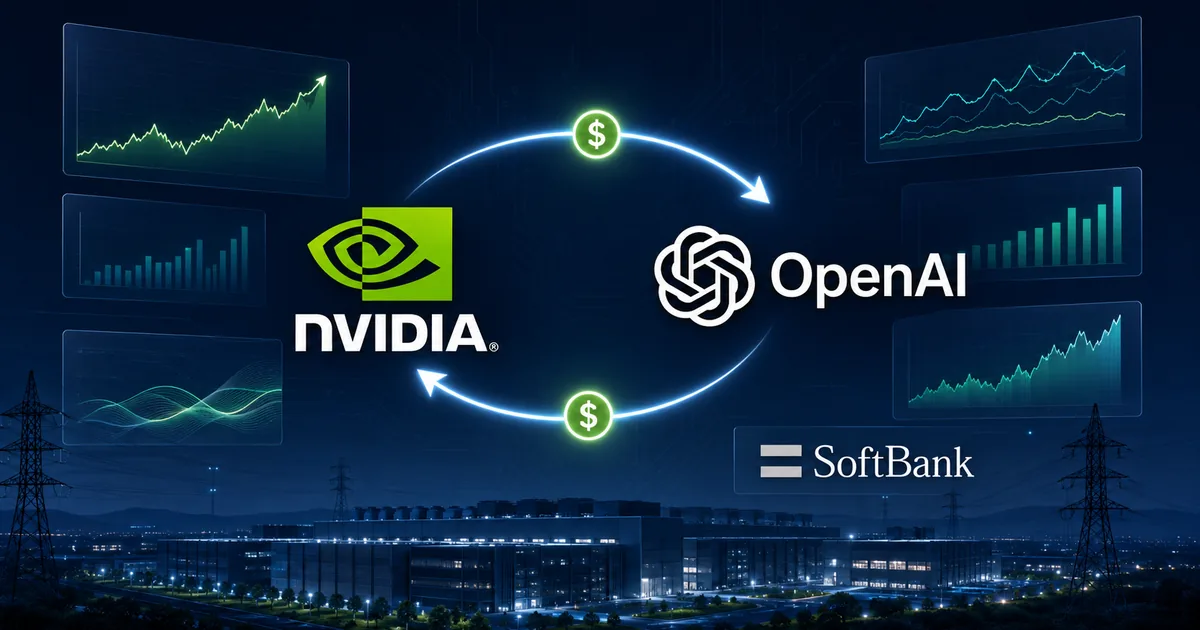
Nvidia is in talks to guarantee as much as $250 billion of OpenAI’s obligations on a 10-gigawatt data center campus in Piketon, Ohio, and Oracle shares jumped close to 5% on Monday on the read-through to its own OpenAI contracts. Strip away the number and what you have is a chip vendor pledging its balance sheet so its largest customer can rent buildings to put its chips in.
CNBC reported on Monday that the guarantees would cover the lease and the construction debt on a campus being developed by SoftBank Group’s energy unit on the site of a former uranium enrichment plant. The chips themselves are a separate conversation, one that Bloomberg reported could run to another $350 billion in financed purchases. Add it up and the project clears half a trillion dollars, which would make it the largest single data center commitment ever announced. Terms are not final. The talks could collapse.
The Guarantee Is the Story, Not the Zeroes
Everyone is quoting the $250 billion. The more useful detail sits one layer down: why a guarantee is needed at all.
OpenAI does not have an investment-grade credit rating. It is a private company that loses money at scale, and lenders price that accordingly. SoftBank’s unit needs to raise construction debt against a 10-gigawatt build, and the cost of that debt depends entirely on who the lenders think is good for the payments. With OpenAI alone on the paper, the answer was expensive, or nothing. With Nvidia standing behind it, the paper reprices toward Nvidia’s own credit.
That is the whole mechanism. A company with a fortress balance sheet is renting it out so a company without one can commit to twenty years of fixed obligations. The capital markets looked at OpenAI’s credit on its own and did not fund it at a workable price. Nvidia’s guarantee is the workaround, and workarounds are worth reading closely.
Vendor Financing Has a Track Record, and It Is Not a Good One
There is a name for a supplier lending its customer the money to buy its product, and telecom investors learned it the hard way. Lucent booked enormous revenue in the late 1990s selling switching gear to competitive carriers it had financed itself, and when those carriers folded, the receivables and the revenue went with them. The demand had been real on the income statement and imaginary in the market.
The AI version is more elegant because the money mostly does not move as a loan. It moves as a guarantee, which sits off the income statement entirely and shows up as a contingent liability in the footnotes. Nvidia books chip revenue now. The exposure only becomes real if OpenAI cannot pay the lease later. That asymmetry is precisely what makes it attractive to management and precisely what should make shareholders read the 10-Q more carefully.
Michael Burry, who has been short Nvidia and expanded the position in a Substack post last week, responded to the report with four words: “Around and around we go.” He is talking his book, and his framing is still the right one to argue with. The Globe and Mail reported on the dispute between Burry and the company, which has grown pointed enough that Nvidia has responded to him directly. His underlying claim is testable: if a meaningful share of Nvidia’s forward demand depends on customers who can only buy because Nvidia arranged their financing, then the demand curve and the balance sheet are the same object viewed twice.
The counterargument is not stupid. Genuinely new infrastructure has always been financed by the people who benefit from it existing, from railroads to fiber. If compute demand is as durable as OpenAI and its backers believe, then guaranteeing the buildout is cheap insurance on a market Nvidia already dominates. The honest position is that nobody knows yet, and the deal structure is designed so that Nvidia finds out last.
Ohio Is Not a Neutral Site
Piketon is a specific choice. A decommissioned uranium enrichment site comes with grid interconnection, transmission capacity, and a local political economy accustomed to large federal-scale industrial projects. Those are the scarce inputs now. Land is not the constraint on a 10-gigawatt build, and neither is money at this point. Power is.
Ohio is also where the politics of this buildout have already turned. State lawmakers suspended a $1.57 billion hyperscale data center tax break earlier this summer, a fight we covered when Ohio froze its data center incentives amid a voter backlash over who pays for the grid upgrades these campuses require. A 10-gigawatt campus is roughly the output of ten large nuclear reactors. Residential ratepayers in the region will find out what that means on their bills, and they will find out before the compute produces anything they can point to.
That is the consumer story hiding inside a financing story. The guarantee determines who absorbs the risk if the project fails. It says nothing about who absorbs the cost if it succeeds.
What to Watch
Nvidia already tapped public debt markets this year with a $20 billion bond sale, its first major debt offering of the AI boom, which tells you something about how even the most cash-rich company in the sector is managing this cycle. Watch three things from here.
First, the contingent-liability disclosure in Nvidia’s next quarterly filing. Guarantees have to be quantified, and the number in the footnotes will be more informative than the number in the headlines. Second, whether the SoftBank unit actually clears its construction debt, and at what spread, because that price is the market’s real opinion of this structure. Third, Big Tech earnings this week from Microsoft, Amazon, and Meta, where capex guidance will show whether the rest of the industry is still willing to fund compute out of operating cash flow rather than someone else’s guarantee.
The market read Monday’s news as good news, and for Oracle’s contract book it plainly is. The longer question is what it means that the fastest-growing company in the world now has to co-sign for its best customer.