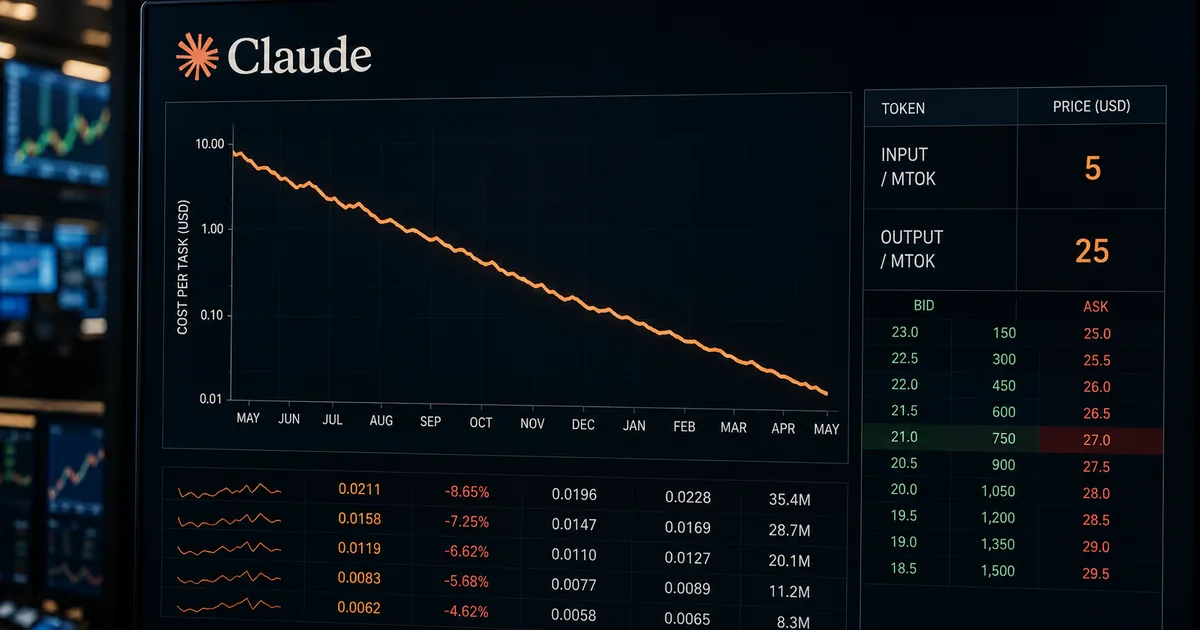
Anthropic launched Claude Opus 5 on Friday at $5 per million input tokens and $25 per million output tokens, holding the line at exactly what Opus 4.8 charged, and positioned it as roughly half the cost of Fable 5, the company’s own top-end model. A vendor that undercuts itself this deliberately is not chasing a benchmark crown. It is defending an enterprise book of business ahead of the most closely watched listing on the calendar.
What Anthropic Actually Shipped
The specifications matter mainly as evidence for the pricing argument. Anthropic’s launch materials put Opus 5 within half a percentage point of Fable 5 on CursorBench 3.2 at half the cost per task, and ahead of Fable 5 on OSWorld 2.0 at roughly a third of the cost. On ARC-AGI 3, built from problems the model has not seen, Anthropic claims a score three times the next best system.
The commercially interesting feature is not a capability at all. Opus 5 exposes an effort setting, low, medium or high, that developers select per API call, trading depth of reasoning against tokens burned. Harvey, the legal AI firm, reported matching the prior model’s maximum-reasoning quality while generating 26% fewer tokens. Box measured 8% better performance overall and 17% on due diligence.
Strip the marketing and the product is a cost-control lever handed to the buyer. That is a notable thing for a frontier lab to build, because every token a customer does not spend is revenue the vendor does not book.
Follow the Revenue, Not the Benchmark
Anthropic’s business is unusually concentrated. Roughly 80% of revenue comes from enterprises and developers rather than consumer subscriptions, which means the API line is close to the whole company. CNBC reported in late May that the company’s latest round valued it near $1 trillion, briefly ahead of OpenAI in private markets, on a revenue run rate that has grown at a pace with few precedents in software.
A valuation built on enterprise API spend has one obvious vulnerability. Enterprise API spend is the easiest line item in the AI budget to move, because switching a model endpoint is a configuration change, not a migration. Consumer subscriptions have inertia. Developer contracts have procurement cycles. Per-token inference has neither, and the moment a rival delivers an acceptable answer for less, the traffic follows within a billing cycle.
That is the structural reason Opus 5 exists in this shape. Anthropic is not defending a capability lead, it is defending a switching decision, and the cheapest way to stop a customer from evaluating a competitor is to make the comparison unflattering before they run it. Undercutting Fable 5 with your own model costs you margin on your premium tier. Losing the account costs you the account.
Four Models in Two Months Is a Cost Signal
This is Anthropic’s fourth frontier release in under two months, following Mythos 5, Fable 5 and Sonnet 5 in June. Fortune noted in its coverage of the launch that Anthropic still points customers toward Fable 5 for long-running autonomous work, casting Opus 5 as the economical option for everything else.
That cadence tells you something about unit economics. Shipping four frontier models in eight weeks is only rational if the marginal cost of training and serving each one has fallen far enough that the release is cheap relative to the revenue it protects. It also compresses the window in which any single model can command a premium. A model that is the best available for six weeks does not get to price like a model that is the best available for a year.
OpenAI reached the same conclusion from the other direction, pitching GPT-5.6 on token economy when it shipped July 9. We covered the enterprise spending shift toward token efficiency last month, and Opus 5 is that thesis arriving as a product. When both leading labs market on thrift in the same quarter, the pricing power has already moved to the buyer.
The Margin Question Nobody Is Answering
Here is what neither company will put in a press release. If capability per dollar roughly doubles every few months while list prices stay flat, revenue per unit of work delivered is falling. That is fine while total demand grows faster than the deflation, and it becomes a problem the moment it does not.
Anthropic is reportedly targeting a public listing later this year, which puts a specific kind of pressure on this release. Public markets will price the durability of the revenue, not the peak capability of the model. A company that has to ship a cheaper flagship every eight weeks to hold its enterprise base is a company whose gross margin is a function of competitive tempo, and competitive tempo is not something an S-1 can promise to sustain.
The effort dial sharpens that question rather than answering it. Give a CFO a setting that lowers the bill and the aggregate spend on a given workload goes down, not up. Anthropic is betting that cheaper inference expands the range of tasks worth automating fast enough to more than replace the revenue, which is the classic volume-for-price trade. It usually works in software. It works less reliably when the underlying cost curve is also collapsing for every competitor at the same time.
What to Watch
Two numbers will settle this before the year ends. The first is whether independent customers reproduce the efficiency claims on production workloads, because vendor figures come from tasks vendors selected. The second is what happens to Fable 5’s price. Anthropic has now published its own evidence that a model at half the cost matches its flagship on most work, and enterprise procurement teams read benchmark tables closely.
If Fable 5’s pricing holds through the fall, the tiering survives and Opus 5 was a well-executed defensive release. If it moves, the more uncomfortable read applies: the premium tier in frontier AI is not defensible on capability alone, and the pricing power everyone underwrote at a trillion-dollar valuation was always going to be temporary.