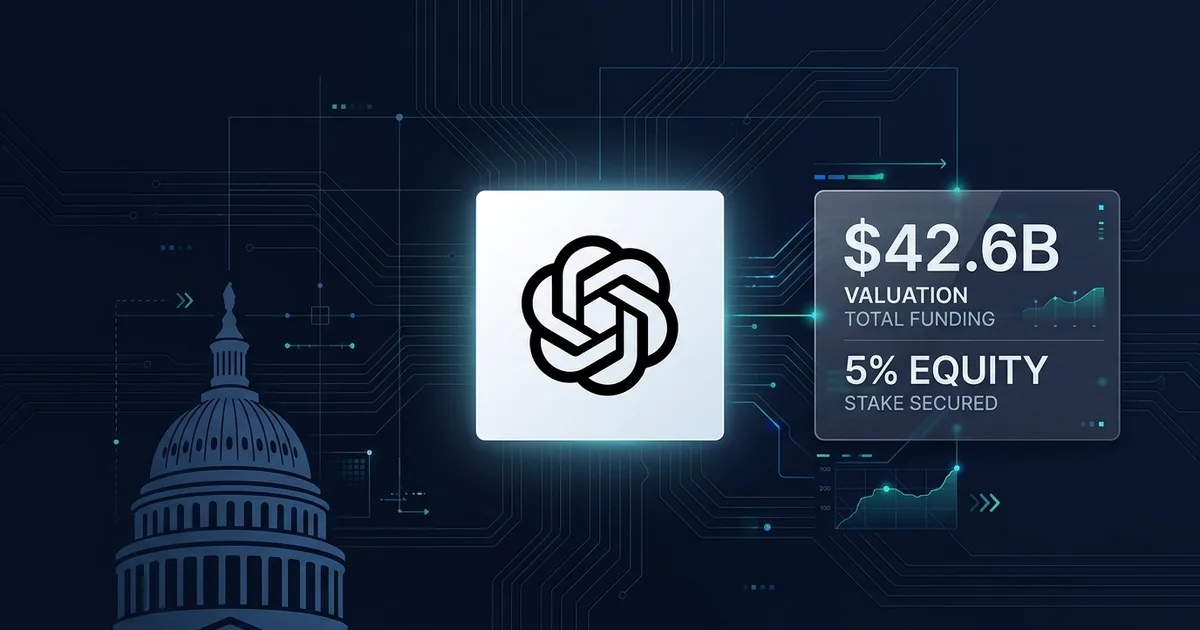
Sam Altman just made Washington an offer it will struggle to refuse: a 5% equity stake in OpenAI, currently valued at roughly $42.6 billion, structured as a peace offering to an administration that delayed GPT-5.6 just days earlier. The proposal, first reported by the Financial Times and confirmed by multiple outlets, would transform the federal government from regulator into shareholder, fundamentally rewriting the power dynamics between Silicon Valley and Capitol Hill.
The Alaska Fund Model for Artificial Intelligence
The mechanics reveal Altman’s ambition. Rather than a one-off concession from OpenAI alone, Altman pitched an industry-wide framework modeled on the Alaska Permanent Fund, which distributes oil wealth dividends to state residents annually. Under his proposal, every leading US AI developer, including Google, Anthropic, Meta, and xAI, would contribute 5% of their equity to a federally managed vehicle. The returns would eventually flow to the American public.
Tom’s Hardware reported that Altman raised the idea directly with President Trump, Commerce Secretary Howard Lutnick, and Treasury Secretary Scott Bessent in recent weeks. The conversations remain “conceptual and early-stage,” and any deal would likely require an act of Congress to implement.
At OpenAI’s current $852 billion valuation, set during its record March 2026 funding round, the government’s slice alone would be worth $42.6 billion. Applied across the industry, the combined public stake could reach hundreds of billions.
Why Altman Is Writing This Check Now
The timing tells the story. Washington delayed the release of GPT-5.6 in late June, a rare direct intervention in a commercial AI product launch. Forty-two state attorneys general have opened investigations into OpenAI’s consumer practices, creating regulatory pressure from the federal and state level simultaneously. The company’s planned IPO, expected in 2027, needs a stable regulatory environment to justify its valuation trajectory.
Altman’s calculus is straightforward: a government with equity upside in AI growth has a structural incentive to enable that growth rather than constrain it. It is the same logic that makes sovereign wealth funds reluctant to regulate industries where they hold major positions. By proposing that every major AI lab participate, Altman also insulates OpenAI from accusations of buying favoritism; the framework looks like public-interest policy rather than a single company’s lobbying play.
The Complications Washington Cannot Ignore
The proposal raises as many questions as it resolves. Engadget noted the obvious tension: a government shareholder in AI companies creates inherent conflicts of interest when that same government writes AI safety regulations, approves mergers, or awards defense contracts. The SEC would face unprecedented questions about insider-trading walls between regulatory bodies and investment managers.
There is also the competitive dimension. Google, Meta, and Anthropic have not publicly agreed to participate. Compelling them would require legislation, and the prospect of Congress mandating equity transfers from private companies to the federal government touches constitutional property-rights debates that could stall progress for years.
Berkshire Hathaway’s $397.4 billion cash pile offers an instructive contrast. Warren Buffett has spent 2026 warning that markets are in a “gambling mood” with valuations at dot-com-era extremes. Altman’s proposal implicitly asks the government to take the other side of that bet, locking public money into AI-sector equity at historically elevated multiples.
The Precedent Problem
No major US technology company has ever voluntarily handed equity to the federal government outside of a bailout or consent decree. The closest historical parallel is the 2008 financial crisis, when banks gave Washington preferred shares in exchange for TARP capital. But those were distressed transactions with mandatory repayment terms. Altman is proposing a gift with no strings attached, aside from the implicit expectation of regulatory goodwill.
The structure also raises governance questions that corporate law has not yet contemplated. Would the government have board representation? Voting rights? Veto power over safety-critical product launches? The difference between a passive financial stake and an active governance role is the difference between an investor and a regulator wearing a different hat. Altman’s public statements suggest he envisions the former, but Congress may demand the latter.
For OpenAI’s existing investors, including Microsoft, Thrive Capital, and the sovereign wealth funds that participated in the March round, a 5% dilution is not trivial. At $852 billion, it represents a meaningful transfer of value from private shareholders to a public entity. Whether those investors were consulted before Altman floated the idea publicly remains unclear.
What Happens Next
The proposal remains conceptual, but the signal matters more than the specifics. Altman is betting that shared ownership is more effective than shared governance, that giving Washington a financial seat at the table neutralizes the regulatory instinct more permanently than lobbying ever could. Whether Congress has the appetite to become an AI investor, with all the conflicts and complications that implies, will define the next chapter of American technology policy.
The AI sector is watching closely. If the framework gains traction, it could reshape how every major technology company thinks about its relationship with Washington: not as an adversarial regulatory dynamic, but as a joint venture where the government’s financial upside is directly tied to the industry’s success. That alignment could accelerate AI deployment across government services, defense contracting, and public infrastructure in ways that pure regulation never would.
The market is watching too. OpenAI’s valuation assumes continued hypergrowth under favorable regulatory conditions. If Altman’s gambit works, the $42.6 billion he is offering to give away could be the cheapest insurance policy in corporate history.