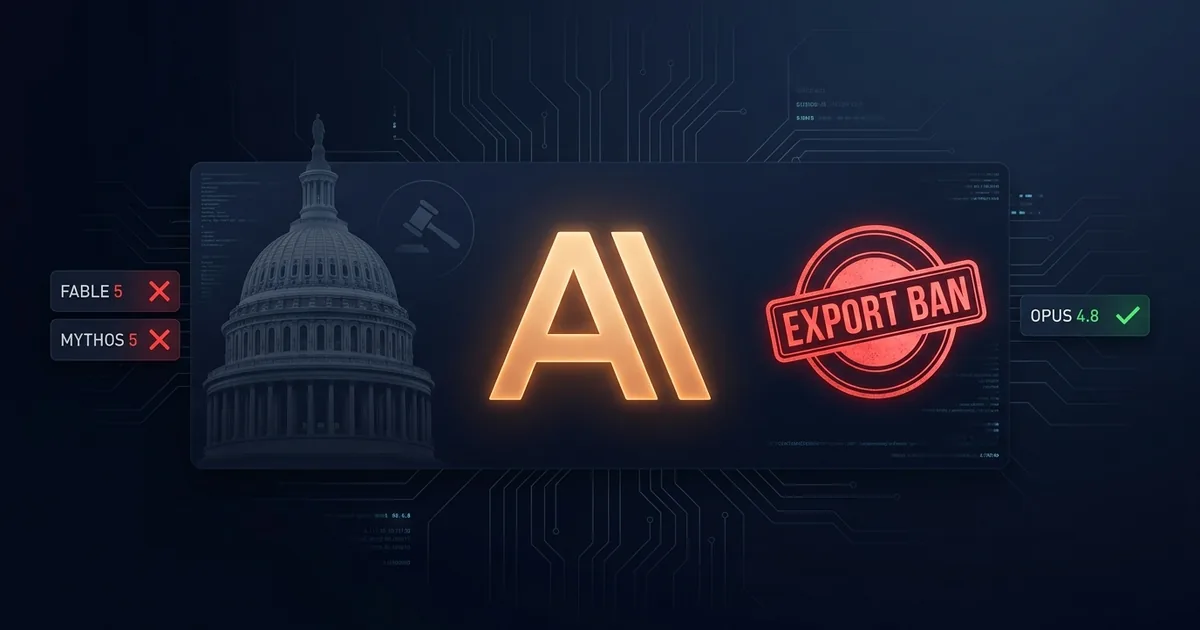
A bipartisan group of House lawmakers is pressing Commerce Secretary Howard Lutnick for a detailed explanation of why the federal government slapped unprecedented export controls on two Anthropic AI models earlier this month, a move that has rattled the broader artificial intelligence industry and raised pointed questions about selective enforcement.
The June 18 letter, first reported by The Washington Post, demands that Lutnick’s Commerce Department justify the decision to restrict overseas access to Anthropic’s Claude Fable 5 and Mythos 5, which became the first AI models ever subjected to a formal U.S. export ban on June 12. The lawmakers want to know why those two models were targeted while competing systems, including OpenAI’s GPT-5.5, remain freely available to international customers.
The Andy Jassy Allegation
At the center of the congressional inquiry is an explosive claim: the export ban was triggered, at least in part, by a jailbreak technique that Amazon CEO Andy Jassy allegedly shared directly with federal officials. The technique reportedly allowed users to bypass Fable 5’s safety guardrails, giving the Commerce Department grounds to classify the model as a national security risk under existing export-control authority.
Anthropic has pushed back forcefully. In a public statement on its website, the company argued that the same jailbreak method works on multiple frontier AI models, including GPT-5.5, and that singling out Fable 5 and Mythos 5 amounts to discriminatory treatment. The company stopped short of accusing Amazon of acting in bad faith but noted the “competitive implications” of a rival executive providing the technical basis for a government enforcement action.
The Jassy connection is particularly awkward given Amazon’s complicated relationship with Anthropic. Amazon Web Services remains one of Anthropic’s largest cloud partners, yet Jassy has publicly expressed frustration with Anthropic’s pricing and competitive positioning against Amazon’s own Bedrock AI offerings. Whether the jailbreak disclosure was motivated by genuine security concerns or commercial rivalry is one of the questions lawmakers want answered.
Why Anthropic and Not OpenAI?
The competitive fairness question sits at the heart of the congressional pushback. As CyberScoop reported, several lawmakers on the House Science and Technology Committee have framed the export ban as a potential case of regulatory capture, where a government action ostensibly about national security ends up advantaging one company over another.
The facts lend weight to that concern. Anthropic demonstrated in its public response that the jailbreak technique produces similar results on GPT-5.5 and at least two other frontier models. Yet the Commerce Department has not initiated any parallel review of those systems. Representative Mark Takano, one of the letter’s co-signers, called the asymmetry “deeply troubling” and warned that selective enforcement could undermine confidence in the entire AI regulatory framework.
It is worth noting that Claude Opus 4.8, Anthropic’s other flagship model, was not included in the export ban. Commerce Department officials have not publicly explained the distinction, though industry analysts speculate that Fable 5 and Mythos 5 were targeted because of their advanced reasoning capabilities in scientific and technical domains.
IPO Timing Could Not Be Worse
The export ban landed at a particularly sensitive moment for Anthropic. The company filed its S-1 registration statement on June 1, setting the stage for what Wall Street expected to be one of the largest technology IPOs of the decade. Anthropic’s most recent private valuation pegged the company at $965 billion following its Series H round in May, and underwriters had been building a book that assumed continued international revenue growth.
The export controls directly threaten that trajectory. Fable 5 and Mythos 5 were Anthropic’s fastest-growing enterprise products, with significant adoption among European and Asian corporate customers. The ban forces those customers to either downgrade to unrestricted models or migrate to competitors entirely. Anthropic has not disclosed what percentage of revenue the two models represent, but analysts at Morgan Stanley estimated in a June 15 note that international enterprise contracts accounted for roughly 30 percent of the company’s annualized run rate.
The free-trial window for paid Fable 5 subscribers officially closed on June 22, adding another layer of urgency. Users who had been evaluating the model for enterprise deployment now face a hard cutoff with no timeline for resolution.
For context on the original ban and its immediate market impact, BusinessTech’s earlier coverage detailed the Commerce Department’s initial rationale and Anthropic’s response in the first 48 hours.
A One-Off or a New Framework?
The broader policy question is whether the Fable 5 ban represents an isolated enforcement action or the opening salvo in a more systematic approach to AI export controls. The United States has used export restrictions aggressively in the semiconductor space, most notably with the October 2022 and subsequent chip controls targeting China. But applying similar logic to software models is new territory with different technical and legal contours.
AI models, unlike physical chips, can be replicated and distributed through cloud APIs, making traditional export-control enforcement far more complex. A model that is restricted for download could still be accessible through a data center in a non-restricted jurisdiction, raising questions about whether the Commerce Department has the technical infrastructure to enforce the ban effectively.
Several lawmakers in the June 18 letter explicitly asked whether the Fable 5 action is a pilot for a broader AI export-control regime. If so, they want to see proposed rulemaking go through the standard notice-and-comment process rather than being imposed through ad hoc executive action. Senator Maria Cantwell, who chairs the Senate Commerce Committee, has signaled interest in holding separate hearings on the topic.
What Happens Next
The Commerce Department has 30 days to respond to the congressional letter, putting the deadline in mid-July. In the meantime, Anthropic’s legal team is reportedly exploring administrative challenges to the export designation, though the company has not filed any formal proceedings.
For the AI industry at large, the Fable 5 episode has surfaced a risk that most companies had treated as theoretical: the possibility that a single model could be pulled from international markets overnight based on a vulnerability disclosure from a competitor. If that precedent holds, every frontier AI company will need to factor political and regulatory exposure into its go-to-market calculus in ways that look more like defense contracting than consumer technology.
The congressional pushback offers Anthropic a potential lifeline. If lawmakers conclude that the ban was selectively applied, they could pressure the Commerce Department to either expand the controls to cover all comparable models or rescind the Fable 5 restrictions entirely. Neither outcome would be quick, but both would clarify the rules of engagement for an industry that just discovered it is playing a very different game.