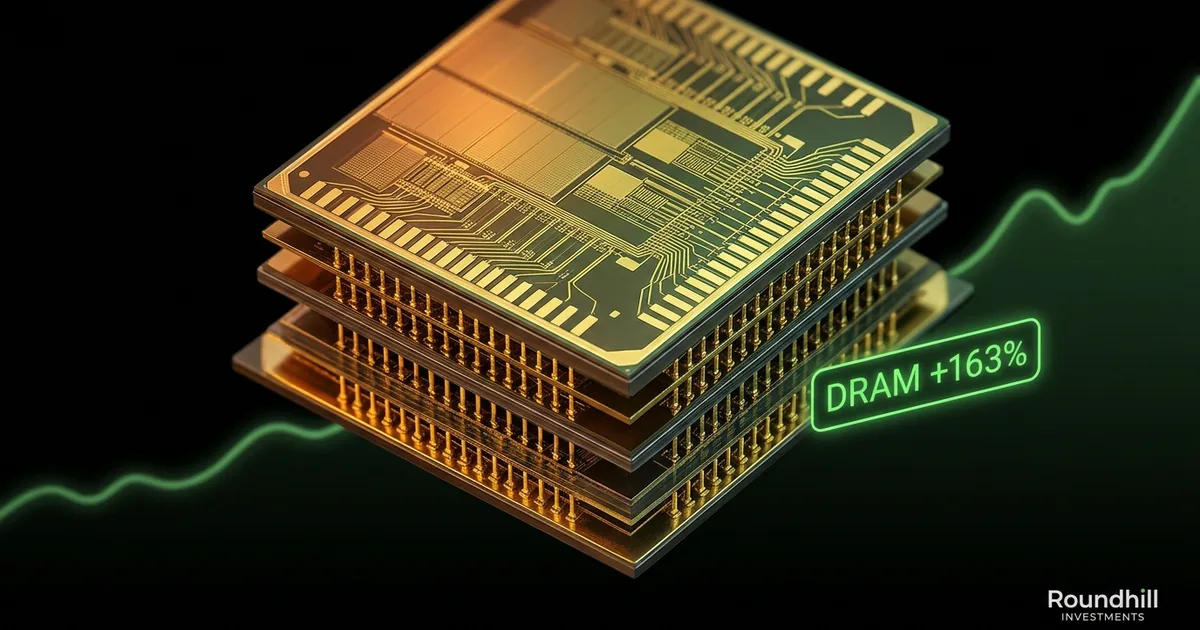
Wall Street has seen its share of breakout launches, but nothing quite like the Roundhill Memory ETF. Trading under the ticker DRAM, the fund crossed $20 billion in assets under management just weeks after its April 2 debut, shattering a record that once belonged to BlackRock’s iShares Bitcoin Trust.
The speed of that capital inflow tells a story about where institutional and retail investors alike believe the next great profit pool sits: not in the AI models themselves, but in the physical silicon that feeds them.
How DRAM Broke BlackRock’s Record
When BlackRock launched IBIT in early 2024, the fund pulled in $6.5 billion within 30 days, a figure 24/7 Wall St. called “supercharged” at the time. That record stood for two years. DRAM obliterated it.
The Roundhill Memory ETF is the first fund exclusively targeting memory chip manufacturers, and its 163% gain since launch has turned it into a magnet for momentum capital. Through May 15, the fund was already up 77.9%, making it one of the best-performing ETFs of 2026 by any measure.
What separates DRAM from the crowded semiconductor ETF field is its surgical focus. This is not a broad chip basket. It is a concentrated wager on the specific companies building the high-bandwidth memory (HBM) chips that power Nvidia’s data center GPU clusters.
Three Stocks, 73% of the Fund
The concentration risk is impossible to ignore. SK Hynix accounts for roughly 25% of assets, Micron holds about 24%, and Samsung Electronics rounds out another 24%. Together, those three names represent nearly three-quarters of the entire fund.
The remaining allocation spreads across Kioxia and SanDisk, but make no mistake: DRAM is functionally a three-stock portfolio with a 0.65% expense ratio.
For investors who already hold individual positions in Micron or SK Hynix, buying DRAM is essentially doubling down on the same thesis with modest diversification. That is either a feature or a bug, depending on your conviction about the memory cycle.
And conviction is exactly what the market has right now. Micron’s run to a $1 trillion market cap earlier this year validated the thesis that HBM demand is not a flash-in-the-pan trade but a structural shift in semiconductor economics.
The AI Memory Demand Cycle
The bull case for DRAM starts and ends with one acronym: HBM. High-bandwidth memory chips are the bottleneck component in every Nvidia H100, H200, and Blackwell GPU cluster. Each rack of AI accelerators requires exponentially more memory than the server hardware it replaced, and the major cloud providers are still early in their buildout cycles.
SK Hynix pioneered the HBM3E standard and holds the lion’s share of Nvidia’s supply contracts. Micron has been closing the gap with its own HBM3E production, and Samsung is ramping aggressively after a late start. All three are running near full utilization on HBM production lines, with order books stretching into late 2027.
The demand math is straightforward: every dollar spent on AI training and inference compute requires a proportional spend on memory. As long as hyperscalers keep writing checks for GPU clusters, the memory manufacturers print money.
Morningstar’s Valuation Warning
Not everyone is buying the euphoria. Morningstar flagged DRAM’s top holdings as overvalued based on fundamental analysis, warning that investors risk paying a premium for growth that is already priced into the stocks.
The concern is not without merit. Memory chips are historically cyclical, prone to boom-and-bust pricing swings driven by supply gluts. The current super-cycle, fueled by AI demand, has pushed margins to record levels at all three major producers. But memory cycles turn fast. When new fab capacity comes online in 2027 and 2028, the supply-demand balance could shift, compressing margins even if total volume keeps growing.
The counterargument from DRAM bulls is that HBM is structurally different from commodity DRAM. The manufacturing complexity is higher, the customer base is more concentrated (read: Nvidia and AMD set the specs), and switching costs are significant. That gives HBM producers more pricing power than traditional memory makers ever enjoyed.
Today’s Premarket Action
Monday morning added another data point for the bull camp. Memory and storage stocks were moving higher across the board in premarket trading: Western Digital gained 5.2%, Seagate climbed 4%, and Micron added 3%. The broader semiconductor sector showed strength, suggesting the AI hardware trade is far from exhausted.
Those moves matter for DRAM holders because the ETF’s concentrated portfolio amplifies sector momentum. When memory stocks rally, DRAM rallies harder. When they sell off, the pain is proportionally worse.
What DRAM Tells Us About the AI Trade
The speed at which capital flooded into a single-theme ETF reveals something important about how investors are positioning for the AI buildout. The consensus bet is no longer just on the model builders or the cloud platforms. It has migrated down the stack to the component makers who supply the physical infrastructure.
That shift mirrors what happened in previous technology cycles. During the dot-com era, the biggest winners were not always the internet companies themselves but the networking equipment makers (Cisco) and chip designers (Intel) who supplied the backbone. The AI analog is GPU makers and, increasingly, the memory companies that sit one link deeper in the supply chain.
DRAM’s record-breaking launch is a market signal, not just an asset-gathering story. It says that investors believe the AI memory boom has duration, that HBM demand will outlast the initial hype, and that three companies control enough of the supply chain to capture an outsized share of the value.
Whether that belief survives the next memory cycle downturn is a different question entirely. But for now, $20 billion says the market is all in.