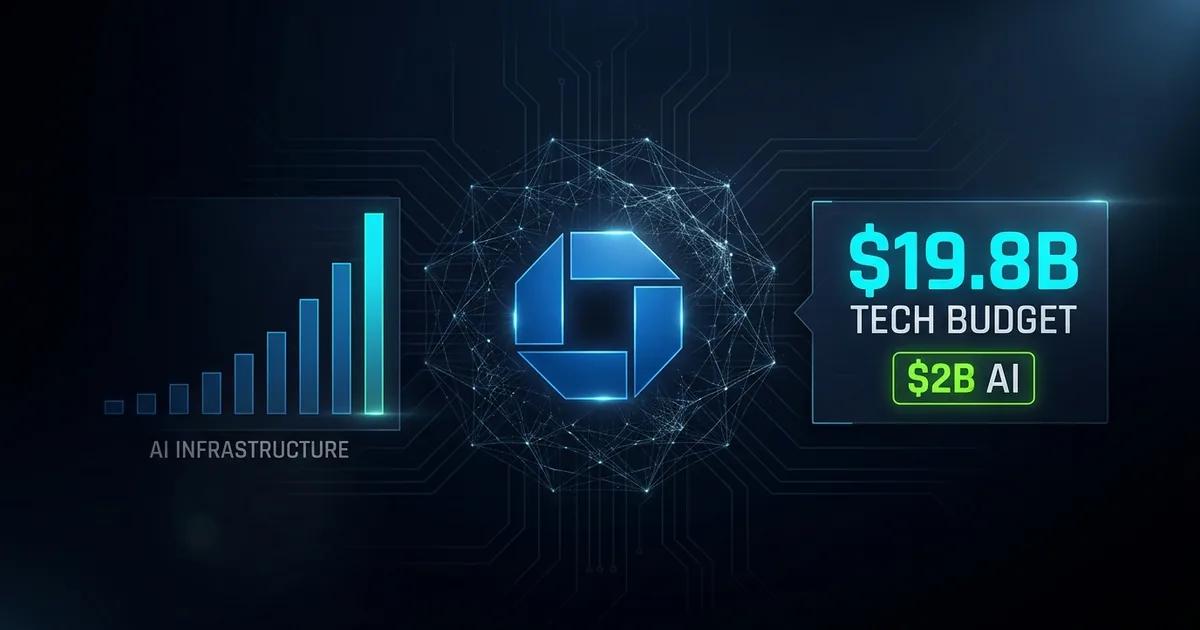
JPMorgan Chase has formally reclassified its artificial intelligence investments from experimental R&D to core infrastructure, placing AI alongside cybersecurity, payment systems, and operational resilience in its $19.8 billion technology budget for 2026. The move signals that the largest U.S. bank by assets no longer views AI as a bet on the future. It views it as plumbing.
From Innovation Budget to Non-Negotiable Line Item
The reclassification shifts approximately $2 billion in AI-related spending out of the discretionary innovation category where it had lived for years. In practical terms, this means AI spending at JPMorgan is now protected from the kind of budget cuts that hit experimental programs during downturns. It gets the same ring-fencing as the systems that process trillions of dollars in daily transactions.
CEO Jamie Dimon has been building toward this moment for the better part of two years. In February, he told analysts that AI would impact “virtually every function” at the bank, from fraud detection to client advisory to back-office operations. The reclassification makes that rhetoric structural. When Dimon says AI is as important as cybersecurity, he is now putting the budget authority behind the claim.
The bank employs more than 2,000 people dedicated to AI and machine learning development, a headcount that has roughly doubled since 2024. Those roles are no longer classified as innovation staff. They are infrastructure engineers.
The Self-Funding Argument That Changes the Calculus
What makes JPMorgan’s move particularly significant is the claim that AI has already paid for itself. Banking Exchange reported that the bank credits AI with generating $2 billion in operational savings across more than 150,000 employees, producing a 10% to 11% productivity gain in engineering, operations, and fraud detection.
If those numbers hold up to scrutiny, the ROI argument for AI infrastructure spending is no longer theoretical. A $2 billion investment that produces $2 billion in savings in the same fiscal cycle is not an experiment. It is a capital allocation decision that any CFO would approve, and one that makes the “wait and see” approach at smaller banks look increasingly like a competitive liability.
The contrast with the broader market narrative is striking. While tech companies have faced investor skepticism over massive AI capital expenditure, with Meta’s stock dropping 10% on its $145 billion AI capex announcement earlier this year, JPMorgan is reporting measurable returns on a fraction of that spend. The difference: JPMorgan is deploying AI into existing workflows with quantifiable outputs, not building speculative foundation models.
What This Means for the Banking Industry
JPMorgan’s reclassification will likely force a conversation at every major financial institution. When the industry’s dominant player treats AI as non-negotiable infrastructure, the competitive pressure on mid-tier banks to follow suit becomes intense. The question is no longer whether to invest in AI, but whether institutions that delay can maintain operational parity.
Crypto News noted that JPMorgan’s approach contrasts sharply with European banks, most of which still categorize AI spending under innovation or digital transformation budgets, categories that are inherently vulnerable to cuts during tightening cycles. With the ECB and BOJ both raising rates this month and the Fed signaling hikes ahead, cost pressure on banks is increasing precisely when the case for AI investment is becoming harder to ignore.
The bank’s $19.8 billion total technology budget for 2026 is itself a statement. That figure exceeds the entire market capitalization of many regional banks. JPMorgan is spending more on technology in a single year than most competitors spend on everything, and it is now declaring that the AI slice of that budget is as untouchable as the fraud systems that keep the lights on.
The Bigger Picture for Enterprise AI
JPMorgan’s move matters beyond banking because it represents a shift in how legacy enterprises account for AI. Reclassifying AI from R&D to infrastructure is an accounting and governance decision as much as a technology one. It changes how the spending is reported to shareholders, how it is audited, and how it is evaluated in regulatory stress tests.
For the AI industry, this is validation of the enterprise deployment thesis over the consumer chatbot thesis. The money that will sustain AI companies long-term is not coming from subscription fees on chat products. It is coming from institutions like JPMorgan embedding AI into processes where the cost savings are measurable in billions, not in minutes saved per user. That is the market that Anthropic, OpenAI, and Google are really competing for, and JPMorgan just told them the budget line is permanent.
Dimon has never been shy about making bets before the rest of the industry catches up. He built JPMorgan’s mobile banking infrastructure years before competitors took digital seriously, and the result was a platform moat that still generates billions in deposits. The AI reclassification is the same playbook: move early, move structurally, and let competitors explain to their boards why they waited.