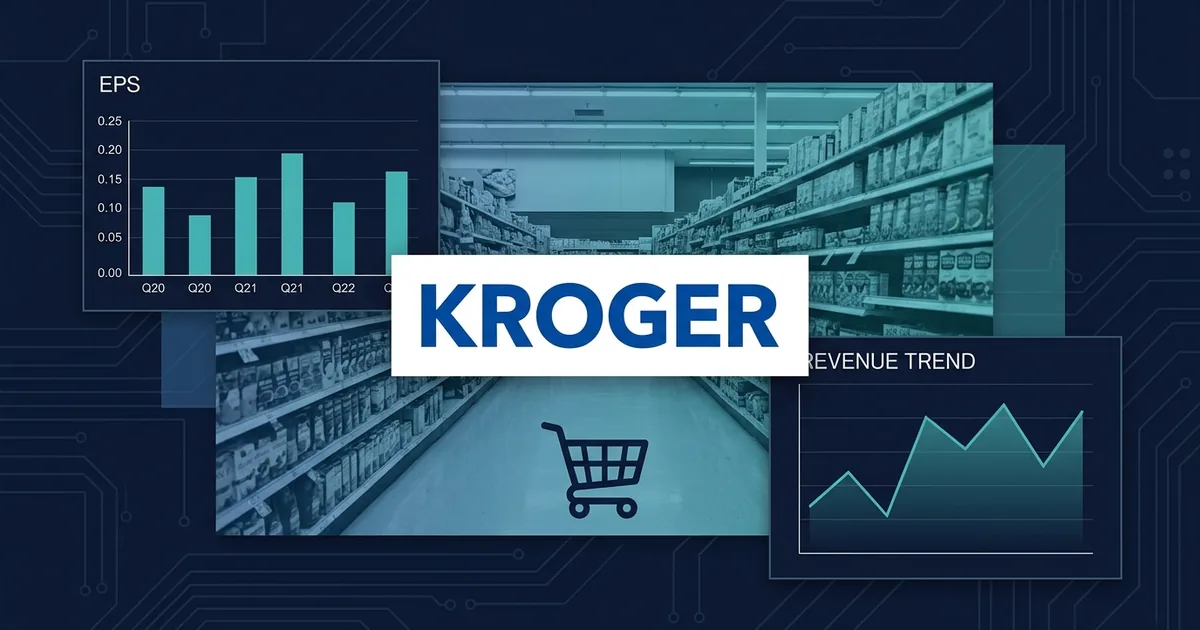
Kroger reports first-quarter fiscal 2026 results before the bell on Wednesday, and the numbers landing this morning will function as a real-time consumer spending X-ray at the worst possible moment. With CPI stuck at 4.2%, food prices grinding higher, and energy costs spiking on the Iran conflict, what America’s largest standalone grocer reveals about shopping behavior matters more than any Fed speech this month.
Wall Street expects earnings per share of $1.58, a 6% year-over-year increase, on revenue of roughly $45.4 billion. Those are fine numbers in isolation. The real story is whether Kroger can keep delivering them while 160 million American households are quietly reshuffling every grocery list they write.
The Identical-Sales Number Is the One That Matters
Forget the top-line revenue print for a second. The metric institutional investors will zero in on is identical-sales growth, Kroger’s term for same-store sales excluding fuel. That figure strips out new store openings and closures, leaving a clean read on whether existing customers are spending more or less per trip.
Last quarter, Kroger posted identical-sales growth that surprised to the upside, and the stock responded accordingly. The company has beaten consensus EPS in its last two quarters by an average of 3.81%, which has trained the market to expect outperformance. That creates a dangerous setup: when beats become the baseline, a mere in-line print can feel like a miss.
What analysts really want to see is whether identical-sales growth is being driven by volume or by price. If customers are buying the same number of items at higher prices, that is inflation doing the work, not genuine demand. If unit volumes are ticking up, that signals the consumer is more resilient than the headline data suggests.
E-Commerce Is Kroger’s Margin Story Now
Kroger’s digital business has quietly become one of the most important variables in its earnings model. The company has invested billions in automated fulfillment centers, delivery infrastructure, and its Boost membership program. Those investments need to start pulling their weight in the P&L.
Digital grocery is a notoriously low-margin business. The pick, pack, and deliver economics are brutal compared to a customer walking into a store and doing the labor themselves. Kroger’s bet is that automation, specifically its Ocado-powered customer fulfillment centers, can compress those costs enough to make digital orders profitable at scale.
Watch for two data points on the call: digital sales growth rate and any commentary on fulfillment center throughput. If Kroger reports digital growth above 10% while simultaneously showing margin improvement in the segment, that validates the entire capital allocation thesis. If digital is growing but still bleeding money, the market will start asking harder questions about the payoff timeline.
The Kroger investor relations page has the earnings call scheduled for 10:00 AM ET, and management’s tone on digital profitability will be as telling as the numbers themselves.
Inflation, Iran, and the Grocery Aisle
Here is the macro backdrop Kroger is operating against: the Iran conflict has pushed energy costs sharply higher, which flows directly into food supply chains through transportation, refrigeration, and fertilizer costs. The May CPI print of 4.2% was the highest in three years, and food-at-home inflation has been a persistent contributor.
Kroger sits in an unusual position during inflationary cycles. As a grocer with massive private-label brands (its Our Brands portfolio generated over $30 billion in annual sales last year), the company can actually benefit when consumers trade down from name brands. Every shopper who swaps Tide for Kroger-brand detergent or picks Simple Truth over a national organic label is handing Kroger a higher-margin sale.
The question is whether this trade-down effect is enough to offset the margin pressure from rising input costs. Grocery is a razor-thin-margin business even in good times, typically running at 1% to 3% net margins. When your cost of goods sold is climbing and you cannot fully pass those increases to a price-sensitive consumer, the squeeze gets real fast.
Management guidance will be critical. If Kroger raises or reaffirms its full-year outlook, that is a strong signal that the consumer, while stressed, is not breaking. If they trim guidance and point to accelerating cost pressures, buckle up, because every retailer reporting after them will be telling a similar story.
What Happens Next
One timing note for investors: U.S. markets are closed tomorrow, June 19, for the Juneteenth holiday. That means today’s post-earnings price action gets an extra day to marinate before the next trading session. Any gap move, up or down, will carry outsized weight because there is no immediate follow-through session to absorb it.
Kroger’s report also sets the table for a broader grocery and consumer staples earnings cycle. Costco, which just posted record revenue north of $69 billion last quarter, showed that the value-seeking consumer is alive and spending. If Kroger confirms the same trend from the middle of the market, rather than the warehouse-club high end, it paints a more complete picture of American spending behavior.
The bigger question hanging over all of this is whether the Fed can cut rates later this year with inflation this sticky. Every data point from companies like Kroger feeds into that calculus. Strong consumer spending with persistent price increases is exactly the scenario that keeps the Fed on hold, which keeps mortgage rates elevated, which keeps housing unaffordable, which keeps consumer sentiment depressed. It is a feedback loop, and Kroger’s earnings are one more input into the machine.
The numbers drop this morning. Pay attention.