The most valuable public company in the world is borrowing money for the first time in five years, and the size of the check tells you how fast the AI infrastructure arms race is accelerating.
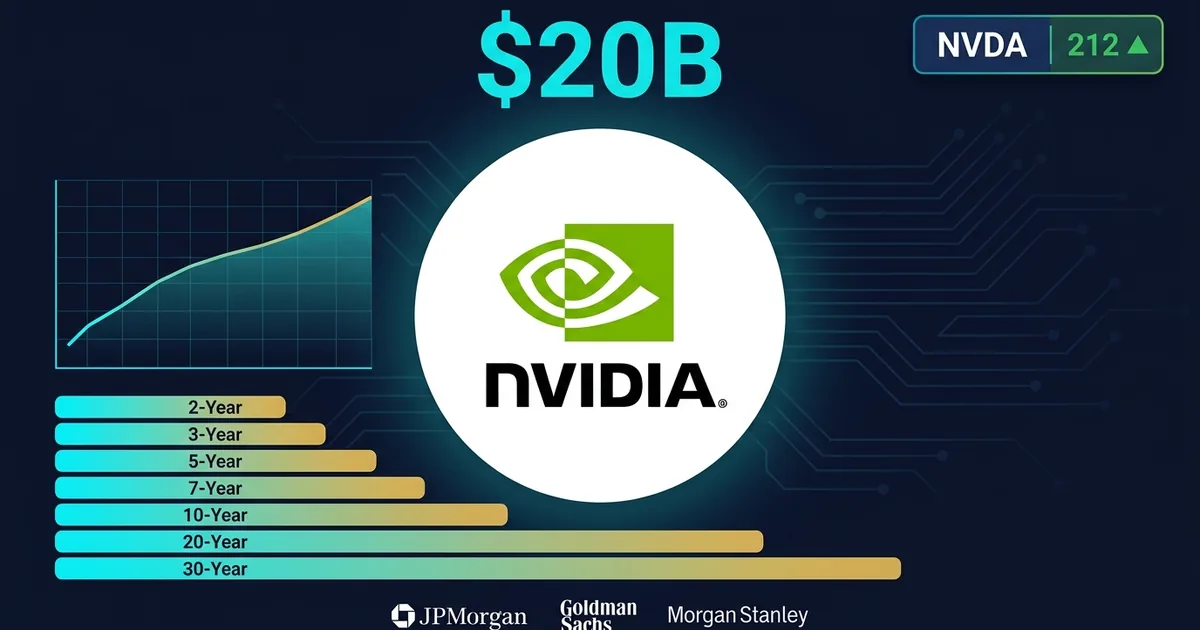
Nvidia announced Monday that it plans to raise at least $20 billion through a bond offering, its first trip to the debt markets since 2021. CNBC reported that JPMorgan Chase, Morgan Stanley, and Goldman Sachs are managing the deal, which will be structured across seven tranches spanning maturities from two years to 30 years. The longest-dated portion is being discussed at roughly 0.9 percentage points above Treasuries.
Why Borrow When You Print Cash?
On the surface, Nvidia borrowing $20 billion seems counterintuitive. The company sits atop a $5.2 trillion market cap, generates enormous free cash flow from its data center GPU business, and has no urgent need for capital. Its balance sheet is already fortress-grade.
But the math of the AI buildout changes the equation. Hyperscalers like Microsoft, Google, Amazon, and Meta are collectively spending hundreds of billions on AI infrastructure, and Nvidia is the primary supplier of the silicon that powers it. Morgan Stanley estimated in a recent report that AI-related debt across the tech sector could reach $570 billion by year-end. Nvidia is joining a borrowing wave that also includes Oracle, Meta, and Alphabet, all of whom have tapped bond markets in 2026 to fund data center expansion.
The proceeds will go toward general corporate purposes including refinancing existing debt. But the strategic signal is bigger than the stated use: Nvidia is locking in favorable borrowing costs while its credit rating is pristine and spreads are tight. If the AI cycle decelerates or interest rates rise further under new Fed Chair Kevin Warsh, today’s rates will look cheap in retrospect.
The Scale Is Historic
To put the $20 billion in context, Nvidia’s last two bond offerings combined, in 2020 and 2021, raised roughly $5 billion total. This single deal dwarfs both by a factor of four. Yahoo Finance noted that the offering is among the largest corporate bond sales of 2026, reflecting both Nvidia’s expanded scale and the capital intensity of the next phase of AI infrastructure.
The seven-tranche structure is also notable. By spreading the debt across maturities from two to 30 years, Nvidia is building a diversified debt stack that reduces refinancing risk. The 30-year tranche effectively locks in capital at today’s rates for a generation, a bet that the AI hardware cycle will produce returns well beyond the current decade.
What It Means for the AI Sector
Nvidia’s bond sale is not happening in isolation. It is the latest in a cascade of tech-sector borrowing that reflects a consensus view: the AI infrastructure buildout is real, it requires enormous capital, and the companies best positioned to supply it are using every tool available to fund their expansion.
For investors, the offering underscores a tension in the Nvidia story. The stock has returned over 200% in the past two years, driven by AI enthusiasm. Adding $20 billion in debt does not threaten that thesis, but it does signal that Nvidia sees the need to invest at a scale that even its massive cash flows cannot fully support. The AI boom is expensive, and even the winners need to borrow.
Nvidia shares traded around $212 on Monday, up roughly 3% on Friday’s session, with a market cap of $5.23 trillion. The bond pricing is expected to finalize within days.