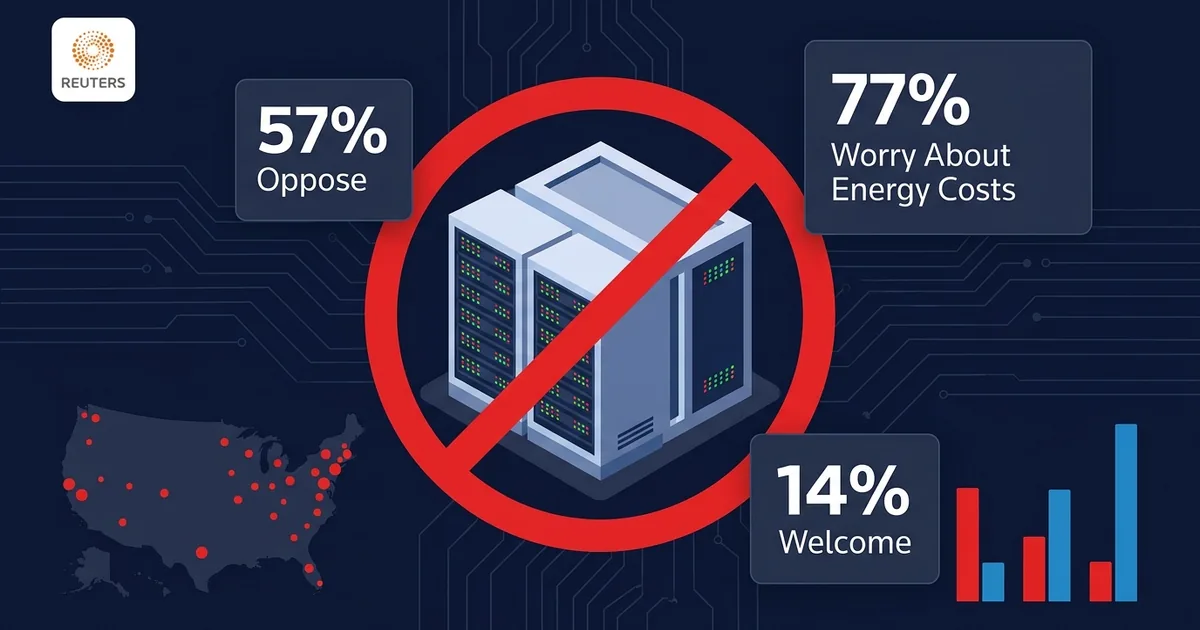
A Reuters/Ipsos poll released Wednesday found that 57% of Americans would oppose a data center being built in their community, with only 14% saying they would welcome one. The survey of 4,531 people represents the most comprehensive measure yet of public sentiment toward the AI infrastructure boom, and the numbers should alarm every hyperscaler, utility executive, and state economic development officer who assumed these projects would face minimal resistance.
The Numbers Are Worse Than the Industry Expected
The headline finding is stark enough: nearly six in ten Americans do not want a data center near them. But the details underneath are more damaging. Reuters reported that 77% of respondents, including similar shares of Republicans, Democrats, and independents, said they were worried that AI would make electricity more expensive. That is not a partisan issue. That is a consensus concern that crosses every demographic line in the survey.
Only 33% of Americans agreed that building data centers at a rapid pace was “mainly a good thing.” The remaining two-thirds either disagreed or were uncertain, a result that tracks with the backlash already visible in specific communities. Ohio suspended a $1.57 billion data center tax break after voter opposition. Illinois froze new data center incentives pending a cost-benefit review. The Reuters poll suggests these were not local aberrations but reflections of a national mood.
Why Public Opinion Matters for the AI Trade
The data center boom is the physical layer of the AI trade. Without new facilities, the compute expansion that SpaceX, Anthropic, OpenAI, and every hyperscaler are planning simply does not happen. Meta’s $200 billion Hyperion campus in Louisiana needs local permits, grid connections, and water access. Amazon’s multibillion-dollar fiber deal with Corning assumes new facilities to connect. Alphabet’s $80 billion equity raise is earmarked for AI infrastructure that must be built somewhere.
When 57% of the population opposes these projects near their homes, the permitting timeline extends, the political risk premium increases, and the cost of community engagement goes up. None of this kills the data center buildout, but it slows it, and speed is the one variable that separates the AI infrastructure bulls from the bears.
The growing political reckoning over data center tax incentives BTN covered this week is the policy expression of the same sentiment the Reuters poll captures at the voter level. When states freeze incentives and voters reject projects, the financial models that assumed cheap land, cooperative regulators, and grateful communities need to be rewritten.
The Energy Cost Argument Is Landing
The 77% electricity concern is the most actionable finding in the poll for opponents of data center expansion. AI algorithms require data centers to consume enormous quantities of electricity, and the projects often take up large swaths of land and consume significant water without providing substantial long-term employment. A typical hyperscale data center employs 30 to 50 permanent workers after construction ends.
Utility companies are caught in the middle. They need the guaranteed demand that data centers provide to justify grid upgrades, but they cannot raise residential rates to subsidize industrial customers without triggering precisely the backlash the poll measures. TradingView noted that the poll’s timing coincides with midterm election positioning, making data center opposition an increasingly attractive issue for candidates in both parties.
The Midterm Election Wildcard
The poll results land six months before the November midterm elections, and both parties are already positioning on data center policy. The bipartisan nature of the opposition, with two-thirds of Democrats and half of Republicans against local data centers, makes this a rare issue where candidates can court voters across the aisle without alienating their base.
If data center opposition becomes a midterm issue, the regulatory environment could shift meaningfully in 2027. New permitting requirements, environmental impact mandates, and caps on electricity consumption could add years and billions to planned projects. The companies that assumed a permissive regulatory environment may need to rethink their capacity timelines.
What This Means for AI Valuations
The AI infrastructure thesis that underpins trillions of dollars in market capitalization assumes that compute capacity will scale roughly in line with demand. If public opposition constrains the physical buildout, the supply of compute grows more slowly than the models require, and the economics of the entire AI stack change.
This does not mean the data centers will not get built. It means they will cost more, take longer, and face ongoing political risk that is not currently priced into the stocks of the companies that depend on them. The gap between what the market assumes about AI infrastructure and what voters are willing to tolerate is the most underpriced risk in the technology sector right now.