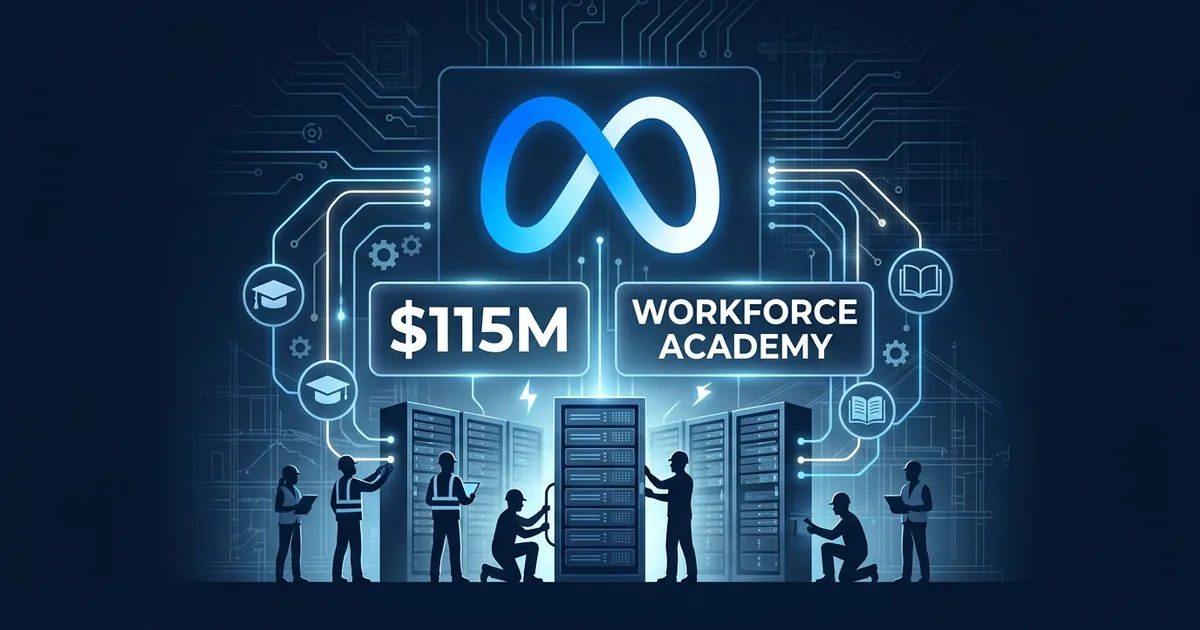
Meta is betting that the biggest bottleneck in the AI infrastructure race is not chips, land, or power. It is people. The company committed $115 million to a new training program called America’s Workforce Academy, offering free five-week courses with a guaranteed job at the end, and the move signals that the labor shortage in skilled trades has become an existential threat to Big Tech’s buildout plans.
The Program and Why It Matters
The academy, announced in partnership with CBRE, Associated Builders and Contractors, and the National Urban League, covers all costs for participants: tuition, housing, a daily training stipend, and no prior experience required. Graduates walk into immediate employment as fiber technicians, electricians, welders, plumbers, and other roles critical to data center construction and operation.
Pilot locations are Baton Rouge, Columbus, Indianapolis, and Houston, all cities where Meta has active data center projects. Engineering News-Record reported that Meta is calling it the largest private-sector commitment to skilled trades training with a job guarantee in U.S. history.
That claim is worth interrogating. The construction industry needs roughly 350,000 additional workers this year, with demand concentrated in exactly the trades this program targets. Meta alone has committed to spending over $200 billion on AI infrastructure, including the massive Hyperion campus in Louisiana, which will be the largest data center ever built. You cannot build a facility of that scale without electricians, and those electricians do not currently exist in sufficient numbers.
A Business Problem Disguised as a Philanthropy Story
The framing from Meta and its partners is feel-good: career pathways for underserved communities, a bridge between Silicon Valley and blue-collar America, Mike Rowe lending his “Dirty Jobs” credibility to the announcement. Meta’s president of global affairs told Fox Business that America cannot compete with China on AI without these workers.
Strip away the messaging, and this is a supply-chain problem. Meta, Microsoft, Google, and Amazon are collectively planning to spend over $700 billion on AI capital projects in 2026 alone, according to Morgan Stanley estimates. Every one of those projects requires physical infrastructure built by human hands. The talent pipeline for those hands is not keeping up.
The U.S. Bureau of Labor Statistics projects that construction employment will need to grow 4.7% annually through 2033 to meet demand, well above the 2.1% historical average. Data center construction is the fastest-growing segment within that projection, and it requires specialized skills, high-voltage electrical work, precision fiber optic installation, cooling system engineering, that general construction apprenticeships do not cover.
What $115 Million Actually Buys
Five weeks of training is not an apprenticeship. It is a fast-track bootcamp designed to produce entry-level workers who can be productive on a job site quickly. The comparison is not to a four-year union electrician program but to the accelerated training models that the military and logistics companies have used for decades: narrow scope, high intensity, immediate deployment.
The guarantee of a job is the key differentiator. Traditional trade programs have high dropout rates partly because the path from training to employment is uncertain. Meta is removing that uncertainty, which should improve completion rates and attract people who would not otherwise consider a career change. The no-experience requirement opens the door to career-switchers, recent high school graduates, and workers displaced from other industries.
Whether 5 weeks of training produces workers who can handle the precision demands of data center construction is an open question. Meta will likely supplement the academy graduates with experienced supervisors and more seasoned trades workers. The program is designed to address volume, not expertise, and that distinction matters when you are wiring a facility that will draw more power than a small city.
The Competitive Landscape for Data Center Labor
Meta is not the only hyperscaler scrambling for construction talent. Amazon announced its own $10 billion training initiative earlier this year. Google has partnered with community colleges in Nevada and Texas to create data center technician certificate programs. Microsoft has been recruiting directly from military transition programs.
The labor shortage is already affecting timelines. Multiple data center projects across the Sun Belt have reported 6 to 12 month delays attributable to skilled labor constraints, with electricians and fiber technicians commanding wage premiums of 30 to 50% above pre-2024 rates. In states like Ohio and Illinois, where data center tax incentives are facing political backlash, the labor squeeze adds another layer of risk to an already fragile policy environment.
What This Tells You About the AI Boom
When a company worth over $1.5 trillion creates a training program to produce welders and plumbers, the AI economy has crossed a threshold. The bottleneck is no longer in the research lab or the semiconductor fab. It is in the physical infrastructure layer, the concrete, copper, fiber, and steel that turns a GPU cluster into a functioning data center.
Meta’s $115 million is a rounding error on its balance sheet. The signal it sends is not. The company that defined the metaverse pivot, then abandoned it for AI, is now telling the market that it cannot build fast enough because there are not enough people who know how to pull cable and terminate fiber. That is the kind of constraint that slows an entire industry, and Meta just put a price tag on trying to fix it.