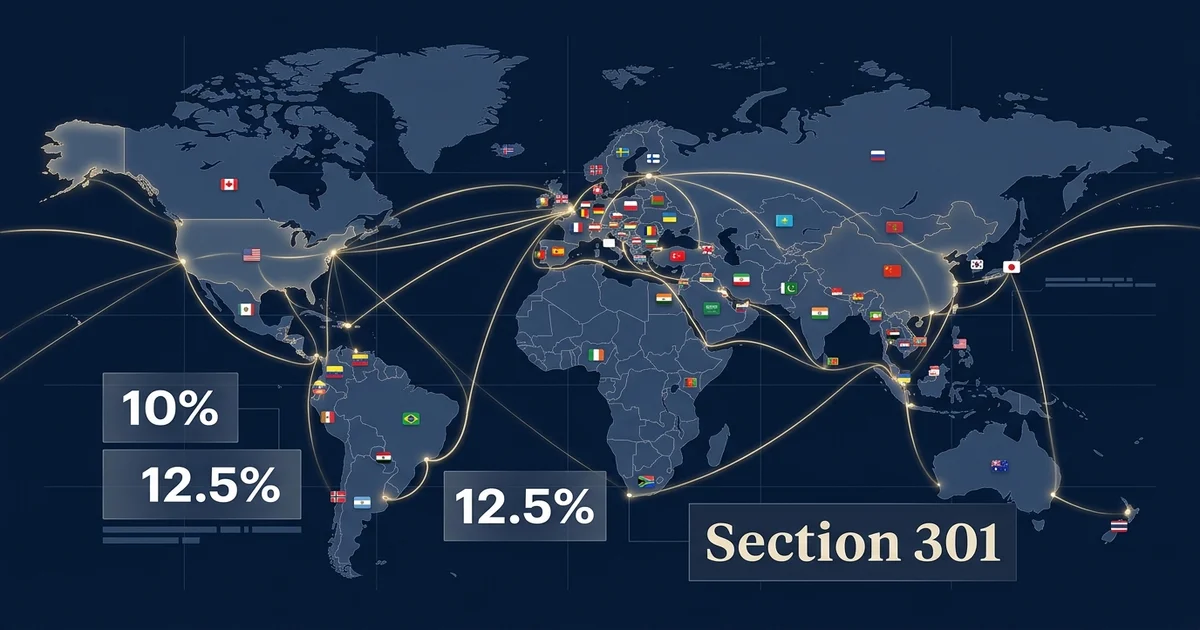
The Office of the United States Trade Representative on June 2 proposed additional tariffs of up to 12.5% on imports from 60 trading partners, marking the single largest Section 301 action in the statute’s five-decade history. The move targets economies that have failed to ban or enforce prohibitions on goods produced with forced labor, and it lands on top of an already towering stack of trade barriers that American importers are struggling to navigate.
What the USTR Is Actually Proposing
The USTR’s determination breaks the 60 economies into two buckets. Six countries that have forced-labor import bans on the books but have failed to enforce them, including Canada, the EU, Mexico, Ecuador, Indonesia, and Pakistan, face a proposed 10% additional duty. The remaining 54 economies, which have neither imposed nor enforced such a prohibition, face 12.5%. That second group reads like a who’s who of global manufacturing: China, Japan, South Korea, India, Vietnam, Bangladesh, Thailand, Taiwan, Australia, the UK, and Brazil all make the list.
The investigations were initiated on March 12, 2026. Public comments are due by July 6, with USTR hearings scheduled for July 7. Requests to testify must be filed by June 22.
The Tariff Layer Cake Gets Another Tier
This is not happening in a vacuum. American importers are already contending with at least three overlapping tariff regimes, and the Section 301 forced-labor duties would add a fourth.
The existing 30% tariffs on Chinese goods remain in full effect. The administration’s 10% global surcharge under Section 122 of the Trade Act is still being collected even though the Court of International Trade ruled in May that it exceeded the president’s statutory authority. The appeals court issued an administrative stay on May 12, keeping the surcharge in place while the government appeals to the Federal Circuit. That surcharge is technically set to expire on July 24, but the legal fight could drag on to the Supreme Court.
Then there is the IEEPA tariff refund process. Of roughly $166 billion in duties collected under the International Emergency Economic Powers Act, approximately $85 billion in refund claims have been accepted for processing through CBP’s new CAPE system, with about $20.6 billion already paid out. The refund pipeline is moving, but the administrative burden on importers is enormous.
Stack the proposed Section 301 duties on top of all that, and you get a tariff environment of unprecedented complexity. A single shipment of electronics components from Vietnam could theoretically face the 10% Section 122 surcharge plus a 12.5% Section 301 forced-labor tariff, on top of any existing duty rates.
Who Gets Hit Hardest
The breadth of this action is what makes it unusual. Traditional Section 301 investigations target a single country’s specific trade practices. This one targets 60 economies over a systemic failure to address forced labor in supply chains.
Apparel and textiles are squarely in the crosshairs. The USTR’s proposal includes a textile mechanism that would allow a certain volume of apparel imports from partner economies to enter at reduced rates, but only if those economies increase their purchases of American textile inputs like cotton and man-made fibers. That is an industrial-policy carrot buried inside a trade-enforcement stick: buy our raw materials, and we will lower the tariff on your finished goods.
For companies with diversified Asian supply chains, the math is brutal. Vietnam, Bangladesh, Cambodia, Thailand, Indonesia, the Philippines, and Sri Lanka all appear on the 54-economy list at the 12.5% rate. The “China plus one” strategy that manufacturers have pursued for the past decade does not help when the alternative sourcing countries face nearly the same tariff penalty.
Automotive and electronics supply chains face similar exposure. Japan, South Korea, and Taiwan, the backbone of global semiconductor and auto-parts manufacturing, are all on the list. USMCA-compliant goods from Canada and Mexico are excluded, and goods covered by Section 232 steel and aluminum tariffs are carved out, but those exceptions are narrower than they sound.
The Compliance Headache
Beyond the direct cost of higher duties, this action creates a compliance nightmare for multinational supply chains already stretched thin by successive tariff waves. Companies will need to map their supply chains not just to origin countries but to the forced-labor enforcement regimes of those countries. The 10% versus 12.5% rate distinction depends on whether an economy has a prohibition on the books. That determination can change, which means tariff rates could shift under companies’ feet.
The exclusion list in Annex A of the Federal Register notice, covering informational materials, donations, accompanied baggage, and CAFTA-DR textile goods entering duty-free from Central American partners, offers limited relief. For most importers, the question is not whether they will pay more but how much more, and how quickly they can restructure sourcing to minimize the hit.
The Bigger Picture
The forced-labor framing gives this action a moral dimension that makes it politically durable. Opposing tariffs designed to combat forced labor is a hard vote for any legislator. That political cover is the point. The administration is building a tariff architecture that uses human-rights language to justify broad trade barriers, and the Section 301 mechanism gives it legal footing that the embattled Section 122 surcharge may not survive.
The July 7 hearings will be the first real stress test. Industry groups from retail, automotive, electronics, and agriculture will push for exemptions and phase-in periods. The textile mechanism signals the administration is open to deal-making. But the core structure, tariffs on 60 economies covering virtually all product categories, is unlikely to change dramatically.
For CFOs and supply-chain executives, the planning horizon just got shorter. The comment period closes July 6. The hearings start the next day. And the tariff layer cake is not done rising.