Italy’s largest bank just crashed a party it wasn’t invited to, and the resulting bidding war could redraw the map of European finance.
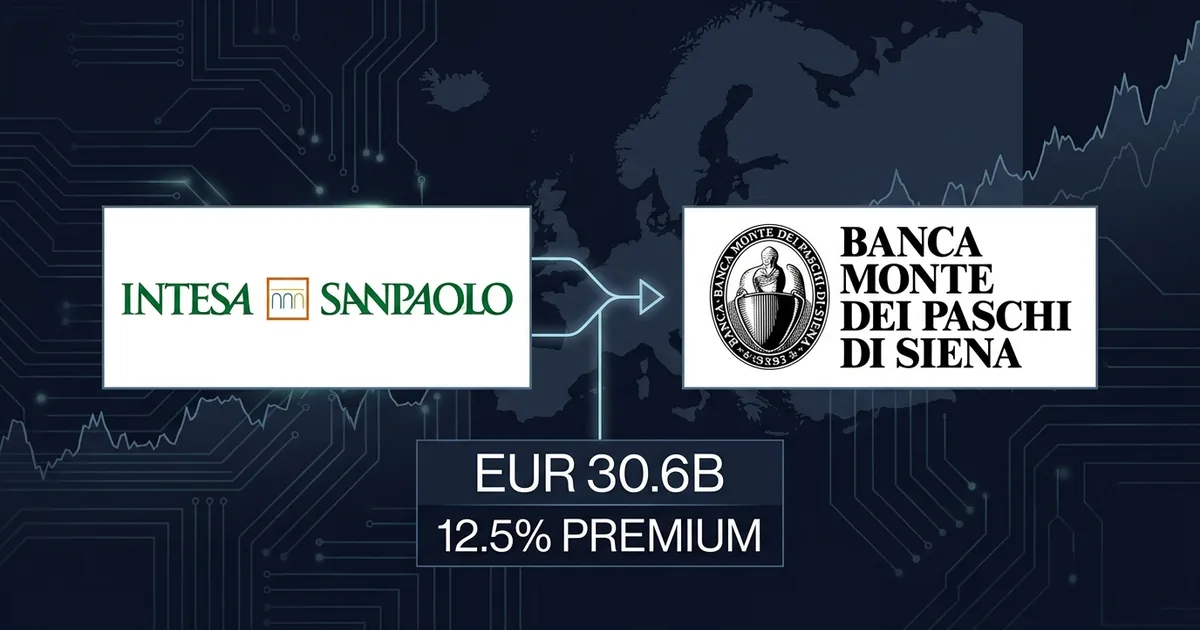
Intesa Sanpaolo on Sunday launched a EUR 30.6 billion ($35.3 billion) unsolicited cash-and-stock offer for Banca Monte dei Paschi di Siena, the world’s oldest bank, in what would be Italy’s largest banking deal ever. The move came barely 24 hours after Banco BPM publicly proposed a merger of equals with MPS, a deal that would have created a EUR 50 billion combined entity. Intesa’s counterpunch values MPS at EUR 27.4 billion, a 12.5% premium to Friday’s close, and it sent MPS shares surging 12.8% on Monday morning.
The Deal Structure: Cash, Stock, and a Pre-Built Antitrust Fix
Under the terms reported by Euronews on Sunday, MPS shareholders would receive 16 newly issued Intesa Sanpaolo shares for every 10 MPS shares tendered, plus EUR 1 in cash per share. That ratio prices the acquisition at a level designed to look generous enough to preempt the BPM merger talks before they gain momentum.
What makes this offer unusual is how much regulatory groundwork Intesa did before going public. The bank pre-negotiated a carve-out with Unipol Assicurazioni: if the bid succeeds, Intesa will sell 635 MPS branches plus the Monte dei Paschi brand name to Unipol for EUR 3 to 3.5 billion. Unipol plans to fold those assets into BPER Banca, effectively creating a third major Italian banking group as a byproduct of the deal.
That is not a concession. That is a chess move. By handing regulators a ready-made competition remedy before they even ask for one, Intesa is trying to collapse the approval timeline. The target close is December 2026.
Why Now: BPM Forced Intesa’s Hand
The timing matters. Banco BPM’s June 7 merger proposal was itself a defensive play, as CNBC reported. BPM has been fending off UniCredit’s own hostile advances for months, and a merger with MPS would have given BPM enough scale to become essentially untouchable. BPM pitched the combination as a “merger of equals” with over EUR 1.1 billion in pretax savings, including EUR 650 million in cost reductions and EUR 450 million in revenue upside.
Intesa clearly decided it could not let that combination form. A BPM-MPS entity with EUR 50 billion in market capitalization would have created a genuine domestic rival, one large enough to compete for the same institutional clients, the same corporate lending relationships, and the same government bond mandates that have been Intesa’s home turf.
So Intesa moved fast. The unsolicited bid is a textbook example of what deal-room veterans call a “bear hug”: an offer rich enough that the target’s board cannot easily reject it without facing shareholder lawsuits.
The Eurozone Power Play
If the deal closes, the combined Intesa-MPS group would command a market capitalization of approximately EUR 126 billion, roughly EUR 1.7 trillion in total assets, and a client base exceeding 27 million. That would make it the second-largest eurozone bank by market cap, trailing only Santander.
The scale is not just a vanity metric. European banking has spent a decade watching American megabanks pull away in investment banking revenue, trading market share, and technology spending. JPMorgan alone generated more profit in 2025 than the top five European banks combined. The consolidation wave now rolling through Italy, with echoes of the strategic independence push seen in European AI, reflects a belated recognition that fragmented national champions cannot compete globally.
Intesa CEO Carlo Messina has projected a combined net income target of EUR 16 billion by 2029, up from a combined EUR 13.6 billion last year. Those numbers suggest the value creation case rests more on revenue growth from cross-selling insurance, asset management, and wealth products to MPS’s client base than on the branch-level cost cuts that defined the last decade of European bank M&A.
What MPS Gets (and What It Loses)
Monte dei Paschi di Siena was founded in 1472, making it the oldest continuously operating bank in the world. It is also the bank that nearly collapsed during the eurozone debt crisis, required multiple state bailouts, and became a symbol of everything wrong with Italian banking governance. The Italian government only completed its exit from MPS equity in late 2024, after more than a decade of intervention.
For MPS shareholders, the 12.5% premium is real money. But the Unipol carve-out means the MPS brand itself would survive under a different owner, operating 635 branches as part of a Unipol-BPER combination rather than as part of Intesa. That is a politically significant detail in Tuscany, where MPS is not just a bank but a civic institution that has funded local arts, culture, and charity for over five centuries.
The Italian government, which retains significant informal influence over banking consolidation even after divesting its equity stake, will be watching closely. Rome has historically preferred domestic consolidation over cross-border deals. An Intesa-MPS merger keeps the assets Italian and creates a national champion large enough to sit at the top table in Brussels.
What Comes Next
BPM has not withdrawn its merger proposal, and the coming weeks will test whether it can sweeten its terms or find a white knight. UniCredit, which already holds a significant stake in BPM, could complicate matters further by making its own move.
The regulatory path is clearer than usual for a deal this size, precisely because Intesa pre-negotiated the Unipol branch sale. The European Central Bank, which supervises all eurozone banks above a certain threshold, will still need to sign off, but the competition remedy is already on the table.
For investors watching European banking, the signal is unmistakable: the era of polite consolidation proposals is over. Italy’s banks are now in open bidding wars, and the winners will emerge as genuine pan-European players. The question is no longer whether European banking consolidation will accelerate. It is who gets left behind.